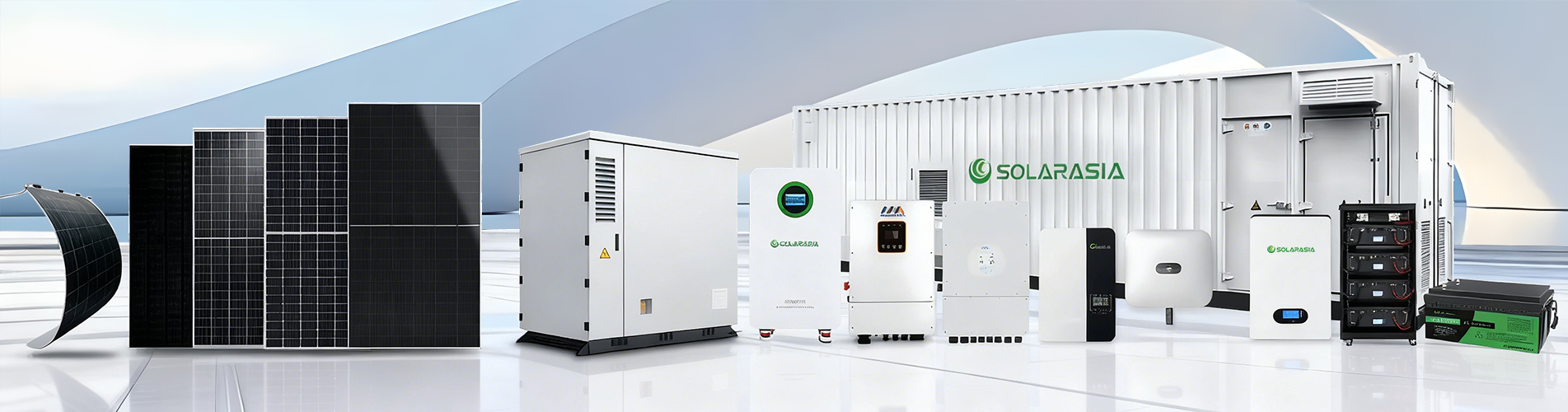
Solarasia banner

Solar Inverter

Home

Solar Inverter

  • How to Choose the Best Solar Panels and Inverters for Your Home? Apr 07, 2025
      Why Choosing the Right Solar Panels & Inverters Matters?(The most popular solar panel) Installing solar panels is a smart investment, but choosing the wrong equipment can lead to wasted money and inefficient energy production. Whether you’re powering a small home or a large property, solar panels for home and inverters must align with your energy needs, budget, and local climate. Let’s break down the key factors to consider.   Step 1: Compare Solar Panel Types. Not all solar panels are created equal. Here’s a quick breakdown: Monocrystalline Panels (20-25% efficiency): Best for limited space but higher costs. Polycrystalline Panels (18-22% efficiency): Affordable and ideal for moderate climates. Thin-Film Panels (10-15% efficiency): Lightweight and flexible for unique installations. Pro Tip: Look for panels with low temperature coefficients to maintain efficiency in hot weather.   Monocrystalline offers higher efficiency but costs more than polycrystalline.   Step 2: Match Inverter Power & Type. Your inverter converts solar energy into usable electricity. Key considerations: Power Matching: Ensure the inverter’s capacity slightly exceeds your solar panel’s peak output (e.g., 3kW panels need a 3.5kW inverter). Inverter Types: String Inverters: Affordable but less efficient in shaded areas. Microinverters: Higher cost but optimize individual panel performance. Hybrid Inverters: Ideal for battery storage systems. Must-Have Feature: Look for MPPT (Maximum Power Point Tracking) technology to maximize energy harvest.   Step 3: Prioritize Durability & Warranty. Solar panels and inverters are long-term investments. Check: Panel Warranty: 10-25 years for materials. Inverter Warranty: 5-10 years for most models. Weather Resistance: Ensure panels are certified for high winds (2400Pa) and hailstones (25mm).   Final Checklist for Solar Success. 1.Calculate your daily energy usage (kWh). 2.Research local incentives and rebates. 3.Partner with a trusted installer for professional sizing.   By focusing on solar panels for home efficiency, inverter compatibility, and durability, you’ll enjoy years of clean, cost-effective energy. Ready to make the switch? Contact us for a free consultation!
  • How Do Inverters Work? Unlocking the Power Behind Every Energy Setup. Apr 21, 2025
    Ever wondered how a small device powers your home during outages or makes solar energy usable? The answer is the inverter—a key player in modern energy systems. Let’s break down how inverters work in simple terms. Inverters specialize in DC to AC conversion. They take direct current (DC) from batteries or solar panels and use electronic switches (like IGBTs) to create alternating current (AC), the power type most devices need. High-quality inverters also stabilize voltage, ensuring safe, reliable energy for your appliances.   You might ask: “How is an inverter different from a converter?” While converters turn AC to DC (like phone chargers), inverters do the opposite. This inverter vs converter distinction matters—especially in off-grid setups, where inverters bridge stored DC energy and AC-powered devices.   In short, inverters are silent heroes that transform static energy into usable power. Whether for backup systems or solar setups, understanding their role helps you choose the right energy solutions. Ready to explore inverter options for your needs? If you're not ready yet, don't worry. You can contact us directly. We offer a one-stop solution.  
  • What Are the Main Components of a PV System? Here's Everything You Need to Know! May 16, 2025
    With global efforts to achieve carbon neutrality and build a sustainable future, solar power is becoming one of the most accessible and cost-effective renewable energy solutions. Whether it’s a residential rooftop installation, a commercial distributed system, or a large-scale utility plant, understanding the core structure and components of a solar photovoltaic (PV) system is essential. So, what exactly makes up a PV system? What roles do different components play? And how can you choose the right setup for your needs? This article breaks down the key parts of a solar system and offers insights to help you get started in the world of solar energy.      What Makes Up a Solar PV System? A complete solar PV system typically includes the following major components: 1. Solar Panels (PV Modules) These are the heart of the system, responsible for converting sunlight into direct current (DC) electricity. Panels are made of multiple solar cells connected in series and/or parallel to achieve the desired voltage and power output.     2. Combiner Box This unit consolidates the outputs from multiple panel strings into a single DC output and provides protection against overcurrent through fuses or breakers. It's an essential safety and wiring component. 3. Distribution Cabinet The cabinet handles secondary power distribution and protection. It connects the inverter to the grid or energy storage system, acting as a key control and transition point in the power flow. 4. Inverter This is the system’s "brain," converting DC electricity from the solar panels into alternating current (AC) electricity used by household appliances or the grid. It also performs Maximum Power Point Tracking (MPPT), grid synchronization, and safety protections.     5. Transformer (for Large-Scale Systems) Used in utility-scale plants to step up the voltage for efficient transmission to the grid. It ensures the solar-generated power can be delivered over long distances with minimal loss.    A Closer Look at Solar Panels: The Key to System Efficiency What Are Solar Panels Made Of? A solar panel consists of dozens (sometimes hundreds) of solar cells packaged and encapsulated together. Since individual cells generate small amounts of electricity, they are grouped into panels to meet real-world power requirements.   Common Types of Solar Panels (Pros & Cons)   Type Efficiency Appearance Pros Cons Monocrystalline 21–24% Black or dark blue High efficiency, long lifespan Higher cost Polycrystalline 16–18% Light blue, grainy texture Cost-effective, mature technology Lower efficiency Heterojunction (HJT) Up to 25% Similar to mono High efficiency, great low-temp performance Expensive, not widely adopted yet Thin Film (Perovskite/CIGS) 15–22% (theoretical) Flexible or semi-transparent Lightweight, low-cost, good in low light Shorter lifespan, lower stability, still under development   🌟 Special Mention: Perovskite Panels This new technology is generating a lot of buzz due to its high theoretical efficiency and low production cost. However, it still faces technical challenges such as shorter lifespan, potential toxicity, and limited commercial scalability.     Panel Structure Breakdown Standard crystalline silicon panels are made of the following layers: Tempered Glass: Protects the cells from weather and debris while allowing maximum sunlight penetration. EVA Film: Encapsulates and binds the cells, providing durability and adhesion. Solar Cells: The core energy-generating unit, converting light to electricity. Backsheet (e.g. TPT or TPE): Provides insulation and environmental protection. Aluminum Frame: Offers mechanical strength and helps with installation. Junction Box & Sealant: Ensures safe external connections and waterproofing.     What Affects Solar System Efficiency? Aside from the inherent performance of the panels, several external factors can influence the overall efficiency of your solar system: ☀️ 1. Hot Spot Effect Caused by partial shading or damaged cells, leading to local overheating and potential panel damage. Can be prevented with proper panel layout and bypass diodes. ⚡ 2. PID (Potential Induced Degradation) Occurs when high voltage differences cause power loss, especially in humid environments. Selecting PID-resistant panels and proper grounding can help mitigate this. 🔍 3. Micro-Cracks Tiny cracks in solar cells, often caused during shipping or installation, can reduce output. High-quality panels are usually EL-tested to detect and eliminate micro-cracks. 🌤️ 4. Tilt Angle & Orientation To maximize energy production, panel angles should match your local latitude (±10°). Simulation tools like PVsyst can optimize positioning based on sun exposure data. 🌡️ 5. Temperature Coefficient As temperatures rise, panel output tends to drop. Panels with a lower temperature coefficient (e.g. -0.30%/°C) perform more reliably under hot conditions.   How to Choose the Right Solar Panels? When selecting panels for your project, consider the following: Budget vs Performance: Monocrystalline panels offer better efficiency, but polycrystalline can be more budget-friendly. Roof Space: If space is limited, go for high-efficiency modules like N-type or HJT. Climate Conditions: In areas with high humidity, temperature, or dust, choose panels with strong resistance to PID and corrosion. Warranty & Brand Reputation: Look for panels with a solid 25-year performance warranty and a proven track record in quality control.   Final Thoughts A well-designed PV system depends not only on panel quality but also on how each component integrates within the system. Choosing the right modules, inverter, and accessories ensures long-term performance and safety. 🌎 Ready to go solar? Whether you're planning a residential setup or a large commercial project, we're here to help. Contact us for customized, end-to-end solar solutions tailored to your needs.
  • Why Commercial and Industrial Solar Systems Are a Smart Investment for Your Business Sep 08, 2025
    Introduction As energy costs continue to rise, businesses are looking for reliable and cost effective ways to power their operations. Commercial and industrial solar systems, starting from 50kW, offer a sustainable solution that not only reduces electricity bills but also ensures a stable power supply for factories, warehouses, and enterprise buildings. 1. High Capacity Solar Systems for Business Large scale solar PV systems provide the energy your business needs. With commercial solar systems of 50kW and above, companies can cover a significant portion of their electricity consumption, reducing dependency on the grid and lowering monthly energy costs. 2. Reliable Solar Panels and Inverters Using premium solar panels and high efficiency inverters ensures that your system performs optimally. Industrial grade inverters convert solar energy efficiently, while top-quality panels capture maximum sunlight throughout the day, delivering consistent and reliable power. 3. Hybrid and Off Grid Options For businesses requiring uninterrupted power, hybrid solar systems with ESS (Energy Storage System) are ideal. These systems store excess energy for use during nighttime or grid outages, ensuring 24/7 power availability. Off grid solutions are also available for remote locations or industrial sites without reliable grid access. 4. Fast ROI and Energy Savings Investing in commercial solar systems can lead to quick payback periods. By generating your own electricity, your business can save substantially on energy bills and even sell excess energy back to the grid. This makes solar energy a smart financial decision for enterprises of all sizes. 5. Custom Solutions for Every Business Every facility has unique energy needs. Whether it’s a factory, warehouse, or office building, commercial solar solutions can be customized to fit your space, power requirements, and budget. Experts can design, install, and maintain a system tailored specifically for your business. Conclusion Commercial and industrial solar systems are no longer just an environmental choice—they are a smart business strategy. From lowering energy costs to ensuring reliable power and a fast ROI, solar energy provides significant benefits for modern enterprises.   Ready to power your business with solar energy? Contact us today to learn about our commercial solar panels, inverters, and ESS solutions.
  • Solar Inverter Showdown: How to Choose the Best for Your Home or Business? Nov 24, 2025
    When it comes to harnessing solar energy, the solar inverter is the unsung hero that converts sunlight into usable power. But with so many options available, how do you pick the right one? From on grid to hybrid systems, the choices can be overwhelming. Whether you're a homeowner looking to cut electricity bills or a business aiming for sustainability, understanding the role of a solar inverter is key. Why settle for high energy costs when you can switch to efficient solar solutions? In this guide, we'll break down the essentials to help you make an informed decision.   What makes a solar power inverter so crucial in renewable energy systems? Think of it as the brain of your solar setup—it transforms DC electricity generated by panels into AC power for your appliances. But not all inverters are created equal. For instance, on grid inverters sync with the utility grid, ideal for reducing dependency on traditional power sources. Off grid models, on the other hand, operate independently, perfect for remote areas. Then there are hybrid inverters, which combine the best of both worlds by integrating battery storage. How do you know which type suits your needs? It all depends on your energy goals and location.   In the debate of solar inverter technologies, efficiency and reliability take center stage. Modern inverters come with features like MPPT (Maximum Power Point Tracking) to optimize energy harvest, even on cloudy days. We provide robust solutions tailored for residential, commercial, and industrial use. But when should you consider upgrading? If you're expanding your solar array or adding batteries, a hybrid inverter might be the answer. Ultimately, investing in a high quality inverter ensures long term savings and a smaller carbon footprint. Ready to power your life with clean energy? Start by evaluating your inverter options today!
  • On Grid vs Hybrid Solar Inverter for Businesses Mar 17, 2026
    On Grid vs Hybrid Solar Inverter for Businesses: Which Is the Smart Investment? For commercial enterprises, choosing the right solar inverter is more than a technical decision—it’s a strategic one that impacts energy costs, operational resilience, and long-term ROI. On grid and hybrid solar inverters are the two most popular options for businesses connected to the utility grid, but they serve vastly different needs: one prioritizes immediate cost savings and grid synergy, the other delivers energy independence, backup power, and flexible long term value.   In this guide, we’ll break down the core differences between on grid and hybrid solar inverters for commercial use, analyze their performance, cost implications, and ideal use cases, and help you determine which solution aligns with your business’s energy goals, budget, and operational requirements.   Key Definitions: What Are On Grid and Hybrid Solar Inverters? At their core, both inverters convert DC power from solar panels into usable AC power for your business—but their capabilities diverge drastically when it comes to grid interaction and energy storage. • On Grid Solar Inverters (Grid-Tied): The most basic and cost effective option, these inverters manage solar power flow between your business, the grid, and your loads. They feed excess solar energy back to the grid for net metering credits but cannot operate during power outages (due to anti islanding safety standards that protect utility workers). They have no battery compatibility and offer only basic energy management. Top commercial models include Huawei SUN2000-36KTL-M3 and Deye SUN-100K-G03. • Hybrid Solar Inverters: The “all-in-one” solution, hybrid inverters handle solar-to-grid/load power flow and integrate with battery storage (e.g., LiFePO4 batteries). They disconnect safely from the grid during outages to create a self sustaining mini grid for your business, provide seamless backup power, and feature advanced smart energy management for peak shaving and self consumption optimization. Leading commercial models are Huawei SUN2000-15K-MB0 and Deye SUN-50K-SG01HP3-EU-BM4.   Core Feature Comparison for Business Applications The table below highlights the critical differences between on grid and hybrid inverters, tailored to commercial energy needs: Feature On Grid Solar Inverter Hybrid Solar Inverter Energy Storage Compatibility No (AC coupling is a costly workaround) Yes (LiFePO4 battery ready, seamless integration) Backup Power for Outages No (shuts down entirely) Yes (UPS switchover: ≤10ms single phase, ≤20ms three phase) Grid Independence Low (100% grid dependent) High (operates off grid during outages; scalable independence) Smart Energy Management Basic (only solar/grid load balancing) Advanced (peak shaving, TOU tariff optimization, remote monitoring) Net Metering Eligibility Full (maximize excess power sales) Yes (retains grid connection and net metering when needed) System Complexity Simple (fewer components, easy installation) Complex (integrates solar, battery, and grid control) Scalability Easy (add panels for more grid feed in) Flexible (add batteries/panels for greater self consumption) Performance Metrics: On Grid vs Hybrid for Commercial Solar When evaluating performance, businesses need to consider efficiency, power range, and real-world operational reliability—two key commercial inverter series (Huawei SUN2000 on grid, Deye hybrid) illustrate the tradeoffs: • Power Range: On grid inverters offer larger commercial power capacities (36kW–100kW for Huawei SUN2000-36KTL-M3 and Deye SUN-100K-G03), ideal for high output solar arrays focused on grid feed in. Hybrid inverters range from 15kW–50kW (Huawei SUN2000-15K-MB0 and Deye SUN-50K-SG01HP3-EU-BM4), perfect for medium to large businesses balancing self use and grid interaction. • Efficiency: On grid inverters boast slightly higher max efficiency (98.6%–98.7% for Huawei SUN2000-36KTL-M3 and Deye SUN-100K-G03) due to their simpler design. Hybrid inverters offer a still impressive 98.0%–98.6% max efficiency (Huawei SUN2000-15K-MB0 and Deye hybrid models), a small tradeoff for their multi functional capabilities. • MPPT Controllers: On grid inverters have 4–6 MPPTs (for multiple solar panel strings, such as Deye SUN-100K-G03 with 6 MPPTs), while hybrid inverters feature 2–4 MPPTs (Huawei SUN2000-15K-MB0 with 2 MPPTs, Deye 50kW hybrid with 4 MPPTs)—both sufficient for commercial solar array design, with on-grid edging out for ultra large setups. • Outage Performance: The biggest performance gap—on-grid inverters shut down during blackouts, disrupting operations for businesses with critical loads (e.g., manufacturing, retail, healthcare). Hybrid inverters provide instantaneous backup power, ensuring uninterrupted operations for essential equipment.   Cost & ROI: Upfront Savings vs. Long-Term Commercial Value For businesses, ROI is king—and on-grid and hybrid inverters deliver returns in very different timelines and ways.   On Grid Inverters: Low Upfront Cost, Fast Short-Term ROI On grid inverters are the most affordable solar inverter option for businesses, with lower purchase and installation costs thanks to their simple design (no battery integration or advanced control systems). They shine for businesses with: • Access to a stable utility grid and favorable net metering/feed-in tariffs; • A primary goal of maximizing solar power sales to the grid (not self-consumption); • A strict upfront budget and short-term ROI targets.   Commercial Example: A 1 MW rice mill in Pakistan chose 10 Deye SUN-100K-G03 on-grid inverters for its solar project, prioritizing pure power output and fast ROI by selling all excess solar energy to the grid—an ideal choice for a business with no critical backup power needs and a stable grid. Similarly, a large warehouse in Southeast Asia opted for Huawei SUN2000-36KTL-M3 inverters to leverage their 98.6% efficiency and wide voltage compatibility for maximum grid feed-in benefits.   Hybrid Inverters: Higher Upfront Cost, Superior Long-Term ROI Hybrid inverters have a higher initial investment (due to battery compatibility and advanced electronics) but deliver greater and more versatile long-term savings for commercial operations. Their key financial advantages for businesses include: • Peak Shaving: Store excess solar energy during low-tariff hours and use it during peak evening/operational hours, avoiding expensive grid electricity for high-demand periods; • Energy Cost Insulation: Protect your business from rising utility prices and volatile grid tariffs by increasing solar self-consumption (critical for businesses with high energy usage); • Operational Resilience: Avoid costly downtime from power outages—for businesses like retail stores, data centers, or manufacturing facilities, even a short blackout can lead to significant revenue loss; • Subsidy Eligibility: Many regions offer green energy subsidies for battery-integrated solar systems, further reducing payback time (e.g., a Spanish commercial user achieved 15% annual profitability with a Huawei hybrid inverter, a metric easily scaled for larger operations).   Ideal Commercial Use Cases: When to Choose On-Grid vs Hybrid The right inverter for your business depends on grid reliability, energy goals, critical load needs, and budget. Use this checklist to align your choice with your operations:   Choose an On-Grid Inverter If Your Business: • Operates in an area with a 100% stable utility grid (no frequent outages); • Prioritizes fastest possible ROI through grid feed-in/net metering; • Has no critical loads that require uninterrupted power; • Is working with a strict upfront budget for solar installation; • Plans to use solar power primarily for offsetting grid usage (not full self-sufficiency). Best For: Large commercial rooftops (e.g., warehouses in urban China with stable grids), manufacturing plants with grid-backed backup generators, and businesses with favorable feed-in tariffs. Recommended models: Huawei SUN2000-36KTL-M3, Deye SUN-100K-G03.   Choose a Hybrid Inverter If Your Business: • Operates in an area with grid fluctuations, blackouts, or unreliable power (e.g., Victoria, Australia); • Has critical loads (e.g., refrigeration, medical equipment, production lines) that cannot tolerate downtime; • Aims to maximize solar self-consumption and reduce reliance on the grid; • Wants to future-proof its solar system (add batteries at any time for greater independence); • Operates under Time-of-Use (TOU) tariffs (peak shaving delivers massive savings); • Values energy resilience as a core business priority (e.g., retail, healthcare, data centers). Best For: Medium to large businesses in regions with unstable grids, commercial operations with high peak-hour energy costs, and any business looking to build a sustainable, grid-independent energy system. Recommended models: Huawei SUN2000-15K-MB0, Deye SUN-50K-SG01HP3-EU-BM4.   Common Misconceptions for Businesses: Debunking On Grid vs Hybrid Myths Many business owners make costly decisions based on misinformation about on grid and hybrid inverters—here are the most common myths, busted: 1. Myth: “I can add a battery to my on-grid inverter later for backup power.”Reality: Adding a battery to an on-grid system requires AC coupling—a costly, complex process that needs a separate battery inverter and causes double conversion efficiency loss. It’s a workaround, not a planned upgrade, and far more expensive than choosing a hybrid inverter (such as Huawei SUN2000-15K-MB0 or Deye 50kW hybrid) from the start. 2. Myth: “Hybrid inverters are only for off-grid businesses—we don’t need that.”Reality: Modern hybrid inverters (like Huawei and Deye models) are designed to work with the grid while providing battery backup—they deliver the best of both worlds. For grid-connected businesses, they retain net metering capabilities while adding the safety net of backup power and energy optimization. 3. Myth: “The cheaper on-grid inverter always saves my business more money.”Reality: While on-grid inverters (e.g., Huawei SUN2000-36KTL-M3, Deye SUN-100K-G03) save money upfront, hybrid inverters deliver significantly greater long-term savings by cutting peak-hour grid costs, avoiding downtime, and insulating your business from rising energy prices. On-grid saves on day one; hybrid saves over 5–10 years (and beyond). 4. Myth: “Hybrid inverters are too complex for commercial operations.”Reality: While hybrid systems have more components, modern models (e.g., Huawei SUN2000-15K-MB0 with Fusionsolar intelligent monitoring, Deye hybrid with smart cooling and remote management) feature user-friendly smart energy management systems (EMS) with remote monitoring and automated load balancing. Most solar installers are trained to design and maintain commercial hybrid systems from Huawei and Deye, making them a manageable investment.   Final Verdict for Businesses: On-Grid for the Present, Hybrid for the Future For commercial enterprises, the choice between on grid and hybrid solar inverters boils down to immediate needs vs. long-term strategic planning: • On-Grid Inverters are the perfect entry point for businesses with a strict budget, a stable grid, and a focus on fast ROI through grid feed-in. Top choices like Huawei SUN2000-36KTL-M3 and Deye SUN-100K-G03 are reliable, efficient, and easy to install, letting you dip your toes into solar without the complexity of battery storage. • Hybrid Inverters are the superior long-term investment for most businesses. Models like Huawei SUN2000-15K-MB0 and Deye SUN-50K-SG01HP3-EU-BM4 deliver operational resilience (no downtime from outages), maximum solar self-consumption, protection from rising energy costs, and future flexibility (add batteries anytime). For businesses that view energy as a strategic asset—rather than just an expense—hybrid inverters from Huawei and Deye are the clear choice.   Key Takeaways for Business Owners 1. Prioritize operational resilience if your business has critical loads—hybrid inverters (Huawei, Deye) are the only option for backup power. 2. Calculate ROI over 5–10 years (not just upfront) — hybrid inverters from Huawei and Deye outperform on-grid inverters in long-term savings for most commercial use cases. 3. Avoid AC coupling for on-grid systems—it’s a costly, inefficient way to add battery storage later. 4. Leverage TOU tariffs and green energy subsidies—hybrid inverters from Huawei and Deye maximize the value of these incentives through peak shaving and self-consumption.   5. Choose a reputable commercial inverter brand (e.g., Huawei, Deye) with proven performance for on-grid (Huawei SUN2000 series, Deye G03 series) and hybrid (Huawei SUN2000-MB0 series, Deye SG01 series) applications.   Contact us now to get the latest price and technical support.    
foot logo

Address : Room 305, Tower B, Yinuo Business Center, intersection of West Second Ring Road and Hehuan Road, Bijiashan Street, Shushan District, Hefei city, Anhui Province

Tel : +86 17730022793

Email : [email protected]

Subscribe

Please read on, stay posted, subscribe, and we welcome you to tell us what you think.

submit

Links: Inverter Cables Cowellxm Copyright 2026 @ Anhui Solarasia Energy Technology Co.,Ltd .All Rights Reserved. Sitemap | Blog | XML | Privacy Policy Network Supported

Click To Leave A Message

leave a message
If you are interested in our products and want to know more details,please leave a message here,we will reply you as soon as we can.
submit

Home

Products

whatsApp

contact