
How Does Commercial Battery Energy Storage Work with Solar Panels?
Solar panels help businesses generate electricity from sunlight, but solar power generation does not always match electricity consumption. During the day, a commercial solar system may produce more electricity than a facility needs. In the evening or during periods of low sunlight, the same facility may need to purchase electricity from the grid.
This is where commercial battery energy storage becomes valuable.
By combining solar panels with a battery energy storage system (BESS), businesses can store surplus solar electricity and use it when needed. This approach helps improve solar self-consumption, manage electricity demand, reduce dependence on grid power, and provide additional energy flexibility.
A properly designed commercial solar battery storage system connects solar PV panels, inverters, battery modules, an energy management system, and the facility's electrical loads into one coordinated energy solution.
But how does the entire system work? When does the battery charge? How is stored electricity used? And what type of configuration is suitable for a factory, warehouse, or commercial building?
This guide explains how commercial battery energy storage works with solar panels, the main system components, common configurations, and the factors businesses should consider before investing in a solar-plus-storage project.
A commercial solar battery storage system combines a solar photovoltaic (PV) installation with rechargeable batteries to store and manage electricity.
Instead of using solar electricity only when it is generated, businesses can store surplus energy and use it later.
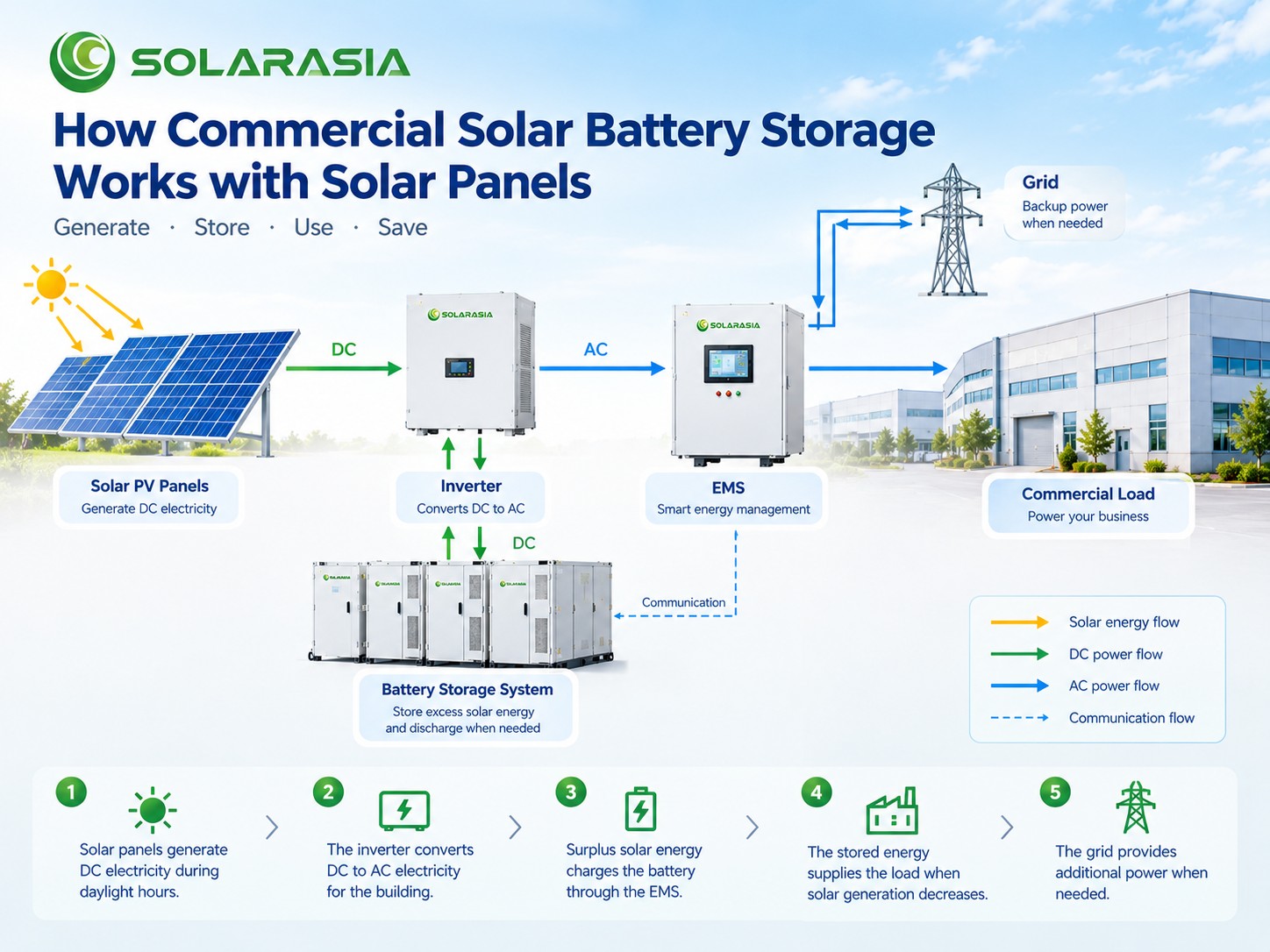
A typical commercial solar-plus-storage system includes:
Solar PV panels: Convert sunlight into DC electricity.
Solar inverter: Converts DC electricity into AC electricity for commercial loads or grid connection.
Battery modules: Store electricity for later use.
Battery Management System (BMS): Monitors battery voltage, current, temperature, and operating conditions.
Power Conversion System (PCS): Controls power conversion between the battery and the AC electrical system.
Energy Management System (EMS): Coordinates charging, discharging, and energy distribution according to project requirements.
Grid connection: Provides additional electricity when solar and battery power are insufficient, where applicable.
The exact system architecture depends on the inverter configuration, battery voltage, grid connection, and intended application.
For commercial and industrial projects, battery storage is commonly configured to work alongside an existing or newly installed solar PV system.
The basic principle is simple: solar panels generate electricity, the facility uses the electricity it needs, and surplus energy can charge the battery.
When solar generation decreases or electricity demand increases, the battery can discharge stored energy to support the facility.
A commercial solar battery storage system typically operates in four stages.
During daylight hours, solar panels convert sunlight into DC electricity.
The amount of electricity generated depends on:
Installed solar PV capacity
Solar irradiation
Weather conditions
Panel orientation and installation angle
Temperature
System performance and shading
For example, a commercial facility with a 200kW solar PV installation may generate substantial electricity during sunny hours.
The actual output changes throughout the day and is not necessarily equal to the system's rated capacity.
The generated electricity is used to supply the facility's electrical loads.
Typical commercial loads include:
Manufacturing equipment
Air conditioning and ventilation
Lighting systems
Refrigeration equipment
Pumps and motors
Office equipment
In many grid-connected configurations, solar electricity is prioritized for local consumption.
If the facility's demand is greater than the available solar generation, the grid or battery may supply the remaining electricity, depending on the system's control strategy.
When solar generation exceeds the facility's immediate electricity demand, the surplus can be directed to the battery.
The PCS or hybrid inverter manages the charging process, while the BMS monitors battery operating conditions.
For example:
Solar generation: 150kW
Facility consumption: 90kW
Potential solar surplus: 60kW
In this simplified example, up to 60kW may be available for battery charging before considering conversion losses, battery charging limits, and other system constraints.
The EMS can coordinate charging according to the battery's state of charge, electricity prices, solar generation, and operating requirements.
When solar generation decreases, the battery can discharge stored electricity to support the facility.
This is particularly useful during:
Evening operating hours
Periods of low solar generation
Peak electricity demand
Time-of-use electricity price periods
Certain grid outage scenarios, if backup operation is supported
For example, a factory may generate surplus solar electricity during the afternoon and store it in a battery. The stored energy can then support evening production when solar generation is no longer available.
This allows the business to use more of the electricity generated by its own solar installation.
The inverter and battery configuration determine how electricity moves through the system.
There are two common integration methods for commercial solar battery storage: AC-coupled and DC-coupled systems.
In an AC-coupled system, the solar PV installation and battery storage system are connected through the AC electrical system.
A typical configuration includes:
Solar panels
Grid-connected PV inverter
Battery inverter or PCS
Battery storage system
AC distribution panel
Commercial electrical loads
The solar inverter converts PV-generated DC electricity into AC electricity. The battery PCS manages charging and discharging through the AC connection.
When surplus solar electricity is available, the battery PCS can convert AC electricity into DC electricity for battery charging. During discharge, the stored DC energy is converted back into AC electricity for the facility.
Advantages of AC coupling:
Suitable for many existing solar PV installations
Allows battery storage to be added without necessarily replacing the existing PV inverter
Offers flexibility when integrating separate PV and battery systems
Can support different inverter brands and system architectures, subject to compatibility
Considerations:
Electricity passes through additional conversion stages
Overall efficiency depends on the PV inverter, battery PCS, and operating conditions
System controls and power limits must be coordinated
In a DC-coupled system, the solar PV array and battery are connected through a shared DC-side power conversion architecture.
Depending on the system design, a hybrid inverter or dedicated power electronics manages energy flow between solar panels, batteries, and the AC electrical system.
Advantages of DC coupling:
Can reduce certain conversion stages during solar battery charging
May offer efficient integration for newly designed solar-plus-storage systems
Can simplify some system architectures
Considerations:
Compatibility between the PV array, battery voltage, and inverter is essential
Expansion options depend on the equipment design
System configuration must be carefully evaluated before installation
| Comparison | AC-Coupled System | DC-Coupled System |
|---|---|---|
| Connection method | AC side | DC side |
| Suitable applications | Existing solar PV systems and retrofit projects | New solar-plus-storage installations |
| Battery charging | Through AC conversion | Through DC-side conversion |
| PV inverter | Usually separate | May use a shared hybrid inverter |
| System flexibility | Often flexible for retrofits | Depends on equipment compatibility |
| Design considerations | AC power conversion and coordination | DC voltage and inverter compatibility |
Neither configuration is universally better. The appropriate solution depends on whether the project involves an existing PV installation or a new system, as well as equipment compatibility, efficiency targets, and expansion requirements.
Understanding energy flow is essential when evaluating a commercial solar-plus-storage project.
The relationship between solar generation, battery charging, and facility demand changes throughout the day.
During periods of strong sunlight, the PV system may generate more electricity than the facility consumes.
For example:
| Parameter | Power |
|---|---|
| Solar generation | 180kW |
| Facility demand | 100kW |
| Potential surplus | 80kW |
The available surplus can be used to charge the battery, subject to its charging power limit and remaining capacity.
If the battery is fully charged, excess electricity may be exported to the grid where permitted, or the PV system may need to reduce its output depending on the system configuration and export restrictions.
When clouds reduce solar generation or demand increases, the battery can discharge to help supply the facility.
For example:
| Parameter | Power |
|---|---|
| Solar generation | 50kW |
| Facility demand | 120kW |
| Required additional power | 70kW |
The battery may provide the additional 70kW if its PCS has sufficient output capacity and the battery has enough available energy.
Otherwise, the grid supplies the remaining demand in a grid-connected configuration.
At night, solar panels do not generate electricity.
The facility can use stored battery energy or purchase electricity from the grid.
The EMS can schedule battery discharge based on electricity prices, expected demand, backup reserves, and the project's operating strategy.
This is one of the main reasons businesses combine solar PV with battery storage.
Adding battery storage to a commercial solar installation can provide several operational and financial benefits.
Without battery storage, surplus solar electricity may be exported to the grid or curtailed.
A battery allows businesses to store some of this surplus and use it later.
This can increase the percentage of solar electricity consumed directly by the facility, especially when daytime generation and electricity demand do not match.
Some commercial electricity tariffs include demand charges based on maximum power consumption during specific billing intervals.
A battery can discharge during selected peak demand periods to help reduce the amount of electricity drawn from the grid.
This strategy is known as peak shaving.
The actual savings depend on the tariff structure, demand measurement interval, battery dispatch strategy, and facility load profile.
Businesses operating under time-of-use electricity tariffs may benefit from storing energy during lower-cost periods and using it during higher-cost periods.
When combined with solar generation, the battery can provide additional flexibility in managing electricity costs.
A properly designed solar-plus-storage system may provide backup electricity to selected critical loads during grid outages.
However, not every grid-connected solar inverter can operate during a blackout.
Backup operation requires compatible inverter functionality, isolation and transfer equipment, suitable controls, and adequate battery capacity.
A commercial battery storage system gives businesses more control over when electricity is stored and used.
This can be valuable for facilities with variable electricity demand, high solar generation, or changing electricity prices.
Selecting the right battery capacity is essential for achieving good system performance and avoiding unnecessary investment.
A battery that is too small may not store enough surplus solar electricity. A battery that is too large may remain underutilized if the facility does not have sufficient charging energy or later demand.
Consider the following factors.
Estimate how much electricity the solar system generates throughout a typical day.
A 200kW PV installation may generate a substantial amount of energy, but actual generation varies according to location, season, weather, and system performance.
Review the facility's hourly or 15-minute load profile where available.
Monthly electricity bills are useful for understanding total consumption, but interval data provides a more accurate picture of when electricity is used.
Calculate how much solar electricity remains after supplying daytime loads.This is the energy potentially available for battery charging.
Determine how long the battery needs to support the facility.For example, a business that needs 100kW of battery output for two hours requires approximately 200kWh of delivered energy.
The nominal battery capacity must be higher after considering usable depth of discharge and system efficiency.
Battery power is measured in kW, while battery energy capacity is measured in kWh.
Both values must match the project requirements.
For example:
| BESS Configuration | Rated Power | Nominal Energy | Main Consideration |
|---|---|---|---|
| Commercial BESS | 50kW | 100kWh | Smaller energy requirements |
| Commercial BESS | 100kW | 215kWh | Moderate discharge energy |
| Commercial BESS | 100kW | 261kWh | Greater nominal energy capacity |
| Industrial BESS | 125kW | 261kWh | Higher power requirements |
These are illustrative configurations. Actual system suitability depends on usable capacity, PCS ratings, load requirements, and operating conditions.
For more details, see our guide on how to calculate the right battery capacity for a commercial energy storage system.
Commercial solar battery storage can be applied across many industries.
Factories often have high electricity demand from production equipment, motors, compressors, and cooling systems.
Combining solar PV with battery storage can help shift surplus daytime solar energy to periods when production demand remains high.
Warehouses typically use electricity for lighting, refrigeration, ventilation, and material-handling equipment.
Solar panels installed on large warehouse roofs can generate electricity, while battery storage helps make more of that energy available outside peak solar generation hours.
Shopping centers, office buildings, and commercial complexes may have significant daytime cooling and lighting loads.
Battery storage can help manage demand and support energy use during selected high-cost periods.
Cold storage, processing equipment, pumps, and ventilation systems can create continuous or seasonal electricity demand.
A solar-plus-storage system may help improve energy flexibility, particularly in facilities with suitable solar resources and variable electricity tariffs.
Before investing in a commercial battery energy storage system, businesses should evaluate more than the battery's nominal capacity.
The following factors are important when comparing suppliers and system configurations.
| Item | What to Check |
|---|---|
| Battery chemistry | LiFePO4 or another suitable chemistry |
| Nominal energy | Total rated battery capacity in kWh |
| Usable energy | Actual available discharge energy |
| Rated power | Continuous charging and discharging power |
| Battery management | BMS monitoring and protection functions |
| Inverter or PCS | Power rating, voltage range, and compatibility |
| EMS | Energy scheduling and monitoring capabilities |
| Cooling system | Air cooling or liquid cooling, according to design |
| Protection | Electrical, thermal, and system-level safety features |
| Warranty | Product warranty and performance conditions |
| Certifications | Applicable product and market compliance documentation |
| After-sales support | Technical assistance, maintenance, and spare parts |
It is also important to confirm whether the supplier provides a complete integrated system or only battery modules.
A complete project may require battery cabinets, PCS, EMS, transformers, switchgear, cables, installation, commissioning, and grid interconnection equipment.
Understanding the scope of supply helps prevent unexpected project costs.
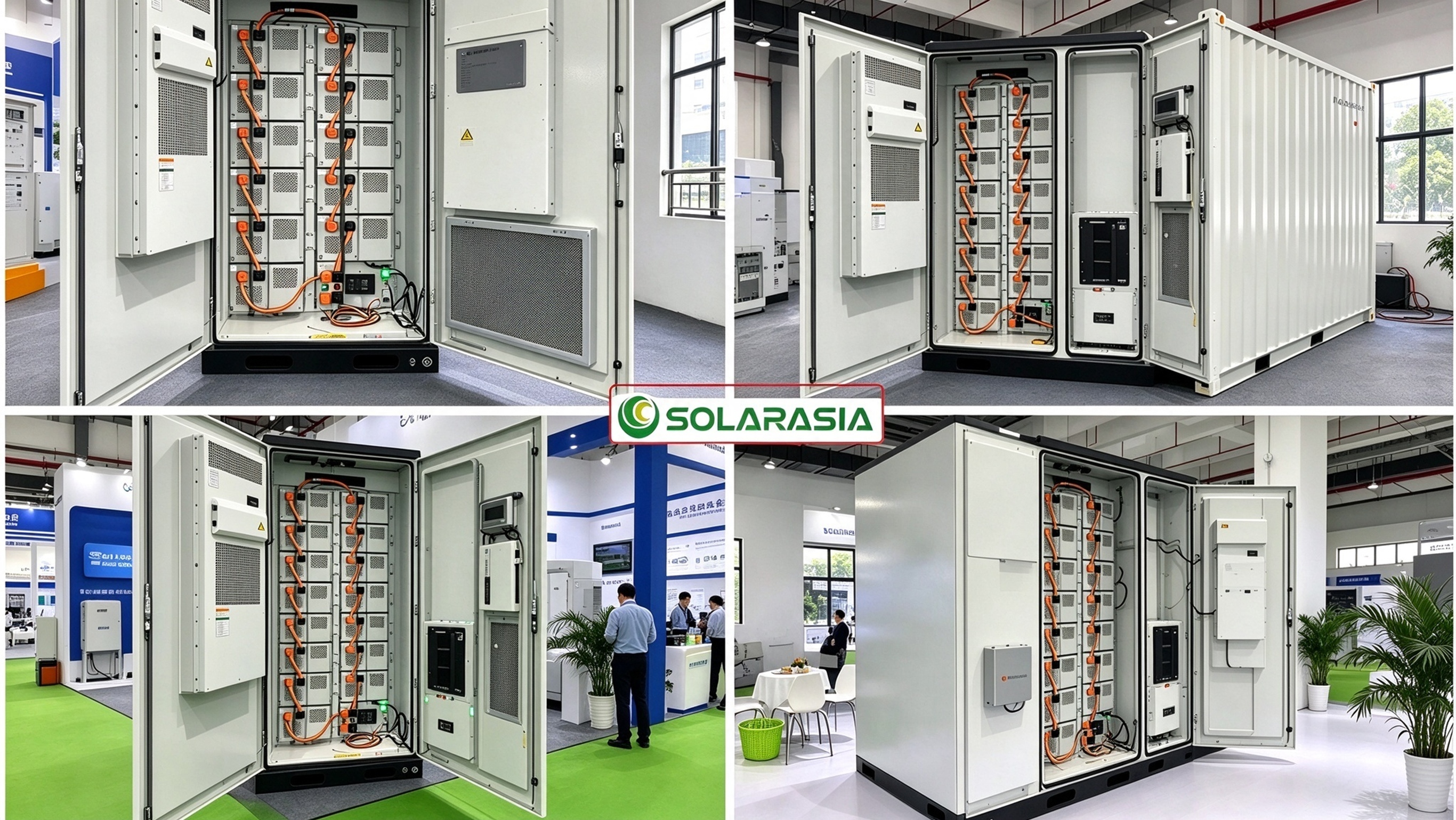
Combining solar panels with battery storage requires careful coordination between PV generation, battery capacity, inverter power, and energy management.
SOLARASIA provides lithium battery and energy storage solutions for residential and commercial applications, including customized configurations for commercial and industrial projects.
Our team can help evaluate project requirements, including:
Commercial and industrial battery capacity
Required charging and discharging power
Solar PV system compatibility
Battery and inverter configuration
Energy storage application
Project-specific technical requirements
Whether you are planning a new commercial solar-plus-storage installation or adding battery storage to an existing PV system, choosing the right configuration is essential.
Explore our Commercial and Industrial Battery Energy Storage Systems to learn more about our solutions.
Planning a solar-plus-storage project for your business?
Contact SOLARASIA and share your project details, including:
Project location
Existing or planned solar PV capacity
Average daily electricity consumption
Peak power demand
Required battery capacity, if known
Main application, such as peak shaving or backup power
Expected project timeline
Our team can help assess your requirements and recommend a suitable commercial battery storage configuration.
Solar panels generate electricity during daylight hours. The facility uses the electricity it needs, while surplus energy can charge the battery. When solar generation decreases or electricity demand increases, the battery discharges stored energy to support the facility.
Yes. Solar electricity can charge batteries through an appropriate hybrid inverter or DC-coupled power conversion system. In AC-coupled systems, electricity passes through the PV inverter and battery PCS before reaching the battery. The exact charging architecture depends on the system design.
It can be worthwhile when a business has significant surplus solar generation, high evening electricity demand, demand charges, or a need for backup power. The financial benefits depend on electricity tariffs, system costs, battery utilization, and operating strategy.
The required battery size depends on solar surplus, electricity consumption, peak demand, and the desired discharge duration. A detailed load profile and solar generation analysis provide a more accurate sizing basis than monthly electricity consumption alone.
Yes. Battery storage can often be added to an existing PV installation using an AC-coupled configuration. A DC-coupled solution may also be possible depending on inverter compatibility and system architecture. The existing inverter, electrical infrastructure, and grid connection should be evaluated before installation.
AC-coupled systems connect solar PV and battery storage through the AC electrical system. DC-coupled systems connect them through a shared DC-side architecture. AC coupling is often considered for retrofitting existing PV systems, while DC coupling can be suitable for newly designed solar-plus-storage projects.
Yes. A battery can store electricity generated during the day and discharge it at night. The available operating time depends on usable battery capacity, electricity demand, and system efficiency.
It can if the system is specifically designed for backup or islanded operation. Compatible inverters, isolation equipment, protection devices, controls, and sufficient battery capacity are required. Standard grid-following solar inverters generally shut down during grid outages for safety.
LiFePO4 batteries are widely used in commercial stationary energy storage because of their thermal stability and cycle-life characteristics. The final choice should consider battery performance, safety documentation, system compatibility, warranty, and project requirements.
Commercial battery energy storage allows businesses to make better use of electricity generated by their solar PV systems.
During the day, solar panels supply facility loads and charge the battery with available surplus electricity. When solar generation decreases, stored energy can be discharged to support commercial operations, helping businesses improve solar self-consumption and manage electricity demand.
The most suitable solution depends on solar generation, electricity consumption, battery capacity, inverter power, and the facility's energy management objectives.
For businesses planning a new solar installation or upgrading an existing PV system, combining solar panels with a properly sized commercial battery energy storage system can provide greater energy flexibility and support long-term energy management.
Contact SOLARASIA to discuss your commercial solar-plus-storage project and explore a customized BESS solution.


Address : Room 908-909, Building 2, No. 469 Huatuo Lane, Shushan District, Hefei City, Anhui Province


Please read on, stay posted, subscribe, and we welcome you to tell us what you think.
Copyright 2026 @ Anhui Solarasia Energy Technology Co.,Ltd .All Rights Reserved. Sitemap | Blog | XML | Privacy Policy
 Network Supported