
What Size Commercial Battery Storage System Do I Need?
Choosing the right size for a commercial battery storage system is one of the most important decisions when planning an energy storage project. Whether you operate a factory, warehouse, office building, shopping center, or commercial solar installation, the correct battery configuration can help reduce electricity expenses, manage peak demand, increase solar self-consumption, and provide backup power when required.
However, there is no single battery capacity suitable for every business. A factory with heavy machinery may require a high-power battery system, while a warehouse with relatively stable electricity consumption may need more energy capacity for longer operating hours.
For example, a 100kW commercial battery storage system may be paired with 215kWh, 261kWh, or another battery capacity depending on the project's operating requirements. The best choice depends on how much electricity the business needs, how long the battery must operate, and how the system will be charged.
In this guide, we explain how to determine the right commercial battery storage system size, calculate battery capacity, match battery power with electricity demand, and select a suitable configuration for your project.
Before choosing a battery, you need to understand the facility's electricity consumption and the purpose of the energy storage system.
The main factors include:
Daily electricity consumption, measured in kilowatt-hours (kWh), indicates how much energy a business uses over a typical day.
For example:
Small commercial building: 100–300 kWh per day
Medium-sized commercial facility: 300–1,000 kWh per day
Large factory or industrial facility: 1,000 kWh or more per day
These are illustrative ranges, not fixed classifications. Actual consumption varies significantly according to equipment, operating hours, production processes, and building size.
A business that consumes 800 kWh per day does not necessarily need an 800kWh battery. The battery only needs to cover the portion of electricity demand that the storage system is intended to supply.
Power demand, measured in kilowatts (kW), indicates how much electricity a facility needs at a particular moment.
For example, a factory may consume 500 kWh throughout a working day but experience a peak demand of 150 kW when multiple machines operate simultaneously.
In this case, battery energy capacity and discharge power must both be considered.
A battery with sufficient kWh capacity but insufficient kW output may not be able to support the required equipment.
The facility's operating schedule affects how much energy needs to be stored.
Consider these examples:
A factory operating during the day may use solar electricity directly.
A warehouse operating at night may need battery discharge after sunset.
A commercial building with evening demand may benefit from storing excess daytime solar generation.
A facility requiring emergency backup may need additional capacity reserved for critical loads.
The intended application is equally important. Commercial battery storage systems may be used for:
Solar self-consumption
Peak shaving
Time-of-use energy shifting
Backup power
Grid-connected energy management
A system designed primarily for peak shaving may require higher discharge power, while a system designed for longer backup periods may require greater energy capacity.
Battery capacity is measured in kWh. It represents the amount of energy a battery can store.
To estimate the required battery capacity, first determine how much energy the battery needs to deliver during its intended operating period.
A simplified calculation is:
Required nominal battery capacity (kWh) = Required delivered energy (kWh) ÷ (Usable depth of discharge × Discharge efficiency)
The calculation should use realistic operating parameters rather than assuming that the full nominal battery capacity is available to the load.
Suppose a factory wants its battery system to deliver 200 kWh of electricity during an evening operating period.
Assume:
Required delivered energy: 200 kWh
Usable depth of discharge: 90%
Battery-to-load discharge efficiency: 95%
The estimated nominal battery capacity is:
200 ÷ (0.90 × 0.95) = approximately 234 kWh
Under these assumptions, the project would need approximately 234kWh of nominal battery capacity as a preliminary estimate.
A 261kWh battery configuration could provide additional capacity margin under the same assumptions, while a 215kWh configuration would not deliver the full 200kWh target at the assumed operating limits.
The final selection must be based on the manufacturer's actual usable energy specifications, inverter conversion losses, reserve settings, and operating conditions.
Battery manufacturers commonly specify nominal and usable capacity separately.
For example, a battery rated at 261kWh does not necessarily deliver 261kWh of AC electricity to the facility.
The available energy depends on:
Maximum permitted depth of discharge
Battery operating temperature
Battery management settings
Inverter conversion efficiency
Charge and discharge limits
Battery aging and reserve requirements
When comparing commercial battery systems, always check the usable energy rather than comparing nominal capacity alone.
Battery capacity tells you how much energy is available, while battery power determines how quickly that energy can be delivered.
Both specifications are essential when selecting a commercial energy storage system.
| Parameter | Meaning | Example |
|---|---|---|
| Power (kW) | Rate of electricity delivery | 100kW |
| Energy capacity (kWh) | Amount of stored energy | 215kWh |
| Operating duration | How long the system can supply a given load | Depends on usable energy and load |
A 100kW battery system with 215kWh of nominal capacity is not the same as a 215kW system.
The 100kW rating represents its power output, while 215kWh represents its nominal stored energy.
Assume a factory wants to reduce grid electricity demand by 100kW for approximately two hours.
The required delivered energy is:
100kW × 2 hours = 200kWh
This means the system must provide:
Continuous discharge power of at least 100kW
Approximately 200kWh of delivered energy
Additional nominal battery capacity to account for discharge limits and losses
A system with a 100kW power rating and 261kWh nominal battery capacity may be a suitable starting point for evaluation, depending on its actual usable energy and operating limits.
The final design should also consider whether the battery can maintain its rated output throughout the required discharge period.
Factories generally have higher and more variable electricity demand than many other commercial facilities.
Production equipment, motors, compressors, cooling systems, and other industrial loads can create significant peak demand.
The right battery size depends on the factory's production schedule and energy management objectives.
Consider the following illustrative configurations:
| Factory Requirement | Possible BESS Configuration | Main Application |
|---|---|---|
| 50kW power, shorter discharge period | 50kW / 100kWh | Peak demand management |
| 100kW power, moderate energy requirement | 100kW / 215kWh | Commercial energy management |
| 100kW power, greater energy requirement | 100kW / 261kWh | Longer discharge duration |
| 125kW power, larger energy demand | 125kW / 261kWh | Industrial energy management |
These are example configurations for preliminary comparison, not universal recommendations or guaranteed operating durations. Actual suitability depends on usable battery energy, inverter ratings, load characteristics, and system efficiency.
These two configurations are particularly relevant for commercial and industrial energy storage projects.
Both provide a nominal power rating of 100kW, but their energy capacities are different.
| Comparison | 100kW / 215kWh | 100kW / 261kWh |
|---|---|---|
| Rated power | 100kW | 100kW |
| Nominal energy | 215kWh | 261kWh |
| Nominal energy difference | — | +46kWh |
| Nominal discharge duration at 100kW | 2.15 hours | 2.61 hours |
| Typical consideration | Lower energy capacity and potentially lower initial cost | Greater energy capacity and longer potential discharge duration |
The nominal discharge duration is calculated by dividing nominal energy by rated power. It does not represent guaranteed usable AC discharge time.
For example, if both systems use a 90% usable depth of discharge and 95% discharge efficiency:
215kWh configuration: approximately 184.3kWh delivered, or 1.84 hours at 100kW.
261kWh configuration: approximately 223.5kWh delivered, or 2.23 hours at 100kW.
These are simplified illustrative calculations. Actual system specifications must be checked before making a purchasing decision.
For projects with shorter peak demand periods, the 215kWh configuration may be sufficient. For projects requiring more energy during each discharge cycle, the 261kWh configuration may be more appropriate.
The decision should be based on the facility's actual load profile, solar surplus, tariff structure, and expected operating strategy.
For businesses with an existing or planned solar PV system, battery capacity should be matched to the amount of surplus solar electricity available.
During sunny periods, solar panels generate electricity for the facility. If PV generation exceeds immediate demand, the surplus may charge the battery.
Later, the stored energy can be used when solar generation decreases and electricity demand continues.
However, a large battery does not automatically provide greater savings. If the solar system cannot generate enough surplus electricity to charge it, some of the battery capacity may remain unused.
A preliminary solar generation estimate can be calculated using:
Daily PV generation (kWh) = PV capacity (kW) × Peak sun hours × Performance ratio
For example, consider:
PV capacity: 200kW
Equivalent peak sun hours: 4.5
Performance ratio: 80%
200 × 4.5 × 0.80 = 720kWh per day
The estimated daily PV generation is approximately 720kWh under these assumptions.
However, the actual amount available for battery charging depends on the facility's direct electricity consumption and the timing of solar generation.
Suppose the facility uses 500kWh of electricity during the daytime and generates 720kWh from its PV system.
The difference between generation and consumption is 220kWh in this simplified daily energy calculation.
This does not mean that exactly 220kWh is available for battery charging. Solar generation and electricity consumption vary throughout the day, so interval data is needed to calculate the actual surplus.
A properly designed commercial solar battery storage system should match the battery's charging capacity with the available solar surplus and the facility's later energy demand.
Some commercial facilities require battery storage to maintain essential operations during grid outages.
In this situation, battery capacity should be calculated based on critical loads rather than the entire facility's electricity consumption.
Start by identifying which equipment must continue operating during an outage.
Examples include:
Essential production equipment
Refrigeration and cold storage
Emergency lighting
Security and monitoring systems
IT and communication equipment
Critical control systems
Assume a business needs to support critical loads of 30kW for four hours.
Required delivered energy:
30kW × 4 hours = 120kWh
Assuming a usable depth of discharge of 90% and discharge efficiency of 95%:
120 ÷ (0.90 × 0.95) = approximately 140.4kWh
A preliminary design would therefore require approximately 141kWh of nominal battery capacity under these assumptions.
Additional capacity may be needed for operating reserves, battery aging, temperature conditions, and unexpected load changes.
The inverter must also be capable of supplying the required continuous power and handling equipment startup currents.
Importantly, not every grid-connected solar system can provide backup power during an outage. The inverter, transfer equipment, protection devices, and system controls must support the required backup or islanded operating mode.
Battery capacity is only one part of a complete commercial battery energy storage system.
Before purchasing, evaluate the following factors.
Lithium iron phosphate (LiFePO4 or LFP) batteries are widely used in stationary energy storage because of their thermal stability, cycle-life characteristics, and suitability for many commercial applications.
However, battery performance depends on the cell design, operating conditions, BMS, and complete system architecture.
The BMS monitors important battery parameters, including voltage, current, and temperature. It helps manage charging and discharging within defined operating limits and provides protection functions.
The PCS or inverter determines how power flows between the battery and the electrical system.Check its rated power, overload capability, voltage range, efficiency, and compatibility with the battery.
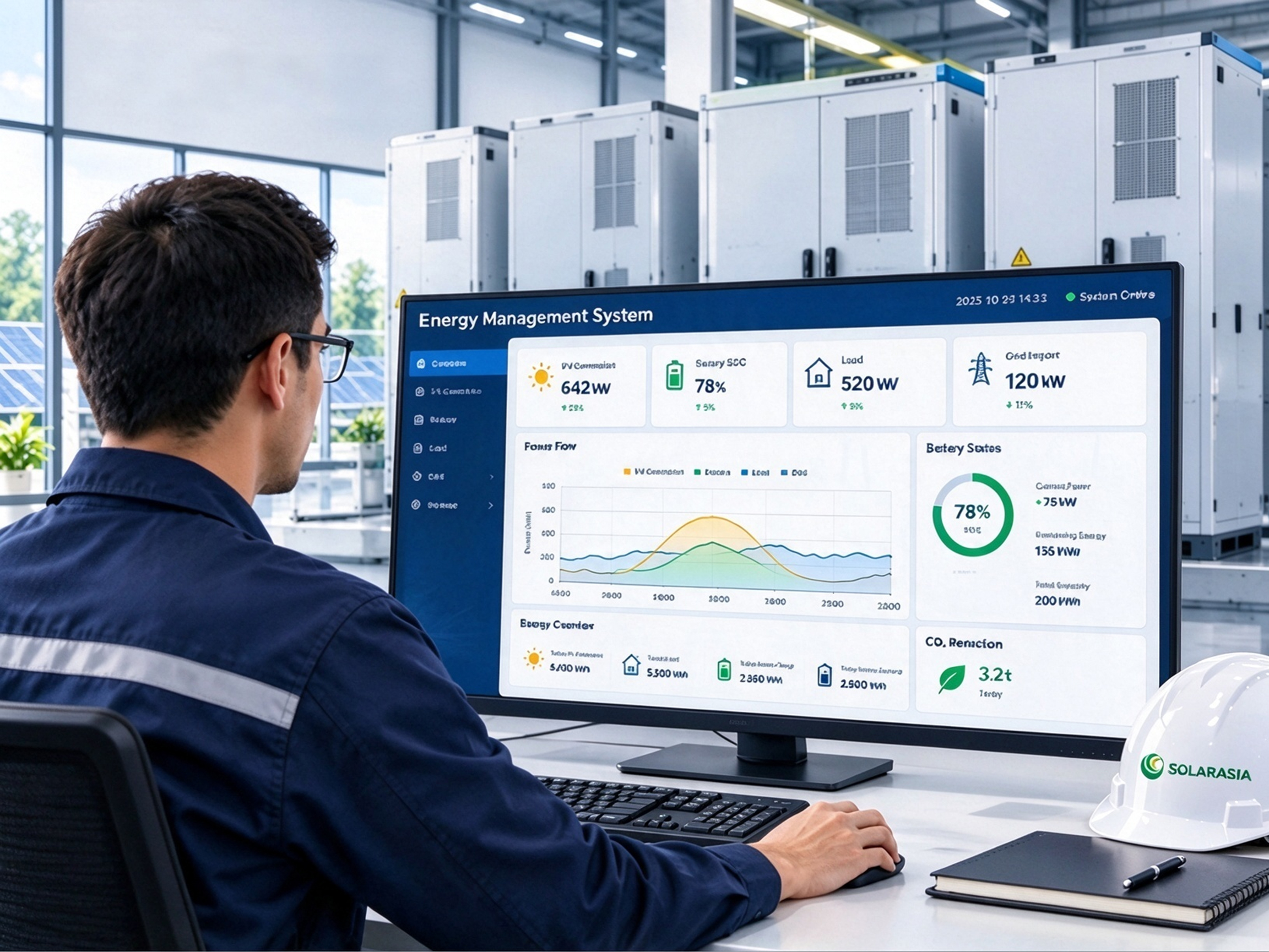
The EMS coordinates battery operation according to the project's requirements.
Depending on the system, it may support peak shaving, solar self-consumption, time-of-use scheduling, monitoring, and other energy management strategies.
Consider the available installation space, ambient temperature, ventilation or cooling requirements, humidity, dust exposure, and applicable local electrical and fire safety requirements.
If the facility expects higher electricity demand in the future, consider whether the proposed system supports additional battery capacity or power expansion.
The expansion method and limits should be confirmed with the supplier before purchasing.
To receive a suitable BESS proposal, provide the supplier with as much project information as possible.
The following details are particularly useful:
| Required Information | Example |
|---|---|
| Project type | Factory, warehouse, commercial building |
| Project location | Country and city |
| Required power | 100kW |
| Required energy | 215kWh or 261kWh |
| Daily electricity consumption | 800kWh |
| Peak demand | 150kW |
| Solar PV capacity | 200kW |
| Main application | Peak shaving and solar self-consumption |
| Backup requirement | Yes or no |
| Installation environment | Indoor or outdoor |
| Project timeline | Expected delivery and installation date |
If you do not know the required battery capacity, you can provide electricity bills and load profile data. A qualified supplier or system integrator can use these details to evaluate the appropriate configuration.
When comparing quotations, check whether they include the battery system, PCS, EMS, cooling equipment, electrical protection, installation, commissioning, and transportation. Make sure that all suppliers are quoting against the same technical requirements.
Selecting the right commercial battery storage system requires more than choosing a nominal kWh rating. The battery, inverter, control system, and energy management strategy must work together to meet the project's actual requirements.
SOLARASIA provides lithium battery and energy storage solutions for residential and commercial applications, including customized configurations for different project requirements.
Our team can help evaluate your required power, energy capacity, application, and system configuration to identify suitable battery storage options.
Whether you are planning a 50kW, 100kW, or larger commercial energy storage project, the right configuration should be selected according to your load profile, operating objectives, and installation conditions.
Explore our Commercial and Industrial Battery Energy Storage Systems to learn more about our BESS solutions.
Planning a commercial battery storage project?
Contact SOLARASIA and share the following information:
Required system power and battery capacity, if known
Project location
Daily electricity consumption
Existing or planned solar PV capacity
Main application and backup requirements
Expected order quantity
Our team can help you evaluate a suitable commercial battery storage configuration for your project.
The required size depends on your electricity consumption, peak demand, operating hours, solar generation, and intended application. Start by calculating the energy required during the battery discharge period, then account for usable depth of discharge and system efficiency.
There is no universal capacity for every factory. A factory with a 100kW peak load may require a different battery configuration depending on whether it needs one hour, two hours, or longer of support. Load profile data is essential for accurate sizing.
It may be suitable for commercial applications requiring up to 100kW of rated power and a moderate amount of stored energy. Actual suitability depends on usable capacity, discharge duration, load characteristics, and system operating limits.
The main difference is nominal energy capacity. A 261kWh system stores 46kWh more nominal energy than a 215kWh system. Under otherwise identical conditions, it can potentially support a longer discharge period, although actual delivered energy depends on usable capacity and efficiency.
The approximate operating duration can be estimated by dividing usable delivered energy by the load power. For example, a system delivering 200kWh to a 100kW load can operate for approximately two hours. Actual duration depends on system efficiency and operating conditions.
Yes. Commercial battery storage systems can be integrated with solar PV systems to store surplus electricity and use it later. The system architecture, inverter compatibility, charging limits, and energy management strategy must be properly designed.
LiFePO4 batteries are widely used in commercial and industrial energy storage because of their thermal stability and cycle-life characteristics. Their suitability should be evaluated based on system specifications, safety documentation, operating conditions, and project requirements.
Provide the project location, required power and energy capacity, electricity consumption, peak demand, solar PV capacity, application, backup requirements, and expected delivery schedule. If the required battery size is unknown, electricity bills and load profile data can help the supplier evaluate the project.
Choosing the right commercial battery storage system starts with understanding how your business uses electricity.
Daily energy consumption determines the required energy capacity, while peak demand and operating loads determine the required power rating. Solar generation, backup requirements, battery efficiency, and operating strategy further influence the final configuration.
A 100kW 215kWh system may be suitable for one project, while a 100kW 261kWh system may be a better option for another. The most appropriate solution is the one that meets the facility's actual energy requirements without unnecessary investment in unused capacity.
If you are planning a commercial or industrial energy storage project, contact SOLARASIA to discuss your requirements and explore a customized BESS solution.


Address : Room 908-909, Building 2, No. 469 Huatuo Lane, Shushan District, Hefei City, Anhui Province


Please read on, stay posted, subscribe, and we welcome you to tell us what you think.
Copyright 2026 @ Anhui Solarasia Energy Technology Co.,Ltd .All Rights Reserved. Sitemap | Blog | XML | Privacy Policy
 Network Supported