Commercial Solar Battery Storage System: How to Size the Right Solution
Oct 28, 2026
Introduction
A commercial solar battery storage system helps businesses store excess solar electricity and use it when energy demand rises, solar generation falls, or grid electricity becomes more expensive. For factories, warehouses, offices, retail buildings, and other commercial facilities, combining solar PV with battery storage can improve solar self-consumption, support energy cost management, and provide backup power when the system is designed for that purpose.
However, selecting the right system requires more than choosing a battery with a large capacity. An oversized battery may increase upfront investment without delivering enough additional savings, while an undersized system may fail to meet the facility's energy or power requirements.
The right configuration depends on several factors, including electricity consumption, solar generation, peak demand, operating schedules, battery discharge duration, inverter capacity, and local electricity tariffs.
In this guide, we explain how to size a commercial solar battery storage system, calculate the required battery capacity, match battery power with solar generation, and evaluate the factors that affect project performance and cost.
1. Understand How a Commercial Solar Battery Storage System Works
A commercial solar battery storage system combines solar panels, power conversion equipment, battery storage, and control systems to manage electricity for a business.
A typical system may include the following components:
Solar PV modules: Convert sunlight into DC electricity.
Solar inverter or hybrid inverter: Converts DC electricity into AC electricity or manages multiple power sources, depending on the system architecture.
Battery energy storage system (BESS): Stores electricity for later use.
Battery management system (BMS): Monitors battery conditions and provides battery-level protection functions.
Energy management system (EMS): Coordinates charging, discharging, and energy flows according to configured operating strategies.
Electrical protection and metering: Support safe operation, monitoring, and energy management.
The exact equipment depends on whether the project uses an AC-coupled or DC-coupled architecture, whether the battery is integrated with a hybrid inverter, and whether backup power is required.
How Solar and Battery Storage Work Together
During sunny periods, the solar PV system supplies electricity to the building's loads. If solar generation exceeds immediate consumption, surplus energy may charge the battery, subject to the system's charging limits and control settings.
When solar generation decreases or electricity demand rises, the battery can discharge to supply part of the load. Depending on the control strategy and tariff structure, the system may also charge from the grid during selected periods.
For a business with high daytime consumption, direct solar use may already be substantial. A battery becomes more valuable when there is sufficient surplus solar energy to charge it and a useful demand period in which that stored energy can be consumed.
Therefore, the first step in system sizing is to understand how much electricity the business uses, when it uses it, and how much solar electricity is available.
2. Analyze Your Commercial Electricity Consumption
Before selecting battery capacity, review the facility's electricity consumption and demand profile.
Monthly electricity bills provide a useful starting point, but interval data is more valuable. If possible, collect 15-minute or 30-minute electricity consumption data for at least several representative weeks, ideally covering seasonal variations.
Look for the following information:
Daily and monthly electricity consumption in kWh
Maximum demand in kW
Typical daytime and nighttime loads
Operating hours and business schedules
Weekend and holiday consumption
Seasonal changes in demand
Time-of-use electricity prices
Demand charges, if applicable
Identify the Main Energy Storage Objective
Different applications require different battery configurations.
Solar self-consumption: The battery stores surplus PV generation for use later in the day. Battery sizing should reflect the amount of surplus energy available and the expected later demand.
Peak shaving: The battery discharges during selected high-demand periods to reduce grid demand. The required power depends on the size and duration of the demand peaks.
Time-of-use energy shifting: The battery charges during lower-price periods and discharges during higher-price periods. The tariff schedule, usable capacity, round-trip efficiency, and cycling limits affect the potential savings.
Backup power: The battery supplies designated loads during grid outages if the system supports backup operation. Sizing must account for critical-load power, expected outage duration, inverter capability, and any required reserve capacity.
A system may support more than one application, but competing objectives can affect the available battery capacity. For example, keeping a battery charged for backup may reduce the energy available for daily peak shaving.
3. Calculate the Required Battery Energy Capacity
Battery capacity is usually expressed in kilowatt-hours (kWh). It indicates how much energy a battery can store, but the nominal capacity is not necessarily the amount of energy that can be delivered to the load.
To estimate the required nominal battery capacity, consider the energy demand during the intended discharge period, the usable depth of discharge, and system efficiency.
A simplified sizing formula is:
Required nominal battery capacity (kWh) = Required delivered energy (kWh) ÷ (Usable depth of discharge × Discharge efficiency)
For preliminary planning, this formula helps estimate the battery size. The final design should use the manufacturer's actual usable-energy specifications and account for system-specific losses, operating limits, and reserve requirements.
Example: A Commercial Building with Evening Energy Demand
Assume a commercial building needs to deliver 120 kWh of electricity from its battery during the evening.
For an illustrative calculation, assume:
Required delivered energy: 120 kWh
Usable depth of discharge: 90%
Battery-to-load discharge efficiency: 95%
The estimated nominal capacity is:
120 ÷ (0.90 × 0.95) = approximately 140.4 kWh
A nominal battery capacity of around 141 kWh would be the mathematical starting point under these assumptions. In practice, the selected product must have sufficient usable energy, and the design may need additional capacity to account for operating reserves, aging, temperature, or future demand.
This example is not a universal sizing recommendation. Actual capacity requirements depend on the selected battery, inverter, operating strategy, and load profile.
Check Whether the Solar System Can Charge the Battery
A battery should not be sized only around the energy demand. It must also have a realistic charging source.
Suppose a business regularly has 100 kWh of surplus solar electricity available for charging, while the battery is intended to deliver 120 kWh later in the day. The system may not be able to meet that target through solar charging alone because charging and discharging involve losses.
The solution may require a smaller battery, more solar generation, grid charging where permitted and economical, or a different operating strategy.
A useful sizing principle is to match battery capacity with both the energy available for charging and the energy that can be usefully discharged.
4. Match Battery Power with the Commercial Load
Battery capacity and battery power are different specifications.
Energy capacity (kWh): How much energy the battery can store.
Power rating (kW): How quickly the system can charge or discharge energy.
A battery with sufficient capacity may still be unsuitable if its discharge power is too low for the required load.
Calculate the Required Discharge Power
Suppose a business wants to reduce grid demand by 50 kW during a peak period. The battery system must be capable of delivering the required power at the point of connection, after accounting for inverter limits, battery limits, and system losses.
If the target is to provide 50 kW for two hours, the load requires 100 kWh of delivered energy before additional design considerations. The battery must therefore meet both the power requirement and the energy requirement.
For example, a nominal 100 kWh battery may not deliver 100 kWh of usable AC energy because of discharge limits and conversion losses. The actual design should use the specified usable energy and continuous discharge rating.
Check the Power-to-Energy Ratio
The power-to-energy ratio provides a simple way to understand a battery system's intended discharge duration.
For example, a 100 kW system with 215 kWh of nominal battery capacity has a nominal ratio of approximately 0.47C. A 100 kW system with 261 kWh has a nominal ratio of approximately 0.38C.
These ratios are calculated from rated power divided by nominal energy capacity. They do not by themselves establish the actual discharge duration, which also depends on usable capacity, inverter ratings, efficiency, and operating limits.
When comparing commercial BESS configurations, check the continuous power rating, usable energy, maximum charge and discharge rates, and the conditions under which the specifications apply.
5. Determine the Right Solar PV Capacity
Battery storage should be sized alongside the solar PV system rather than as a completely separate component.
The appropriate PV capacity depends on available roof or ground space, solar irradiation, panel orientation, shading, system losses, and the facility's consumption profile.
A preliminary estimate of daily solar generation can be expressed as:
Estimated daily PV generation (kWh) = PV capacity (kW) × Equivalent peak sun hours × Performance ratio
For example, assume a 200 kW PV system receives an average of 4.5 equivalent peak sun hours per day and has an illustrative performance ratio of 0.80.
200 × 4.5 × 0.80 = 720 kWh per day
This produces an estimated 720 kWh of daily generation under the assumed conditions. It does not mean that all 720 kWh will be available to charge the battery. Some electricity may be consumed directly by the facility, and actual generation varies with weather, season, shading, and equipment performance.
Avoid Oversizing the Battery Relative to Solar Surplus
A large battery may remain underutilized if the PV system rarely produces enough surplus electricity to charge it.
Conversely, a facility with substantial midday solar surplus and high evening consumption may benefit from greater storage capacity.
The design should evaluate hourly or interval-based PV generation and load data. Annual energy totals alone can conceal important differences between generation and demand timing.
6. Choose Between AC-Coupled and DC-Coupled Storage
Commercial solar battery storage systems commonly use AC-coupled or DC-coupled configurations. The best choice depends on whether the project is new or retrofitted, the existing inverter architecture, and the operating requirements.
AC-Coupled Battery Storage
In an AC-coupled system, the PV system and battery system connect through AC electrical infrastructure, typically using separate conversion equipment.
Potential advantages include:
Flexibility when adding storage to an existing PV installation
Easier separation of PV and battery equipment in some designs
Compatibility with certain existing solar inverter configurations
Potential considerations include additional conversion stages, equipment costs, available connection capacity, and control-system integration.
DC-Coupled Battery Storage
In a DC-coupled system, the battery connects on the DC side of a compatible hybrid inverter or shared conversion architecture.
Potential advantages include:
Potentially fewer conversion stages for some energy flows
Integrated control in compatible system designs
Potential benefits for new PV-plus-storage projects
Potential considerations include inverter compatibility, DC voltage requirements, design limits, and the suitability of the architecture for future expansion.
Neither architecture is universally better. Compare the complete system efficiency, installed cost, control functions, expansion requirements, and compatibility with the intended battery and inverter models.
7. Consider Backup Power and Critical Loads
If backup power is a project requirement, the battery must be sized around the loads that need to remain operational during an outage.
Start by identifying critical equipment, such as essential production controls, communications equipment, refrigeration, emergency lighting, or selected office loads. Record the power demand of each load and the expected backup duration.
A simplified energy estimate is:
Required delivered energy = Total critical load power × Required backup duration
For example, a critical load of 30 kW operating for four hours requires 120 kWh of delivered energy before accounting for conversion losses, reserve capacity, and other design factors.
The system must also support the required instantaneous power and any motor-starting or surge loads.
Importantly, a grid-connected solar inverter does not necessarily continue supplying power during a grid outage. Backup operation may require compatible inverters, transfer equipment, protection arrangements, and an appropriately designed islanding function. Confirm the complete backup architecture with the system supplier and electrical engineer.
8. Evaluate the Cost and Return on Investment
The cost of a commercial solar battery storage system depends on more than nominal battery capacity. The total project price may include batteries, PCS or inverters, BMS, EMS, thermal management, enclosures, electrical protection, installation, commissioning, transportation, and required compliance work.
A meaningful quotation should clearly state the equipment and services included.
Estimate Potential Energy Bill Savings
Potential savings depend on how the system operates and the electricity tariff.
For solar self-consumption, savings may come from using stored solar electricity instead of purchasing grid electricity later. For peak shaving, savings may come from reducing demand charges where the local tariff includes them. For time-of-use shifting, savings depend on the difference between charging and discharging electricity prices.
A simplified estimate of annual net savings should account for:
Electricity costs avoided
Demand-charge reductions, where applicable
Battery and inverter losses
Charging electricity costs
Maintenance and operating expenses
Battery degradation and replacement assumptions
Avoid estimating payback based only on total battery capacity or the retail price difference between daytime and evening electricity. A reliable financial model should use actual load data, tariff rules, system efficiency, and realistic operating assumptions.
Compare Total Cost of Ownership
When comparing suppliers, evaluate the full installed system and its expected performance over time.
Consider warranty conditions, usable capacity, cycle-life test conditions, service availability, component replacement, and potential changes in electricity tariffs. A lower initial price may not produce the lowest long-term cost if the system is poorly matched to the application.
9. How to Select a Commercial Solar Battery Storage Supplier
The supplier should be able to explain the proposed system design and demonstrate that its components are compatible with your project.
Before placing an order, evaluate the following:
Technical specifications: Confirm nominal and usable energy, continuous power, charge and discharge limits, operating temperatures, and efficiency data.
Battery safety and documentation: Request applicable certificates, test reports, manuals, and transport documents. Verify that the documentation covers the quoted product and system configuration.
Inverter and EMS compatibility: Confirm communication protocols, operating modes, grid requirements, monitoring functions, and any backup-power capabilities.
Manufacturing and quality control: Ask about production processes, inspection procedures, factory testing, and component traceability.
Warranty and after-sales service: Review the warranty document, exclusions, technical support process, spare parts availability, and responsibilities for commissioning and maintenance.
Project customization: Confirm whether the supplier can meet the required voltage, power, capacity, enclosure, communication, and installation requirements.
For commercial projects, a supplier should also provide a clear scope of supply and identify which equipment, engineering services, and installation work are excluded from its quotation.
10. Commercial Solar Battery Storage Sizing Checklist
Before requesting a quotation, prepare the following project information:
Sizing Factor
Information to Prepare
Application
Solar self-consumption, peak shaving, time-of-use shifting, backup, or combined use
Electricity consumption
Monthly and daily kWh usage
Load profile
Preferably 15-minute or 30-minute interval data
Peak demand
Maximum demand in kW
PV system
Existing or proposed PV capacity in kW
Solar surplus
Estimated or measured excess solar generation
Battery energy
Required nominal and usable capacity in kWh
Battery power
Required continuous charge and discharge power in kW
Backup requirements
Critical loads and required operating duration
System architecture
AC-coupled, DC-coupled, or another compatible design
Site conditions
Location, ambient temperature, installation space, and environmental requirements
Commercial factors
Electricity tariff, budget, delivery schedule, and expected project life
Providing this information helps suppliers evaluate the project more accurately and reduces the risk of receiving quotations based on different assumptions.
Why Work with SOLARASIA for Your Commercial Solar and Storage Project?
Choosing a commercial solar battery storage system involves coordinating PV generation, battery capacity, power conversion, energy management, and the facility's actual operating requirements.
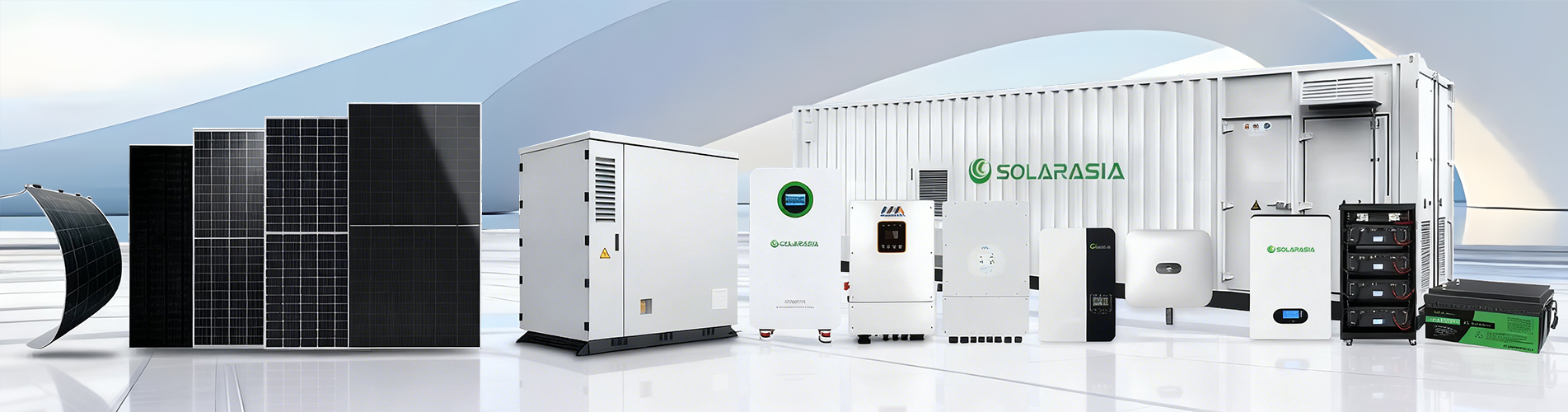
SOLARASIA supplies solar and energy storage products and supports customized solutions for different project requirements. For commercial and industrial projects, the appropriate configuration should be evaluated according to power demand, usable energy requirements, solar generation, installation conditions, and the intended operating strategy.
If you are planning a new commercial solar installation or adding battery storage to an existing PV system, share your project location, target capacity, application, and available load data with the SOLARASIA team to discuss suitable options.
Explore our commercial and industrial battery energy storage solutions for more information.
Request a Customized Commercial Solar Battery Storage Solution
To help assess your project, prepare the following details:
Project location and application
Existing or planned solar PV capacity
Required battery power and energy capacity, if known
Electricity consumption and load profile
Whether backup power is required
Preferred system configuration
Estimated order quantity and project timeline
If you are unsure about the correct capacity, provide your consumption data and operating objectives for an initial technical discussion.
Contact SOLARASIA to discuss your commercial solar battery storage requirements and request a project-specific quotation.
Frequently Asked Questions
1. How do I size a commercial solar battery storage system?
Start with the facility's electricity consumption, load profile, and solar generation data. Determine the energy that must be delivered during the intended discharge period, then account for usable depth of discharge, system efficiency, reserve requirements, and the battery's operating limits. Finally, confirm that the battery power rating meets the required load.
2. How much battery storage does a commercial solar system need?
There is no single capacity suitable for every commercial building. The required capacity depends on the amount of surplus solar energy, the facility's demand after solar generation declines, the intended operating strategy, and the target backup duration if applicable.
3. What is the difference between kW and kWh in battery storage?
Kilowatts (kW) measure power, or how quickly electricity can be delivered or absorbed. Kilowatt-hours (kWh) measure energy capacity. A battery system needs sufficient power for the load and sufficient usable energy for the required operating duration.
4. Can I add battery storage to an existing commercial solar system?
Yes, in many cases. The solution may use AC-coupled storage or another compatible architecture, depending on the existing PV inverter, electrical infrastructure, grid requirements, and operating goals. The existing equipment should be assessed before selecting the battery system.
5. Is a larger battery always better?
No. A larger battery may increase project cost without delivering proportionally greater savings if there is insufficient surplus solar energy or demand to use the additional capacity. Battery size should be matched to charging opportunities, useful discharge demand, power requirements, and project economics.
6. Should I choose AC-coupled or DC-coupled battery storage?
AC-coupled systems can be useful for retrofitting storage to an existing PV system, while DC-coupled systems may suit certain new PV-plus-storage designs. The choice depends on equipment compatibility, efficiency, installation costs, control requirements, and expansion plans.
7. Can a commercial solar battery storage system provide backup power?
It can if the system is specifically designed and configured for backup operation. The project may require compatible inverters, transfer equipment, protection devices, and support for islanded operation. Critical loads and backup duration must be defined before sizing.
8. What information should I provide to get a commercial battery storage quotation?
Provide the project location, application, solar PV capacity, electricity consumption, load profile, required power and energy capacity, backup requirements, installation conditions, and expected project timeline. If the final battery size is not known, the supplier may use this information to evaluate an appropriate configuration.
Conclusion
Sizing a commercial solar battery storage system requires a coordinated assessment of electricity demand, solar generation, battery capacity, power ratings, system architecture, and project economics.
The most suitable solution is not necessarily the largest battery or the lowest-priced system. It is the configuration that can reliably meet the intended operating requirements while making practical use of available solar energy and delivering a reasonable total cost of ownership.
By preparing accurate load data, comparing complete system specifications, and working with a supplier that can explain the proposed configuration, businesses can make more informed decisions about commercial solar and battery storage investments.
For a project-specific assessment, contact SOLARASIA to discuss your commercial solar and energy storage requirements.






 Network Supported