
Commercial Battery Energy Storage for Peak Shaving: How to Reduce Demand Charges

For many factories, warehouses, manufacturing facilities, and commercial buildings, electricity costs are not determined only by how much energy they consume. In some markets, businesses also pay demand charges based on their highest recorded electricity demand during a billing period.
A short period of high electricity consumption can therefore increase a company's monthly electricity bill, even if its average power demand is much lower.
This is where commercial battery energy storage systems can make a difference.
By storing electricity and discharging it during periods of high demand, a Battery Energy Storage System (BESS) can help reduce the amount of power a facility draws from the grid. This strategy is known as peak shaving.
A properly designed commercial battery energy storage system can help businesses manage peak demand, improve energy flexibility, and potentially reduce electricity costs without changing their entire production process.
In this guide, we explain how battery storage performs peak shaving, how to estimate the required battery capacity, and what businesses should consider when selecting a commercial BESS solution.
Peak shaving is an energy management strategy that reduces a facility's maximum electricity demand during specific periods.
Commercial and industrial facilities often experience fluctuations in power consumption. For example, a factory may operate several production lines, air compressors, cooling systems, and other high-power equipment simultaneously.
When these systems operate at the same time, electricity demand can rise significantly.
A battery energy storage system can discharge electricity during these high-demand periods, supplying part of the facility's load and reducing the power drawn from the utility grid.
In simple terms:
When electricity demand is low, the battery can charge.
When electricity demand increases, the battery discharges.
The battery supplies part of the required power.
The facility draws less power from the grid during peak periods.
This helps lower the facility's grid demand peak.
Imagine a manufacturing facility with the following electricity demand:
| Parameter | Without BESS | With BESS |
|---|---|---|
| Normal grid demand | 250 kW | 250 kW |
| Peak grid demand | 400 kW | 300 kW |
| Battery discharge power | 0 kW | 100 kW |
| Peak demand reduction | 0 kW | 100 kW |
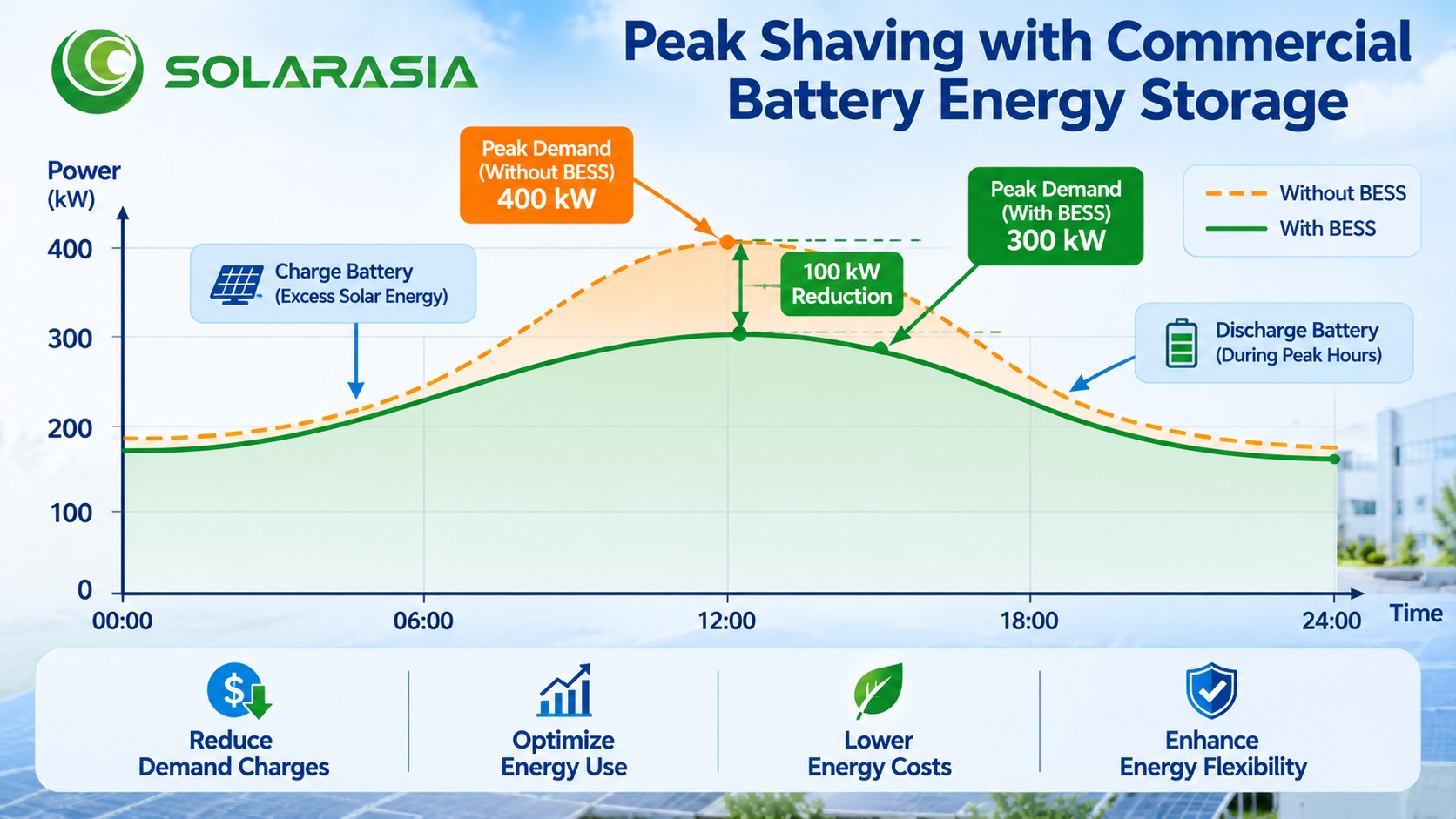
In this simplified example, the facility experiences a peak demand of 400kW. A battery system supplies 100kW during the peak period, reducing grid demand to approximately 300kW.
The battery does not eliminate the facility's electricity consumption. Instead, it changes when electricity is drawn from the grid.
This is the basic principle of battery energy storage peak shaving.
Electricity bills for commercial and industrial users may include several components:
Energy charges: Based on the total electricity consumed, usually measured in kWh.
Demand charges: Based on the highest measured power demand, usually measured in kW or kVA.
Time-of-use charges: Electricity prices that vary depending on the time of day.
Fixed charges: Monthly service or connection fees.
Not every electricity market or utility tariff includes all these components. The exact billing structure depends on the local electricity provider and applicable regulations.
Demand charges can be significant for facilities with high and fluctuating electricity consumption.
For example, a factory may normally draw 250kW from the grid. However, when several production machines start simultaneously, its demand may temporarily increase to 400kW.
If the utility calculates demand charges using the highest recorded demand during a billing period, that short peak may affect the entire month's bill.
Consider this simplified example:
| Parameter | Value |
|---|---|
| Monthly peak demand | 400 kW |
| Demand charge rate | $15/kW |
| Monthly demand charge | $6,000 |
If a battery system reduces the billed peak demand to 300kW:
| Parameter | Value |
|---|---|
| Original peak demand | 400 kW |
| Reduced peak demand | 300 kW |
| Demand reduction | 100 kW |
| Demand charge rate | $15/kW |
| New demand charge | $4,500 |
| Potential monthly savings | $1,500 |
This example illustrates a potential demand charge reduction of $1,500 per month.
Actual savings depend on the utility's demand measurement interval, billing rules, seasonal tariffs, ratchets, battery efficiency, and whether the battery successfully controls the billing peak.
A commercial BESS for peak shaving uses battery power to support facility loads when electricity demand approaches a predefined threshold.
The system generally includes:
Lithium battery modules
Battery Management System (BMS)
Power Conversion System (PCS)
Energy Management System (EMS)
Energy meters and monitoring equipment
Protection and electrical distribution equipment
The EMS monitors electricity consumption and controls battery charging and discharging according to the operating strategy.
The system collects real-time or interval-based power consumption data from the facility.
The EMS compares actual demand with a configured demand limit.
For example, a facility may set a target grid demand limit of 300kW.
The battery can charge during periods when electricity demand is relatively low.
Depending on the project design, charging energy may come from:
The utility grid during lower-cost periods
Surplus solar PV generation
A combination of grid and solar electricity
The charging schedule should consider electricity tariffs, battery charging limits, and the facility's expected demand.
When facility demand approaches or exceeds the target threshold, the EMS instructs the PCS to discharge the battery.
The battery supplies part of the facility's electricity demand, reducing the power drawn from the grid.
The EMS continuously monitors the system and adjusts battery output according to demand fluctuations.
A suitable control strategy can help prevent short-duration load spikes from becoming new monthly demand peaks.
However, battery output must be sufficient, and enough stored energy must remain available throughout the relevant demand period.
Choosing the correct battery configuration is essential for effective peak shaving.
Two key parameters must be considered:
Power capacity (kW): Determines how much power the battery can deliver at one time.
Energy capacity (kWh): Determines how much energy the battery can store and deliver over time.
A battery may have sufficient energy capacity but insufficient discharge power to reduce a large demand peak. Similarly, a high-power battery may not sustain peak shaving for long enough if its energy capacity is too small.
First, identify the difference between the facility's current peak demand and its desired grid demand limit.
Formula:
Target Battery Power = Current Peak Demand − Target Grid Demand
Example:
Current peak demand: 400kW
Target grid demand: 300kW
Required battery output: 100kW
The battery system needs to deliver approximately 100kW during the peak period.
Next, determine how long the battery needs to support the facility.
For example, if the battery must provide 100kW for two hours:
Required Delivered Energy = 100kW × 2 hours = 200kWh
This represents the energy delivered to the load, not necessarily the battery's nominal capacity.
The nominal battery capacity must account for usable depth of discharge and conversion efficiency.
A simplified sizing formula is:
Required Nominal Battery Capacity = Required Delivered Energy ÷ (Usable Depth of Discharge × Discharge Efficiency)
For example, assuming:
Required delivered energy: 200kWh
Usable depth of discharge: 90%
Discharge efficiency: 95%
The estimated nominal battery capacity is:
200 ÷ (0.90 × 0.95) ≈ 234kWh
Therefore, a battery system with approximately 234kWh of nominal capacity would be a starting point under these assumptions.
In practice, engineers should also consider temperature, battery aging, operating reserves, PCS limits, auxiliary consumption, and the actual load profile.
Monthly electricity bills alone are usually insufficient for accurate battery sizing.
Businesses should ideally provide:
15-minute or finer interval demand data, where available
Daily electricity consumption
Maximum demand records
Production schedules
Electricity tariff information
Expected operating hours
This information helps determine the required battery power, energy capacity, and charging schedule.
For commercial and industrial energy storage projects, battery systems with different energy capacities can provide different operating durations.
Consider two illustrative configurations:
| Parameter | 100kW 215kWh BESS | 100kW 261kWh BESS |
|---|---|---|
| Rated power | 100 kW | 100 kW |
| Nominal energy | 215 kWh | 261 kWh |
| Power-to-energy ratio | 0.47C | 0.38C |
| Main difference | Smaller energy capacity | Larger energy capacity |
| Potential application | Shorter peak periods | Longer peak periods |
Both configurations have the same rated power, meaning they can theoretically provide the same maximum power output under suitable operating conditions.
The main difference is energy capacity.
The 261kWh system stores more energy and may support longer discharge periods. The 215kWh system may be sufficient for projects with shorter peak periods or lower energy requirements.
For peak shaving, the right choice depends on the facility's demand profile rather than battery capacity alone.
A detailed assessment should compare:
Peak demand magnitude
Peak duration
Daily charging opportunities
Battery usable capacity
Required backup reserve
Electricity tariff structure
For more information, read our guide: 100kW 215kWh vs 100kW 261kWh BESS: Which Configuration Is Right for Your Project?
Yes. Combining solar PV panels with commercial battery storage can provide additional energy management opportunities.
During daylight hours, solar panels generate electricity that can directly supply the facility's loads.
When solar generation exceeds immediate demand, surplus electricity can charge the battery.
The stored energy can then be discharged during periods of high demand, including periods when solar generation decreases.
A solar-plus-storage configuration can provide several benefits:
Instead of exporting all surplus solar generation or curtailing it, the facility can store available electricity for later use.
The battery can discharge during high-demand periods, reducing the amount of electricity purchased from the grid.
Businesses can use more of their own solar electricity outside peak generation hours.
An EMS can coordinate solar generation, battery charging, battery discharge, and grid electricity according to project objectives.However, solar generation is variable. A peak shaving strategy should not assume that solar electricity will always be available when the facility experiences its highest demand.For more details, see our guide on how commercial battery energy storage works with solar panels.
Peak shaving is particularly relevant for businesses with high electricity demand, significant load fluctuations, or demand-based electricity tariffs.
Manufacturing facilities often operate heavy machinery, compressors, motors, and production lines.When several machines operate simultaneously, electricity demand may increase rapidly.A BESS can support these loads during selected peak periods.
Large warehouses may use substantial electricity for lighting, ventilation, refrigeration, and material-handling equipment.Battery storage can help manage demand fluctuations and support more flexible electricity consumption.
Shopping centers, office complexes, and commercial facilities may experience high demand during business hours due to air conditioning, elevators, lighting, and other electrical equipment.
A battery system can help reduce selected demand peaks.
Refrigeration equipment can create significant and recurring electricity demand.
A properly configured battery system can support peak demand management while maintaining the required operating conditions of the facility.
Industrial parks with multiple production facilities may have complex electricity demand patterns.
Battery storage can support demand management at the facility level or as part of a larger energy management strategy.
Selecting a commercial battery storage system requires more than comparing nominal kWh ratings.
Businesses should evaluate the following factors before purchasing.
| Selection Factor | What to Consider |
|---|---|
| Rated power | Whether the PCS can provide sufficient discharge power |
| Battery capacity | Whether usable energy supports the required discharge duration |
| Battery chemistry | LiFePO4 and other suitable battery technologies |
| BMS | Battery monitoring and protection functions |
| EMS | Demand monitoring and peak shaving control |
| PCS compatibility | Voltage, power rating, and grid connection requirements |
| Cycle life | Expected operating cycles and warranty conditions |
| Thermal management | Cooling design and operating temperature range |
| Safety | Electrical protection, thermal monitoring, and system-level safeguards |
| Warranty | Product warranty and performance guarantees |
| Technical support | Installation guidance, commissioning, and after-sales service |
It is also important to understand the complete scope of supply.
Some suppliers provide battery cabinets only, while others offer integrated solutions including batteries, PCS, EMS, cooling, protection equipment, and monitoring systems.
For commercial and industrial projects, compatibility between the battery, PCS, EMS, and existing electrical infrastructure is essential.
The financial value of peak shaving depends on how much demand can be reduced and how much the local utility charges for peak demand.
A basic annual demand charge saving estimate is:
Annual Demand Charge Savings = Monthly Demand Reduction × Demand Charge Rate × 12
For example:
Monthly demand reduction: 100kW
Demand charge rate: $15/kW
Estimated annual demand charge savings: $18,000
However, this is not the same as the project's total financial return.
A complete economic evaluation should also consider:
Battery system purchase cost
Installation and commissioning costs
Battery charging electricity costs
Round-trip efficiency losses
Maintenance and operating expenses
Battery degradation
Financing costs
Other potential revenue or savings
A project may also generate value through time-of-use energy arbitrage, solar self-consumption, or backup power, depending on the system design and local market rules.
Businesses should compare the total project investment with realistic annual savings to estimate the payback period.
Choosing the right battery configuration is important for achieving reliable peak shaving performance.
SOLARASIA provides lithium battery and energy storage solutions for residential and commercial applications, including customized solutions for commercial and industrial energy storage projects.
Our team can assist with evaluating project requirements, including:
Required battery power and energy capacity
Commercial and industrial BESS configurations
Battery and inverter compatibility
Solar-plus-storage integration
Project-specific technical requirements
Customized energy storage solutions
Whether your goal is to reduce demand charges, manage peak electricity consumption, or integrate battery storage with an existing solar installation, selecting the right system configuration is essential.
Explore our Commercial and Industrial Battery Energy Storage Solutions to learn more.
Planning a commercial or industrial battery storage project?
Contact SOLARASIA with your project information:
Project location
Facility type
Current maximum demand (kW)
Average daily electricity consumption (kWh)
Peak demand duration
Existing solar PV capacity, if available
Local electricity tariff structure
Expected battery capacity, if known
Our team can help evaluate your requirements and recommend a suitable commercial battery energy storage configuration.
Peak shaving is a strategy that uses battery energy storage to reduce electricity demand drawn from the grid during high-demand periods. The battery discharges to support facility loads, helping lower the recorded grid demand peak.
A commercial battery discharges when facility electricity demand approaches a predefined limit. By reducing grid power consumption during the relevant demand measurement interval, the system may lower the demand value used to calculate the electricity bill.
Battery size depends on the required power reduction and discharge duration. For example, a 100kW battery discharge lasting two hours requires approximately 200kWh of delivered energy. Nominal battery capacity must be adjusted for usable depth of discharge and system efficiency.
Battery power is measured in kW and determines how much electricity the battery can deliver at one time. Battery energy capacity is measured in kWh and determines how much electricity it can store. Both are important for peak shaving.
Yes. LiFePO4 batteries are widely used in stationary commercial and industrial energy storage applications. Their cycle-life characteristics and thermal stability make them a common option for projects requiring frequent charging and discharging.
Yes. Solar panels can supply facility loads and charge batteries with surplus electricity. The battery can then discharge during periods of high demand, helping reduce grid consumption and improve solar self-consumption.
The operating duration depends on battery energy capacity, discharge power, usable capacity, and facility demand. A 215kWh battery does not necessarily deliver 215kWh of usable AC energy because conversion losses and operating limits must be considered.
No. Peak shaving is most financially attractive when the electricity tariff includes demand charges or other costs linked to maximum power consumption. Businesses should review their utility billing rules before investing in a battery system.
Peak shaving reduces the maximum power drawn from the grid during high-demand periods. Load shifting moves electricity consumption from one time period to another, often to take advantage of lower electricity prices. A battery system can support both strategies.
Commercial battery energy storage provides businesses with a practical way to manage electricity demand and potentially reduce demand charges.
By charging during lower-demand periods and discharging when electricity consumption reaches a peak, a properly designed BESS can reduce grid power demand and improve energy flexibility.
However, successful peak shaving depends on more than battery capacity. Power rating, discharge duration, load profiles, electricity tariffs, and EMS control strategies all influence system performance and financial returns.
For factories, warehouses, commercial buildings, and industrial facilities, a customized commercial battery energy storage system for peak shaving can be an important part of a long-term energy management strategy.
Contact SOLARASIA to discuss your project requirements and explore a suitable commercial BESS solution.


Address : Room 908-909, Building 2, No. 469 Huatuo Lane, Shushan District, Hefei City, Anhui Province


Please read on, stay posted, subscribe, and we welcome you to tell us what you think.
Copyright 2026 @ Anhui Solarasia Energy Technology Co.,Ltd .All Rights Reserved. Sitemap | Blog | XML | Privacy Policy
 Network Supported