
Commercial Battery Energy Storage System Installation: Process, Requirements and Costs
Commercial battery energy storage systems are becoming an important part of modern energy management for factories, warehouses, commercial buildings, and industrial facilities.
By storing electricity and releasing it when needed, a commercial BESS can help businesses reduce peak demand, improve solar energy self-consumption, manage electricity costs, and increase energy flexibility.
However, purchasing a battery storage system is only one part of an energy storage project. Proper installation, electrical integration, site preparation, and commissioning are equally important for achieving reliable system operation.
So, how is a commercial battery energy storage system installed? What site conditions should businesses prepare? How long does installation take, and what costs should buyers consider?
This guide explains the main stages of a commercial BESS installation project, from initial planning to system commissioning.
A commercial battery energy storage system installation involves more than placing battery cabinets at an industrial site.
A complete project may include several interconnected components:
Battery cabinets or energy storage containers
Lithium battery modules and battery management system (BMS)
Power conversion system (PCS)
Energy management system (EMS)
Cooling and thermal management equipment
Electrical distribution and protection equipment
Fire detection and suppression systems, where required
Communication and monitoring systems
Grid connection and commissioning
The exact configuration depends on the project's power rating, energy capacity, application, installation environment, and local electrical regulations.
For example, a 100kW 215kWh BESS and a 100kW 261kWh BESS have the same nominal power rating but different energy capacities. Their installation requirements may also differ depending on cabinet dimensions, weight, cooling design, and electrical configuration.
Before installation begins, the project team should confirm the system design and the responsibilities of the equipment supplier, electrical contractor, and site owner.
Before purchasing or installing a commercial battery energy storage system, businesses should evaluate the installation site.
Proper site preparation can help reduce unexpected engineering work, installation delays, and additional project expenses.
Battery cabinets require sufficient space for equipment placement, maintenance, ventilation or cooling, and safe access.
The site assessment should consider:
Battery cabinet dimensions and weight
Equipment layout and maintenance access
Distance from buildings and other equipment
Access for transportation and lifting equipment
Cable routing and electrical connection locations
Emergency access and applicable safety clearances
For outdoor installations, the foundation and surrounding environment should be suitable for the selected enclosure and equipment specifications.
Commercial battery storage cabinets can be heavy, particularly when multiple battery modules are installed.
The foundation should be designed to support the equipment's operating weight and comply with local structural requirements.
Depending on the project, site preparation may involve:
Concrete foundations or equipment pads
Leveling and load-bearing verification
Drainage planning
Cable trenches or underground conduits
Equipment anchoring, where required
The required foundation design should be confirmed using the manufacturer's installation documentation and project engineering assessment.
The existing electrical infrastructure must be evaluated before connecting a BESS.
Important considerations include:
AC voltage and frequency
Transformer capacity
Main distribution board configuration
Circuit breaker and protection requirements
Cable sizing and routing
Grounding and earthing arrangements
Grid connection requirements
Existing solar PV inverter configuration, if applicable
For grid-connected systems, the installation design may also require utility approval, protection coordination, and compliance with local interconnection standards.
The installation environment can affect battery performance and service life.
Before selecting an outdoor or indoor BESS, consider:
Ambient temperature
Humidity and water exposure
Dust and airborne contaminants
Corrosion risk
Ventilation and heat dissipation
Flood risk
Altitude and other operating conditions specified by the manufacturer
The battery enclosure and thermal management system should be suitable for the actual site environment.
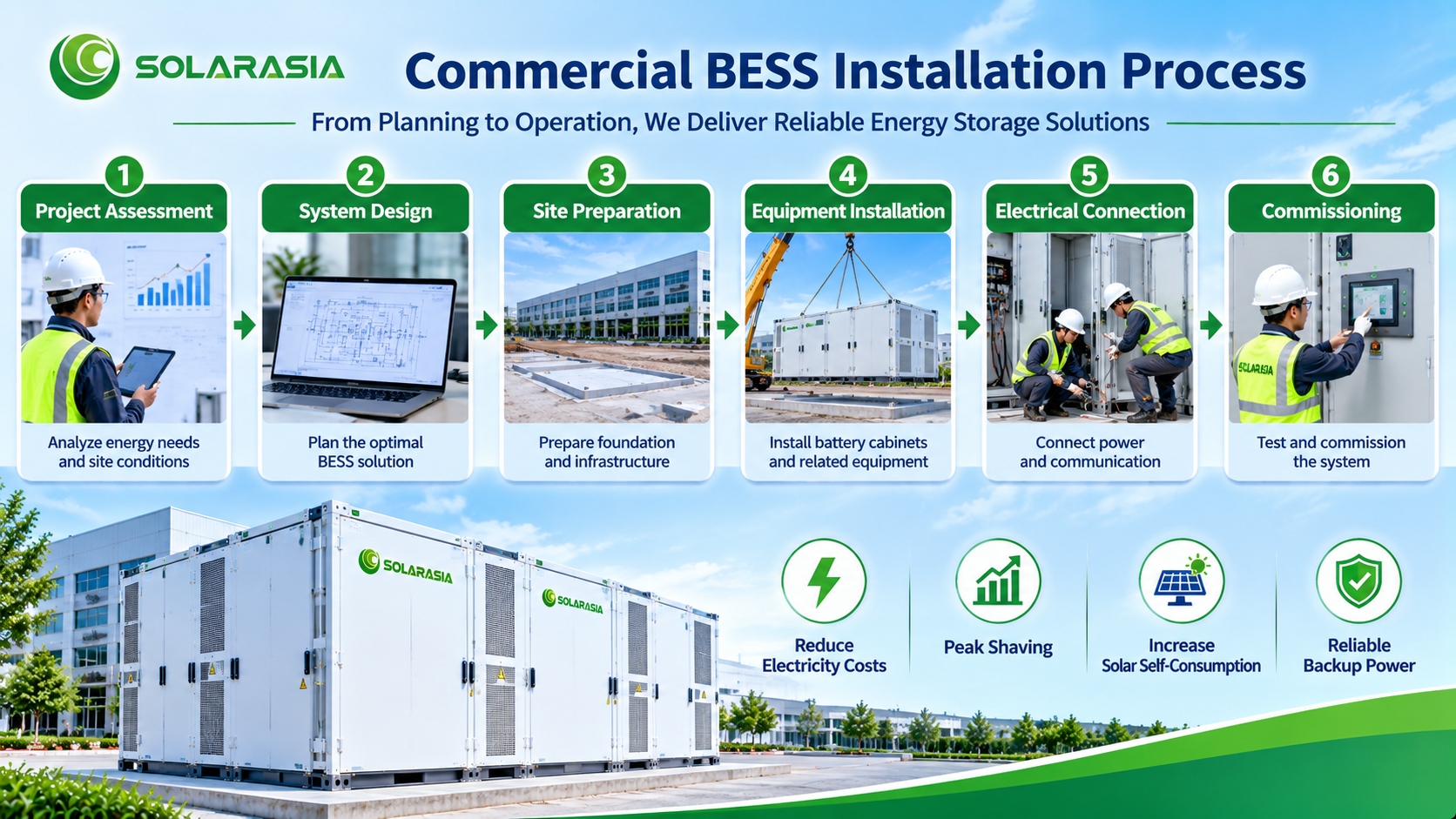
Although project requirements vary, most commercial BESS installations follow several major stages.
The first step is to understand how the facility consumes electricity.
The project team should evaluate:
Daily electricity consumption
Maximum demand
Load profiles
Electricity tariff structure
Peak and off-peak periods
Existing solar PV generation
Required backup loads
Expected battery operating hours
This information helps determine the required battery power and energy capacity.
For example, a factory mainly interested in peak shaving may require a different configuration from a warehouse that wants to increase solar energy self-consumption.
After evaluating the facility's energy requirements, the engineering team can develop a suitable BESS configuration.
The main design parameters include:
| Parameter | Description |
|---|---|
| Rated power (kW) | Maximum specified charge or discharge power |
| Battery capacity (kWh) | Nominal stored energy |
| Usable energy | Energy available within specified operating limits |
| Battery chemistry | For example, lithium iron phosphate (LFP) |
| PCS | Power conversion and AC integration |
| EMS | Energy management and operating control |
| Cooling system | Air cooling or liquid cooling, depending on design |
| Installation type | Indoor or outdoor |
| Grid connection | Voltage, frequency, and interconnection requirements |
The system should be selected according to the actual application rather than battery capacity alone.
Before equipment delivery, the installation site should be prepared.
Typical activities include:
Completing the equipment foundation
Preparing cable routes and conduits
Confirming electrical connection points
Preparing grounding infrastructure
Checking equipment access and lifting arrangements
Confirming safety and emergency access provisions
The project team should also verify that the site is ready to receive the equipment.
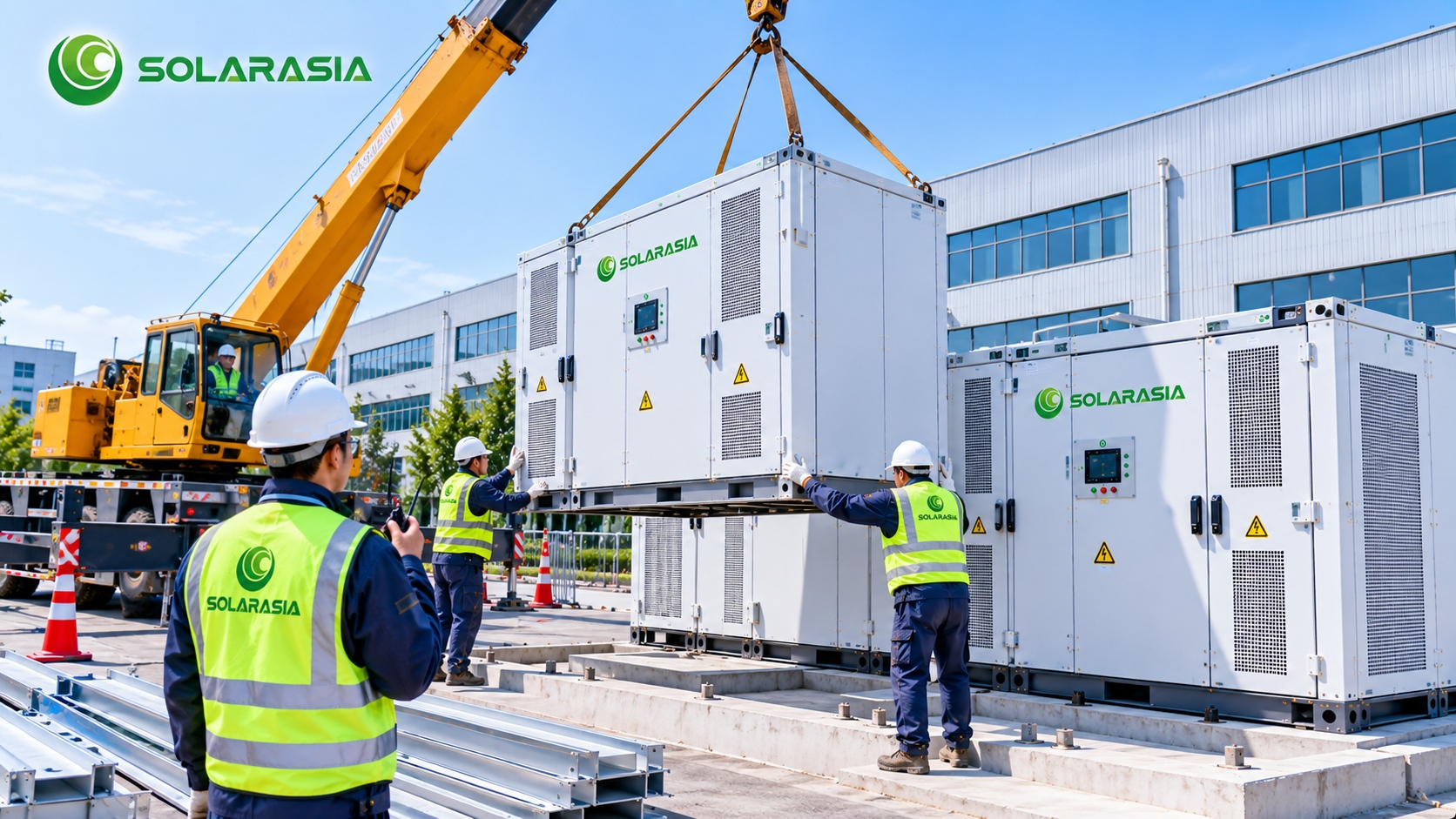
Once the site is ready, battery cabinets, PCS equipment, and other components can be delivered.
Equipment placement should follow the approved layout and manufacturer's handling instructions.
Important considerations include:
Checking equipment condition upon delivery
Verifying model numbers and supplied components
Using appropriate lifting and transportation equipment
Positioning cabinets according to the approved design
Confirming equipment stability and required clearances
Battery equipment should be handled by qualified personnel following the manufacturer's instructions.
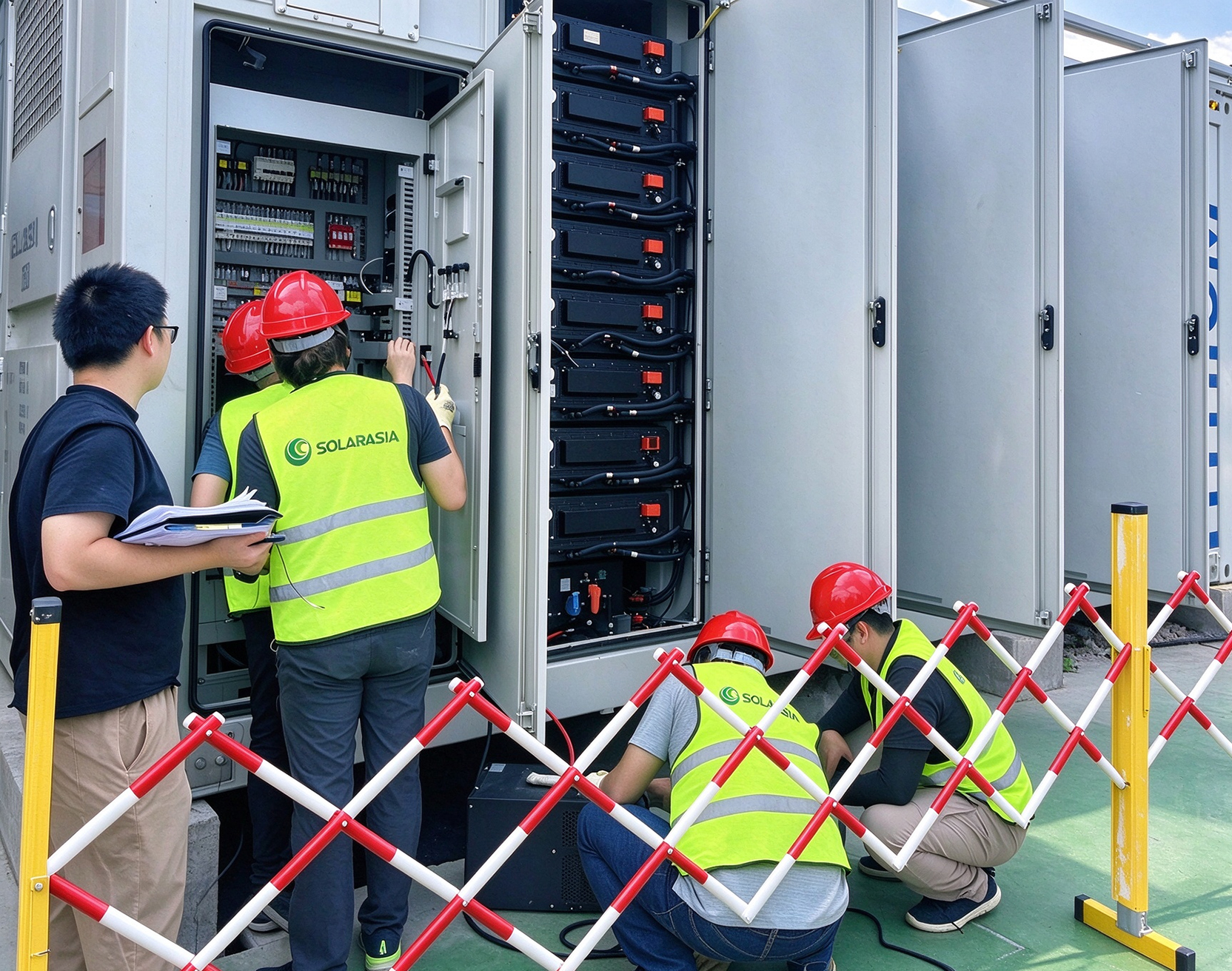
After equipment placement, qualified electrical professionals complete the required connections.
These may include:
Battery DC connections
PCS AC connections
Grounding and earthing
Protection devices
Communication cables
EMS connections
Monitoring and control interfaces
All connections should follow the approved electrical drawings, equipment documentation, and applicable local regulations.
Before the BESS enters normal operation, the system should undergo inspection and commissioning.
Typical checks may include:
Battery voltage and communication checks
BMS protection and monitoring functions
PCS operating performance
EMS communication and control
Cooling system operation
Electrical protection verification
Alarm and emergency shutdown functions
Charging and discharging tests
Grid connection and operating mode verification
Commissioning should be performed by qualified professionals according to the manufacturer's procedures and project requirements.
After successful commissioning, the system can enter its intended operating mode.
Depending on the project, the EMS may manage battery charging and discharging according to electricity prices, demand levels, solar generation, or predefined operating schedules.
Regular monitoring and maintenance help identify abnormal operating conditions and support long-term system performance.
The total cost of a commercial battery energy storage project depends on the equipment configuration and the installation scope.
A battery equipment quotation does not necessarily include all site preparation, electrical work, engineering, and commissioning expenses.
The main installation-related cost categories include:
| Cost Item | Description |
|---|---|
| Battery equipment | Battery cells, modules, racks, BMS, and enclosure |
| PCS | Power conversion equipment |
| EMS | Monitoring and energy management |
| Foundation and civil works | Concrete pads, foundations, drainage, and cable trenches |
| Electrical installation | Cables, switchgear, protection, and wiring |
| Grid connection | Transformer or utility-related work, where required |
| Safety systems | Detection and suppression equipment according to project requirements |
| Transportation | Delivery, unloading, and handling |
| Labor | Qualified installation and electrical professionals |
| Commissioning | Testing, configuration, and system verification |
| Engineering and permits | Design, approvals, and compliance work |
Several project conditions may increase the total installation budget:
Long distances between the BESS and the electrical connection point
Additional transformer or switchgear requirements
Complex civil works
Limited equipment access
Challenging environmental conditions
Special grid interconnection requirements
Additional fire safety or regulatory requirements
For this reason, buyers should provide site information when requesting a quotation.
A supplier can then clarify which costs are included in the equipment price and which must be handled by local contractors.
The installation timeline varies according to system size, equipment configuration, site readiness, local approvals, and project complexity.
A relatively straightforward cabinet-based installation may require less on-site work than a large multi-container project involving extensive civil works and grid integration.
The main project stages are:
| Project Stage | Main Activities |
|---|---|
| Planning | Load analysis and project assessment |
| Engineering | System design and equipment selection |
| Site preparation | Foundation and electrical infrastructure |
| Delivery | Transportation and equipment placement |
| Installation | Electrical and communication connections |
| Commissioning | Testing and operational verification |
Some stages can overlap, while others depend on completion and approval of previous work.
The overall project schedule should therefore be confirmed after the technical assessment rather than relying on a general installation-time estimate.
Many commercial facilities install battery storage systems together with solar PV systems.
This configuration allows businesses to store excess solar generation during periods of high production and use the stored energy later when electricity demand increases or solar generation decreases.
A typical solar-plus-storage system may include:
Solar PV modules generate DC electricity.
Solar inverters convert electricity for AC loads or system integration.
The BESS stores available surplus energy according to the system design.
The EMS coordinates energy flow between solar generation, battery storage, facility loads, and the grid.
Stored electricity is discharged when required by the operating strategy.
When designing a solar-plus-storage project, buyers should confirm inverter compatibility, AC or DC coupling architecture, control communication, power limits, and grid requirements.
A properly integrated system can improve solar self-consumption and provide greater flexibility in managing electricity demand.
Battery safety should be considered throughout project planning, installation, commissioning, and operation.
Commercial battery storage systems should be designed and installed according to applicable electrical, fire safety, building, and grid requirements.
Important considerations include:
The BMS monitors battery operating conditions, including voltage, current, and temperature, and provides protection functions according to its design.
The cooling system helps maintain suitable battery operating temperatures.
The required cooling configuration depends on battery design, operating conditions, and environmental requirements.
Appropriate electrical protection may include circuit breakers, fuses, isolation devices, grounding, and monitoring functions.
Fire detection and suppression provisions should be selected according to the system design, battery technology, installation environment, and applicable local codes.
The installation layout should allow suitable access for inspection, maintenance, and emergency response.
Battery installation and commissioning should only be performed by appropriately qualified personnel.
Selecting an experienced supplier is important for coordinating equipment, system design, and project implementation.
Before making a purchasing decision, buyers should evaluate the following:
| Evaluation Area | What to Check |
|---|---|
| Product quality | Battery specifications and quality control |
| System integration | Compatibility between battery, PCS, and EMS |
| Technical documentation | Datasheets, drawings, and installation manuals |
| Certifications | Applicable product and project compliance documents |
| Engineering support | System configuration and technical consultation |
| Installation guidance | Clear installation and commissioning procedures |
| Warranty | Coverage, terms, and operating conditions |
| After-sales service | Technical support and troubleshooting |
| Project experience | Experience with similar commercial applications |
Buyers should also clarify whether the supplier provides equipment only, remote technical guidance, local installation, or complete engineering and commissioning services.
These service scopes are different and should be clearly stated in the quotation.
Providing accurate project information helps suppliers recommend a suitable energy storage solution.
Before requesting a quotation, prepare the following details:
| Required Information | Example |
|---|---|
| Project location | Country and city |
| Application | Peak shaving, solar storage, or backup |
| Required power | 100kW, 125kW, 250kW |
| Required capacity | 215kWh, 261kWh, 500kWh |
| Electricity consumption | Daily or monthly kWh |
| Maximum demand | Facility peak demand in kW |
| Solar PV capacity | Existing or planned PV system |
| Grid voltage | Local AC voltage and frequency |
| Installation environment | Indoor or outdoor |
| Project stage | Planning, procurement, or installation |
If possible, provide electricity bills, load profiles, site photographs, and electrical diagrams.
This information helps the supplier understand the project and prepare a more accurate technical proposal.
SOLARASIA provides lithium battery and energy storage solutions for residential, commercial, and industrial applications.
We work with project requirements to support suitable battery configurations and customized energy storage solutions.
Our product and service scope includes:
Commercial and industrial battery energy storage systems
Lithium iron phosphate battery solutions
Different power and energy capacity configurations
Battery and inverter integration
Solar-plus-storage applications
Pre-sales technical consultation
Engineering coordination and after-sales support
Whether you are planning a 100kW 215kWh BESS, a 100kW 261kWh system, or a larger industrial energy storage project, our team can discuss the technical requirements and recommend a suitable configuration.
Explore our Commercial and Industrial Battery Energy Storage Solutions.
Planning a commercial battery energy storage installation?
Send us your project location, required power, battery capacity, application, and installation conditions.
The SOLARASIA team can help evaluate your requirements and discuss a customized BESS solution for your project.
A typical installation involves project assessment, system design, site preparation, equipment delivery, cabinet placement, electrical connections, commissioning, and operational monitoring. The exact process depends on system configuration and local requirements.
The site should provide suitable space, a stable foundation, appropriate electrical infrastructure, equipment access, environmental protection, and compliance with applicable safety and installation requirements.
The timeline depends on system size, site readiness, equipment delivery, civil works, electrical integration, and commissioning. A project-specific schedule should be confirmed after technical assessment.
Not every project requires a new transformer. The need depends on the existing electrical infrastructure, system voltage, power rating, grid connection design, and utility requirements.
Yes, many commercial BESS solutions can be integrated with existing solar PV systems. Compatibility depends on inverter configuration, AC or DC coupling architecture, communication protocols, and electrical design.
Equipment supply generally covers the battery system and specified related equipment. Complete installation may additionally include engineering, foundations, electrical work, grid integration, commissioning, and local labor.
Safety measures may include battery monitoring, thermal management, electrical protection, grounding, fire detection, suppression systems, and suitable emergency access. Requirements depend on local codes and project design.
Suppliers generally need the project location, required power and energy capacity, application, electricity consumption, maximum demand, solar PV capacity, grid voltage, and installation conditions.
Installing a commercial battery energy storage system requires careful planning, appropriate equipment selection, site preparation, electrical integration, and professional commissioning.
For businesses considering a BESS project, understanding these requirements before purchasing equipment can help reduce installation risks and avoid unexpected costs.
The right solution should be designed around the facility's energy consumption, operating strategy, electrical infrastructure, and local installation conditions.
Contact SOLARASIA to discuss your commercial energy storage requirements and explore a customized battery storage solution.


Address : Room 908-909, Building 2, No. 469 Huatuo Lane, Shushan District, Hefei City, Anhui Province


Please read on, stay posted, subscribe, and we welcome you to tell us what you think.
Copyright 2026 @ Anhui Solarasia Energy Technology Co.,Ltd .All Rights Reserved. Sitemap | Blog | XML | Privacy Policy
 Network Supported