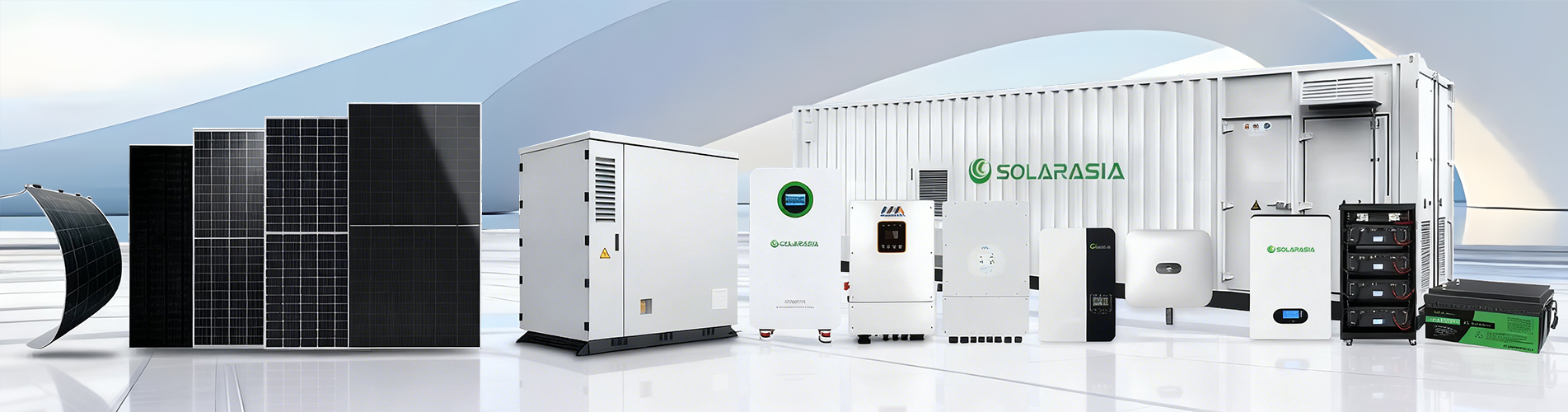
Solarasia banner

solar battery

Home

solar battery

  • How to Choose the Best Solar Panels and Inverters for Your Home? Apr 07, 2025
      Why Choosing the Right Solar Panels & Inverters Matters?(The most popular solar panel) Installing solar panels is a smart investment, but choosing the wrong equipment can lead to wasted money and inefficient energy production. Whether you’re powering a small home or a large property, solar panels for home and inverters must align with your energy needs, budget, and local climate. Let’s break down the key factors to consider.   Step 1: Compare Solar Panel Types. Not all solar panels are created equal. Here’s a quick breakdown: Monocrystalline Panels (20-25% efficiency): Best for limited space but higher costs. Polycrystalline Panels (18-22% efficiency): Affordable and ideal for moderate climates. Thin-Film Panels (10-15% efficiency): Lightweight and flexible for unique installations. Pro Tip: Look for panels with low temperature coefficients to maintain efficiency in hot weather.   Monocrystalline offers higher efficiency but costs more than polycrystalline.   Step 2: Match Inverter Power & Type. Your inverter converts solar energy into usable electricity. Key considerations: Power Matching: Ensure the inverter’s capacity slightly exceeds your solar panel’s peak output (e.g., 3kW panels need a 3.5kW inverter). Inverter Types: String Inverters: Affordable but less efficient in shaded areas. Microinverters: Higher cost but optimize individual panel performance. Hybrid Inverters: Ideal for battery storage systems. Must-Have Feature: Look for MPPT (Maximum Power Point Tracking) technology to maximize energy harvest.   Step 3: Prioritize Durability & Warranty. Solar panels and inverters are long-term investments. Check: Panel Warranty: 10-25 years for materials. Inverter Warranty: 5-10 years for most models. Weather Resistance: Ensure panels are certified for high winds (2400Pa) and hailstones (25mm).   Final Checklist for Solar Success. 1.Calculate your daily energy usage (kWh). 2.Research local incentives and rebates. 3.Partner with a trusted installer for professional sizing.   By focusing on solar panels for home efficiency, inverter compatibility, and durability, you’ll enjoy years of clean, cost-effective energy. Ready to make the switch? Contact us for a free consultation!
  • Why Choose Our Photovoltaic Products Over Competitors? Unveiling the Secrets. Apr 10, 2025
    In an era where sustainable energy has shifted from a luxury to an absolute necessity, the global demand for high - quality photovoltaic solutions is at an all - time high. But with countless options flooding the market, how do you ensure you’re making the right choice? As a leading trading company in the photovoltaic industry, we’re here to answer that question by highlighting what sets our products apart.   What Makes Our Solar Panels Stand Out? Our solar panels are the cornerstone of any efficient solar energy system. Engineered with cutting - edge technology, they boast an impressive conversion rate, turning sunlight into electricity with exceptional efficiency. Among our standout offerings is the Sunman flexible panel, which has been creating waves in the industry. Its unique flexibility allows it to be installed on curved surfaces, making it a game - changer for unconventional architectural designs, RVs, and boats. With power outputs ranging from 425W to 430W and 520W, these panels not only provide reliable, long - term energy but also significantly slash your carbon footprint and electricity bills.   How Do Our Solar Inverters Optimize Your System? A solar energy system is incomplete without a top - tier solar inverter. Our inverters play a pivotal role in converting the direct current (DC) generated by the solar panels into alternating current (AC) for household and commercial use. Equipped with advanced features, they offer high conversion efficiency, stable performance, and intelligent monitoring capabilities. These inverters seamlessly integrate with different solar panel models, optimizing the overall system performance and ensuring you harvest every bit of available energy.   Why Are Our Lithium Batteries a Must - Have? When it comes to energy storage, our lithium batteries reign supreme. With high energy density, a long cycle life, and rapid charging capabilities, they provide a reliable and efficient solution for storing excess solar energy. Whether you’re building an off - grid solar system or aiming to boost self - consumption in an on - grid setup, our lithium batteries fit the bill. Their compact design and low - maintenance nature make them suitable for both residential and commercial applications.   ​What’s the Advantage of Our Complete Solar Systems? For those seeking a hassle - free, all - in - one solution, our solar systems are the ultimate answer. These turnkey systems combine the best of our solar panels, inverters, and batteries, all customized to your specific energy needs, location, and budget. From system design and installation to after - sales support, our team of experts will be with you every step of the way, ensuring a smooth and worry - free experience.   In conclusion, choosing our photovoltaic products isn’t just about purchasing equipment; it’s about investing in a sustainable future. With competitive prices and top - notch customer service, we invite you to join us on this green energy journey. Let our solar panels, inverters, lithium batteries, and solar systems power up your world!   Feel free to contact us at any time, and we will provide you with 24-hour warm service!
  • How to Choose the Right Solar Battery for Your Solar System? Oct 08, 2026
    Solar panels can generate clean electricity during the day, but solar production does not always match a building's electricity consumption.     A home may generate more electricity than it needs during the afternoon, while electricity demand increases in the evening. Commercial and industrial facilities can have similar differences between solar generation and load demand.   Adding battery storage allows excess electricity to be stored and used later.   However, choosing a battery is not simply a matter of selecting the largest capacity available. Battery voltage, usable capacity, power rating, chemistry, inverter compatibility, operating environment and intended application all need to be considered.   The right solar battery should work together with the PV system, inverter and electrical loads as part of a complete energy storage solution.     In this guide, we explain the key factors to consider when selecting a battery for a residential, commercial or industrial solar system.   Why Add a Battery to a Solar System?   A battery allows electricity generated by solar panels to be stored for later use.   A basic solar system works like this: Solar Panels → Solar Inverter → Building Loads   When battery storage is added, the energy flow becomes more flexible: Solar Panels → Building Loads + Battery Charging   Later: Battery → Inverter → Building Loads   This can help businesses and homeowners increase solar self consumption and reduce dependence on grid electricity during selected periods.   Depending on the system design, battery storage can also support: Solar energy shifting Peak demand management Time of use energy management Backup power Energy independence Commercial energy management     The best battery depends on which of these objectives is most important.   What Should You Consider When Choosing a Solar Battery?   There are several important specifications to compare before selecting a battery.   The main factors include: Battery chemistry Battery capacity Battery power Battery voltage Usable energy Depth of discharge Cycle life Inverter compatibility Operating temperature Safety and protection Installation environment Warranty and service     Let's look at each factor in more detail.   1. Choose the Right Battery Chemistry   Battery chemistry has a major impact on performance, safety, lifespan and application.   For modern solar energy storage systems, lithium based batteries are widely used.   One of the most common options is lithium iron phosphate, commonly known as LiFePO4.   LiFePO4 Batteries   LiFePO4 batteries are widely used for residential and commercial energy storage because they offer a combination of: Good thermal stability Long cycle life High usable energy Stable performance Suitable energy density Battery management system integration   They are used in applications ranging from residential wall mounted batteries to larger commercial battery storage systems.     For many modern solar battery storage applications, LiFePO4 is an important technology to consider.   2. Determine the Required Battery Capacity   Battery capacity is normally measured in kilowatt hours, or kWh.   It represents how much energy the battery can store under specified conditions.   For example: 10kWh battery = approximately 10kWh nominal energy capacity   However, the usable energy may be lower depending on the battery's operating limits.   The required capacity should be based on the actual electricity consumption and the purpose of the storage system.   For example, a homeowner may want enough energy to cover evening electricity consumption.   A commercial building may need storage for several hours of peak demand management.     An off grid facility may require substantially more storage to maintain electricity availability during periods of low solar generation.   How Much Battery Capacity Do You Need?   A simple starting calculation is: Required Battery Capacity ≈ Energy Demand × Required Backup or Discharge Time   For example, if selected loads consume approximately 20kW and the target support period is four hours: 20kW × 4 hours = 80kWh   This does not mean an 80kWh nominal battery will always provide four hours of operation.   Real system design needs to account for: Usable battery capacity Depth of discharge Inverter efficiency Battery degradation Temperature Auxiliary consumption Load variation     Therefore, professional system sizing should use actual load data rather than relying only on a simple calculation.   3. Understand Battery Power vs Battery Capacity   This is one of the most important concepts when choosing a battery.   Battery Capacity: kWh   Battery capacity indicates how much energy can be stored.   Battery Power: kW   Battery power indicates how much power the battery can charge or discharge at a given time.   For example, a battery system may be rated around: 100kW / 215kWh   This means the system has approximately 100kW of power capability and 215kWh of nominal energy capacity under specified conditions.   A battery with sufficient kWh but insufficient kW may not be able to support high power loads.     This is particularly important for commercial and industrial applications.   4. Select the Appropriate Battery Voltage   Battery voltage is another important specification.   Solar battery systems can generally be divided into low voltage and high voltage configurations.   Low Voltage Battery Systems   Low voltage batteries are commonly used in residential and smaller energy storage applications.   Typical applications include: Residential solar storage Small commercial systems Backup power Off grid applications   High Voltage Battery Systems   High voltage battery systems can be suitable for larger systems where higher power and energy requirements exist.   Applications can include: Commercial energy storage Industrial energy storage Larger hybrid solar systems C&I battery storage   The battery voltage needs to match the inverter or PCS architecture.     You should never select a battery based only on its capacity without checking electrical compatibility.   5. Check the Usable Battery Capacity   Nominal capacity and usable capacity are not always the same.   For example, a battery may have a nominal capacity of 100kWh, but the amount of energy available for normal operation may be lower depending on the configured state of charge limits.   This is why buyers should compare: Nominal Capacity   and Usable Capacity   rather than looking only at the headline kWh figure.     Usable capacity gives a more practical indication of how much energy can actually be delivered to the loads.   6. Consider Depth of Discharge   Depth of discharge, commonly called DoD, indicates how much of the battery's available capacity is used during a discharge cycle.   For example, if a battery has a 100kWh nominal capacity and operates at an 80% depth of discharge: 100kWh × 80% = 80kWh   approximately represents the energy used during that cycle before considering conversion losses.   A higher usable depth of discharge can provide more available energy from the same nominal battery capacity.     However, battery operating limits should always follow the manufacturer's specifications.   7. Compare Battery Cycle Life   Cycle life is an important specification for solar energy storage.   A battery experiences charging and discharging cycles during operation.   For example: Solar Generation → Battery Charging → Battery Discharging → Load   This represents a basic charge and discharge cycle.   A battery's cycle life can be affected by: Depth of discharge Charge and discharge rate Temperature Operating voltage Battery chemistry Operating conditions   When comparing batteries, do not consider cycle life separately from the conditions under which the cycle life is specified.     A high cycle count without understanding the testing conditions may not provide a complete picture of battery performance.   8. Make Sure the Battery Is Compatible With the Inverter   Battery and inverter compatibility is essential.   The battery must be compatible with the electrical and communication requirements of the inverter or PCS.   Important factors may include: Battery voltage range Maximum charge current Maximum discharge current Communication protocol BMS communication Power rating Battery management requirements   For example, a low voltage battery should not simply be connected to an inverter designed for a high voltage battery system.     Before purchasing, verify the approved battery and inverter compatibility list.   9. Check the Battery Management System   The Battery Management System, or BMS, is an important part of a modern lithium battery.   The BMS can monitor and manage: Cell voltage Battery temperature State of charge Charging current Discharging current Protection status Communication with the inverter   The BMS helps maintain the battery within its specified operating conditions.     For modular systems, the BMS can also help coordinate multiple battery modules.   10. Consider the Installation Environment   Where the battery will be installed can affect the appropriate product selection.   For indoor residential applications, a compact wall mounted or floor mounted battery may be suitable.   For commercial and industrial applications, outdoor battery cabinets may be preferred.   Important considerations include: Indoor or outdoor installation Temperature Humidity Dust Water exposure Ventilation Installation space IP protection Fire safety requirements     For outdoor commercial applications, the enclosure should provide appropriate protection against environmental conditions.   11. Look at Battery Safety Features   Safety is a critical consideration when selecting any energy storage system.   A commercial or residential battery may include multiple layers of protection.   These can include: Overvoltage protection Overcurrent protection Short circuit protection Overtemperature protection Cell monitoring BMS protection Thermal management Electrical isolation   The specific safety architecture varies between battery products.     Buyers should also check applicable certifications and local installation requirements.   12. Consider the Battery's Operating Temperature   Battery performance can be affected by temperature.   Very high or very low temperatures can influence: Charging performance Discharging performance Available capacity Battery life System efficiency   For commercial systems, the installation environment should therefore be evaluated before selecting the battery.     Depending on the application, thermal management or battery heating and cooling may be required.   Low Voltage vs High Voltage Solar Batteries   One common question is whether a low voltage or high voltage battery is better.   There is no universal answer.     The correct choice depends on the inverter, system power, installation requirements and application.   Feature Low Voltage Battery High Voltage Battery Typical Application Residential and small systems Larger residential and commercial systems System Power Lower to medium Medium to high System Architecture Relatively simple More specialized Installation Flexible for smaller systems Suitable for larger systems Inverter Compatibility LV compatible inverter HV compatible inverter Commercial Application Selected projects Common for larger systems   The key point is compatibility.     A higher voltage battery is not automatically better for every solar system.   What Size Solar Battery Should You Choose?   The answer depends on the PV system and electricity consumption.   Consider three basic scenarios.   Residential Solar System   A home may need battery storage primarily for evening consumption and backup power.   The battery can be sized according to: Daily Household Consumption + Desired Backup   Commercial Solar System   A business may use batteries for: Solar self consumption Peak demand management Time of use energy management Backup power   The battery should be sized using actual load profiles and operating objectives.   Off Grid Solar System   An off grid system may require substantially more storage.   The design should account for:   Daily energy consumption Nighttime load Weather conditions Solar resource Required autonomy Backup generator availability   Solar Battery Sizing Example     Imagine a commercial building has the following simplified profile: Average Daily Consumption: 600kWh Daytime Solar Generation: 500kWh   The building consumes much of its solar generation during the day, but there is still electricity demand after solar production decreases.   A battery could be used to shift a portion of daytime solar energy toward later periods.   However, it would not automatically make sense to install a 500kWh battery.   The correct battery size depends on: How much surplus solar is available When surplus generation occurs Evening load Battery charge power Battery discharge power Electricity tariff Desired operating strategy     This is why load profile analysis is more useful than sizing a battery based only on the PV capacity.   AC Coupled vs DC Coupled Battery Systems   The battery can be integrated into a solar system using different architectures.   AC Coupled   A simplified configuration is: Solar Panels → PV Inverter → AC Bus   and: Battery ↔ PCS → AC Bus   AC coupling can be particularly useful when adding battery storage to an existing PV system.   The existing solar inverter may potentially remain in place while a separate battery system is added.   DC Coupled   A simplified configuration is: Solar Panels → DC Bus / Hybrid Inverter ↔ Battery   The PV and battery share a DC side conversion architecture.   DC coupling can be attractive for certain new solar and storage projects.     The appropriate architecture depends on the project design and equipment compatibility.   What Is the Best Solar Battery for Commercial Applications?   For commercial applications, the best battery is not necessarily the battery with the highest capacity.   A suitable commercial battery should match: Solar system capacity Building load Required power Energy storage duration Inverter or PCS Installation environment Operating temperature Energy management strategy Safety requirements Project budget   For larger projects, modular lithium battery systems can provide flexibility.   Multiple battery modules or cabinets can be combined to achieve the required energy capacity.     This can make modular systems useful for warehouses, factories, commercial buildings and other C&I applications.   Solar Battery for Peak Shaving   Peak shaving is an important application for commercial battery storage.   A business may experience short periods of high electricity demand.   For example: Normal Demand → 300kW Peak Demand → 500kW   A battery system may discharge during selected peak periods to reduce grid demand.   The required battery power depends on how much peak demand needs to be reduced.   The required battery capacity depends on how long the peak period lasts.   Therefore: Peak Shaving Battery Size = Required Power × Peak Duration     This is a simplified concept and should be refined using actual interval load data.   Solar Battery for Backup Power   If backup power is the main purpose, battery selection should focus on critical loads.   Instead of asking: "How large is the solar system?"   ask: "Which loads must continue operating during an outage?"   For example, a business may need to support: Server equipment Security systems Emergency lighting Communication equipment Refrigeration Selected production equipment     The battery and inverter can then be sized around the required critical load.   Can You Add a Battery to an Existing Solar System?     Yes, in many cases.   An existing solar PV system can potentially be upgraded with battery storage.   The available options depend on the existing inverter architecture.   For example: Existing PV + AC Coupled Battery   can be a practical retrofit approach.   Another possibility is replacing or upgrading the inverter with a compatible hybrid system.   Before adding a battery, check: Existing solar inverter PV system capacity Grid connection Electrical distribution Battery compatibility Available installation space Backup requirements Local regulations     A professional assessment should be completed before selecting equipment.   How to Compare Different Solar Batteries     When comparing products from different manufacturers, create a specification checklist.   Specification What to Check Battery Chemistry LiFePO4 or other chemistry Nominal Capacity Total kWh Usable Capacity Available energy Voltage Low voltage or high voltage Rated Power kW Charge Power Maximum charging capability Discharge Power Maximum discharge capability Cycle Life Specified operating conditions BMS Integrated battery management IP Rating Indoor or outdoor suitability Communication CAN, RS485 or other compatible protocol Operating Temperature Application environment Safety Certifications Applicable standards Warranty Product and performance coverage   This makes it easier to compare batteries based on the actual project requirements rather than marketing claims alone.   Common Mistakes When Choosing a Solar Battery   Choosing Only by Capacity   A larger battery is not always a better battery.   If the system cannot use the stored energy effectively, excessive capacity can increase project cost without providing proportional benefits.   Ignoring Battery Power A battery may have plenty of kWh but insufficient kW to support high power loads.   Ignoring Inverter Compatibility The battery and inverter need to communicate and operate within compatible voltage and current ranges.   Focusing Only on Cycle Life Cycle life should be evaluated together with depth of discharge, temperature and test conditions.   Ignoring the Installation Environment An indoor battery and an outdoor battery cabinet may have very different requirements.   Not Considering Future Expansion Commercial customers may increase electricity consumption in the future.A modular battery system can provide greater flexibility when expansion is expected.   How to Choose the Right Solar Battery: A Practical Checklist   Before purchasing a battery, answer these questions:   1. What Is the Main Purpose?   Is the battery for: Solar self consumption? Backup power? Peak shaving? Time of use energy management? Off grid operation?   2. How Much Energy Do You Need?   Determine the required kWh based on actual consumption.   3. How Much Power Do You Need?   Determine the required kW based on the loads the battery must support.   4. What Voltage Does the Inverter Require?   Check whether the system requires low voltage or high voltage batteries.   5. Is the Battery Compatible?   Check the approved inverter and PCS compatibility list.   6. Where Will the Battery Be Installed?   Determine indoor or outdoor installation requirements.   7. Will the System Need Future Expansion?   If yes, consider modular battery solutions.   8. What Certifications Are Required?   Verify applicable local and international standards.   9. What Are the Warranty Conditions?   Check both product warranty and battery performance warranty.   10. Can the Battery Be Monitored?     Communication and monitoring are increasingly important for commercial energy storage systems.   Solarasia Power Solar Battery and Energy Storage Solutions   Anhui Solarasia Energy Technology Co., Ltd. provides lithium battery and energy storage solutions for residential, commercial and industrial applications.   Our product portfolio includes: Lithium battery systems LiFePO4 battery systems Residential energy storage batteries High voltage battery systems Low voltage battery systems Commercial and industrial BESS Outdoor battery storage cabinets
  • How to Calculate the Right Battery Capacity for a Commercial Energy Storage System Oct 15, 2026
    Introduction   Choosing the right battery capacity is one of the most important steps when planning a commercial or industrial energy storage project. A battery system that is too small may not provide enough energy for peak shaving, solar self-consumption, or backup power. An oversized system, on the other hand, can increase upfront investment and leave some of its capacity underused.   For businesses considering solar-plus-storage solutions, understanding commercial battery storage capacity calculation helps determine how much energy the battery needs to store and how long it can support the facility's electrical loads. The correct configuration depends on power demand, operating hours, electricity tariffs, solar generation, usable battery capacity, and system efficiency.   In this guide, we explain how to calculate the required battery capacity, compare common commercial applications, and identify the key factors to consider when selecting a commercial battery energy storage system (BESS).   1. What Is Battery Capacity in a Commercial Energy Storage System?   Before calculating battery size, it is important to understand the difference between battery capacity and power output.   Battery capacity is generally measured in kilowatt-hours (kWh), while power is measured in kilowatts (kW). These two specifications serve different purposes when designing an energy storage system.   Parameter Unit What It Means Battery energy capacity kWh The amount of energy stored in the battery Battery power kW The rate at which the battery can charge or discharge Discharge duration Hours How long the battery can supply a specified load Depth of discharge (DoD) % The proportion of rated capacity used during discharge System efficiency % The proportion of input energy retained through the relevant energy conversion process   For example, a 200 kWh battery does not necessarily deliver 200 kW of power. If the system can continuously discharge at 50 kW and has enough usable energy, it could theoretically supply that load for approximately four hours before accounting for operating limits and other losses.   Likewise, a battery with a large energy capacity may still be unsuitable for a facility with high instantaneous power demand if its discharge power is insufficient.   When comparing commercial battery storage systems, evaluate both the required energy capacity and the required continuous and peak power output.   2. What Factors Determine the Required Battery Capacity?   There is no single battery size that suits every commercial facility. The following factors should be evaluated before choosing a system.   2.1 Electricity Load and Energy Consumption   Start by reviewing the facility's electricity consumption. Electricity bills provide a useful overview of monthly energy usage, while interval meter data can reveal when the facility consumes the most power.   Important information includes: Average and peak electrical demand Daily energy consumption Operating hours and shift patterns Nighttime and weekend electricity demand Critical loads that must remain operational during an outage   A warehouse operating mainly during daylight hours may have different storage requirements from a manufacturing plant running multiple shifts. A commercial building with substantial evening demand may also benefit from a different battery configuration.   For accurate industrial battery storage sizing, use actual load data whenever possible instead of relying only on average monthly electricity consumption.   2.2 Required Discharge Duration   Discharge duration describes how long a battery must supply power to a load.   For example, a facility that requires 50 kW for four hours needs 200 kWh of delivered energy before accounting for battery operating limits and system losses.   The required duration depends on the application's purpose. Peak shaving may require relatively short discharge periods during expensive demand peaks, while backup applications may require several hours of power for critical equipment.   A longer required discharge duration generally means a larger battery capacity, assuming the power demand remains unchanged.   2.3 Usable Capacity and Depth of Discharge   A battery's rated capacity is not always fully available for normal operation. The usable energy depends on the manufacturer's specified operating limits, reserve settings, battery management system, and other system requirements.   Depth of discharge, or DoD, represents the proportion of rated capacity used during a discharge cycle.   For preliminary calculations, if a battery has a rated capacity of 200 kWh and an allowable DoD of 90%, the estimated usable energy is: 200 kWh × 90% = 180 kWh   The actual usable capacity should be confirmed from the product datasheet and system design. Do not assume that every lithium battery supports the same usable DoD.   2.4 Battery and System Efficiency   Energy is lost during charging, discharging, and power conversion. These losses affect the amount of rated battery capacity required to deliver a specific amount of energy to the load.   The relevant efficiency depends on the calculation boundary. Battery DC efficiency, inverter efficiency, and overall AC round-trip efficiency are not interchangeable.   For a simplified preliminary estimate, a system efficiency factor can be included in the calculation. For a detailed project design, use the manufacturer's efficiency data and clarify whether the value applies to battery DC output, AC delivery, or the complete charging and discharging cycle.   2.5 Solar Generation and Electricity Tariffs   For a commercial solar battery storage project, battery sizing should consider when solar energy is generated and when electricity is consumed.   A battery may store excess solar generation for use later in the day. It may also charge from the grid when permitted and economically appropriate.   Electricity tariff structures can affect the optimal configuration. Facilities with time-of-use rates or demand charges may benefit from discharging during specific periods, but the best battery size depends on tariff rules, load profiles, and operating constraints.   A larger battery does not automatically produce a better financial return. Its capacity should match the energy that can realistically be charged and discharged under the intended operating strategy.   3. How to Calculate Commercial Battery Storage Capacity   A basic battery sizing calculation starts with the power demand and the required discharge duration.   Step 1: Calculate the Energy Required by the Load   Use the following formula: Required Load Energy (kWh) = Load Power (kW) × Operating Time (hours)   For example, if a commercial facility needs 50 kW of power for four hours: 50 kW × 4 hours = 200 kWh   The load requires 200 kWh of delivered energy over the four-hour period.   Step 2: Account for Usable Depth of Discharge   If the battery has a rated capacity of 250 kWh and an allowable DoD of 90%, its estimated usable energy is: 250 kWh × 90% = 225 kWh   This value is before accounting for any additional losses between the battery and the load.   Step 3: Account for System Efficiency   For a simplified preliminary calculation, the required nominal battery capacity can be estimated using: Required Battery Capacity (kWh) = Required Load Energy ÷ (Usable DoD × Discharge Path Efficiency)   Suppose the facility needs 200 kWh of delivered energy, the allowable DoD is 90%, and the assumed efficiency of the relevant discharge path is 95%.   200 ÷ (0.90 × 0.95) = approximately 234 kWh   The preliminary result is approximately 234 kWh of nominal battery capacity.   A system with a nominal capacity of around 250 kWh might be a candidate for further evaluation, but it should not be selected solely from this calculation. The design must also confirm continuous and peak power, actual usable capacity, reserve requirements, temperature conditions, degradation allowances, and manufacturer specifications.   Important: This simplified formula assumes that the efficiency factor represents losses between the battery's rated capacity and the load. Do not multiply by a round-trip efficiency figure if the calculation only concerns discharge. For a complete solar charging and battery discharging model, charging and discharging losses should be evaluated separately.   4. Commercial Battery Storage Capacity Examples   The following examples illustrate how different operating requirements affect battery sizing. They are preliminary calculations, not recommended configurations or product quotations.   Application Assumed Load Required Duration Delivered Energy Preliminary Battery Capacity* Small commercial facility 20 kW 3 hours 60 kWh About 70 kWh Office or retail building 30 kW 4 hours 120 kWh About 140 kWh Warehouse or workshop 50 kW 4 hours 200 kWh About 234 kWh Manufacturing facility 100 kW 4 hours 400 kWh About 468 kWh   *Illustrative estimates assume 90% usable DoD and 95% discharge path efficiency, with no additional reserve or degradation allowance. Actual designs must use verified product data and site-specific requirements.   These examples show why battery capacity should be based on the intended load and operating duration rather than facility size alone.   Two factories with similar floor areas may have very different storage requirements because their equipment, production schedules, and peak demand patterns differ.   5. How to Size a Battery for Commercial Solar Storage   When adding battery storage to a commercial solar installation, the battery should be sized according to both the site's energy demand and the available surplus solar generation.   Match Battery Capacity to Excess Solar Energy   A solar array may produce more electricity than a facility consumes during sunny periods. A battery can store some of this surplus energy for use later, depending on system configuration, charging limits, and operating conditions.   For example, if a facility regularly has 150 kWh of surplus solar energy available during the day and expects to use the stored energy in the evening, a battery with an appropriate usable capacity may help increase solar self-consumption.   However, the system should not automatically be sized to store all daily surplus energy. The available surplus can vary with weather, season, solar output, and facility demand. The battery's charging power and the time available for charging also matter.   Consider the Solar Inverter and Battery Compatibility   Battery capacity is only one part of a complete solar-plus-storage system. Compatibility between the battery, inverter or power conversion system (PCS), battery management system (BMS), and energy management system (EMS) is also important.   Confirm the following before selecting a system: Battery voltage and operating range Continuous charging and discharging power Communication protocols and control compatibility AC-coupled or DC-coupled system architecture Grid connection and export limitations Required protection and monitoring functions   For projects involving existing solar installations, check whether the current inverter supports battery integration or whether additional power conversion equipment is required.   Plan for Future Energy Needs   Some businesses expect to expand production, add electric vehicle charging, or increase solar generation in the future. In these cases, it may be useful to consider modular battery systems or configurations that allow planned expansion.   Future capacity should be based on a realistic forecast rather than an arbitrary oversized system. Confirm the supplier's supported expansion method, power limitations, controls, and warranty conditions before making a decision.   6. How Much Battery Capacity Do You Need for Backup Power?   Backup power requirements differ from those for peak shaving or solar self-consumption.   A backup system should first identify which loads need to remain operational during a grid outage. These may include essential production equipment, refrigeration, servers, lighting, pumps, or critical control systems.   List the required loads, their power demand, and the expected backup duration. For equipment with high starting currents or variable demand, the system must also be checked for peak power and transient requirements.   For example, if selected critical loads consume an average of 25 kW and must operate for three hours, the delivered energy requirement is: 25 kW × 3 hours = 75 kWh   The nominal battery capacity must be higher than 75 kWh if only part of the rated capacity is usable or if the discharge path has losses.   A complete backup design should also consider: Starting and surge power requirements Whether loads can be shed during an outage Battery reserve settings and minimum state of charge Automatic transfer and grid-forming capabilities Required operating duration under realistic load conditions Whether the system supports the intended backup mode   Not every grid-connected battery system can automatically supply power during an outage. Confirm that the proposed inverter or PCS and system controls support the required backup functionality.   7. Common Mistakes in Commercial Battery Sizing   Avoiding common design errors can help businesses select a more appropriate energy storage solution.   Choosing a Battery Based Only on kWh   A large energy capacity does not guarantee sufficient power output. Always compare the battery's continuous discharge rating and the system's peak power capability with the facility's load requirements.   Ignoring Actual Load Profiles   Monthly electricity consumption alone cannot show when the facility needs power. Use interval meter data or a detailed load assessment to understand daily demand patterns and peak periods.   Overlooking Usable Capacity   Rated capacity and usable capacity are different. Review the manufacturer's specifications, operating limits, reserve settings, and system efficiency before comparing battery products.   Oversizing Without a Financial Justification   An oversized battery may increase capital costs without delivering enough additional savings or operational value. Evaluate expected battery utilization, electricity tariffs, charging opportunities, and project economics.   Neglecting Expansion and Maintenance   Businesses should consider maintenance access, system monitoring, warranty terms, replacement planning, and potential expansion. These factors influence the long-term suitability of a commercial energy storage installation.   8. How to Choose the Right Commercial Battery Energy Storage System   After estimating the required capacity, compare complete systems rather than choosing a battery based on kWh alone.   Selection Factor What to Evaluate Rated and usable capacity Confirm the actual energy available under the intended operating conditions Power output Check continuous discharge power, peak output, and charging capability Battery chemistry Evaluate suitability for the application's safety, performance, and lifecycle requirements Battery management system Review monitoring, protection, balancing, and operating limits Inverter or PCS compatibility Confirm electrical ratings, communication, and system integration Thermal management Assess suitability for the installation environment and operating temperatures Safety and certifications Verify applicable product certifications and project requirements Warranty and service Check warranty conditions, technical support, and maintenance arrangements Expansion capability Confirm supported system configurations and future expansion options   For many stationary storage projects, lithium iron phosphate (LiFePO4 or LFP) batteries are worth evaluating because of their established use in stationary energy storage applications. However, the best choice depends on the specific project, product specifications, safety requirements, and total cost of ownership.   Businesses should also request technical documentation showing usable energy, rated power, operating limits, efficiency, and warranty conditions. These details make it easier to compare proposals on a consistent basis.   9. Explore Commercial Battery Storage Solutions From SolarAsia Power   At SolarAsia Power, we provide lithium battery products and energy storage solutions for residential, commercial, and industrial applications. We work with customers to evaluate project requirements and discuss suitable system configurations based on their intended applications.   If you are planning a commercial solar-plus-storage installation, an industrial battery project, or a battery system for peak shaving and backup power, visit our Commercial Battery Energy Storage System (BESS) page to explore our solutions.   To help evaluate your project, prepare the following information before contacting a supplier: Average and peak load demand in kW Required battery discharge duration in hours Daily energy consumption in kWh Existing solar system capacity, if applicable Main application, such as peak shaving, solar self-consumption, or backup power Site location and operating environment Expected future expansion requirements   With this information, a supplier can more effectively assess the required battery capacity, power rating, system architecture, and integration requirements.   Conclusion   Calculating the right battery capacity for a commercial energy storage system starts with understanding the facility's power demand, required discharge duration, usable battery capacity, and system efficiency. Solar generation patterns, electricity tariffs, backup requirements, and future expansion plans also influence the final design.   A simple calculation can provide an initial estimate, but a reliable commercial battery storage sizing decision requires site-specific load data and verified product specifications. Businesses should evaluate both energy capacity and power output, while also considering system compatibility, safety, maintenance, and long-term operating costs.   Planning a commercial or industrial energy storage project? Visit Solarasia Power BESS to explore battery storage solutions and discuss your project requirements.   Frequently Asked Questions   1. How do you calculate battery capacity for a commercial building?   Multiply the required load in kW by the number of hours the battery must supply power. Then account for usable depth of discharge and relevant discharge losses to estimate the required nominal battery capacity.   2. What is the difference between kW and kWh in battery storage?   kW measures power output, while kWh measures stored or delivered energy. Power indicates how much load the system can support at a given moment, while energy indicates how long it can support that load.   3. How much battery storage does a 100 kW commercial solar system need?   There is no universal battery size for a 100 kW solar installation. The required capacity depends on the surplus solar energy available, the facility's load profile, the intended discharge duration, and the project's operating strategy.   4. How long can a commercial battery storage system provide backup power?   Backup duration depends on usable battery capacity and the connected load. A simplified estimate divides the usable energy in kWh by the average load in kW, while accounting for operating limits and system losses.   5. Is a larger commercial battery always better?   No. A larger battery may offer more stored energy, but it also increases investment. The appropriate size should balance operational requirements, expected utilization, available charging energy, and financial returns.   6. Is LiFePO4 suitable for commercial energy storage?   LiFePO4 batteries are widely used in stationary energy storage applications. Suitability depends on the system design, operating conditions, power and energy requirements, safety provisions, and product specifications.   7. Can I add battery storage to an existing commercial solar system?   In many cases, yes. The feasibility depends on the existing inverter, system architecture, battery compatibility, available electrical capacity, and local grid requirements. A technical assessment can identify the necessary integration equipment and configuration.   8. What information is needed for a commercial battery storage quotation?   Useful information includes required power output, target energy capacity, discharge duration, load profile, solar system details, installation location, application, and expansion plans. Providing these details helps suppliers evaluate an appropriate solution.    
foot logo

Address : Room 908-909, Building 2, No. 469 Huatuo Lane, Shushan District, Hefei City, Anhui Province

Tel : +86 17730022793

Email : [email protected]

Subscribe

Please read on, stay posted, subscribe, and we welcome you to tell us what you think.

submit

Copyright 2026 @ Anhui Solarasia Energy Technology Co.,Ltd .All Rights Reserved. Sitemap | Blog | XML | Privacy Policy Network Supported

Click To Leave A Message

leave a message
If you are interested in our products and want to know more details,please leave a message here,we will reply you as soon as we can.
submit

Home

Products

whatsApp

contact