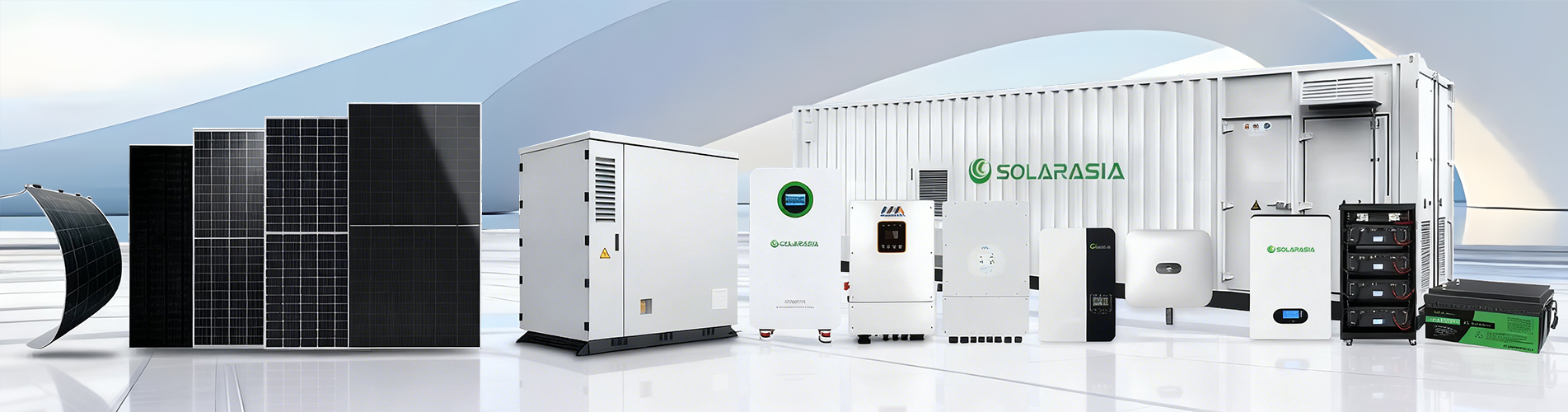
Solarasia banner

commercial battery storage

Home

commercial battery storage

  • Battery Energy Storage System (BESS) Complete Guide: Components, Applications and Benefits Aug 10, 2026
    Introduction     The global transition toward renewable energy has increased the demand for reliable energy storage solutions.   Solar power generation depends on weather conditions and daylight availability, which creates the need for advanced storage technologies that can store excess electricity and provide power when needed.   A Battery Energy Storage System (BESS) solves this challenge by storing renewable energy and managing electricity supply through intelligent control systems.   Today, BESS solutions are widely used in residential, commercial, and industrial solar projects to improve energy efficiency, increase renewable energy utilization, and support energy independence.     Solarasia Power provides complete energy storage solutions including solar batteries, hybrid inverters, ESS, and BESS systems for global customers.   What Is a Battery Energy Storage System (BESS)?   A Battery Energy Storage System (BESS) is an integrated energy storage solution that stores electrical energy using battery technology and releases it when required.   A complete BESS system usually includes: Battery modules Battery management system (BMS) Power conversion system (PCS) Energy management system (EMS) Monitoring platform     Unlike traditional battery storage, BESS combines hardware and intelligent control technologies to manage energy flow efficiently.   How Does a BESS Work? The working process of a BESS system includes four main steps:   1. Energy Charging During periods when solar generation is high, excess electricity is stored in batteries.   2. Energy Management The EMS monitors: Energy production Battery status Electricity demand   and determines the best charging and discharging strategy.   3. Energy Storage The battery system stores electricity for later use.   4. Energy Discharging When electricity demand increases or solar generation decreases, stored energy is released.   Main Components of a BESS System   Battery Module The battery is the core component of BESS.   Modern energy storage systems commonly use lithium battery technology because of:   High energy density Long cycle life High efficiency   Battery Management System (BMS) The BMS protects and manages battery operation.   Its functions include:   Monitoring voltage Temperature control Safety protection Battery balancing   Power Conversion System (PCS)   The PCS converts: DC electricity from batteries into AC electricity used by electrical equipment.It also controls charging and discharging processes.   Energy Management System (EMS) The EMS provides intelligent control of the entire system.   It helps optimize:   Energy usage Peak demand management Renewable energy utilization     Difference Between ESS and BESS Many customers ask about the difference between ESS and BESS.   Term Meaning ESS Energy Storage System BESS Battery Energy Storage System   ESS is a broader concept that includes different storage technologies.   BESS specifically refers to battery based energy storage systems.   Most modern solar energy storage projects use BESS solutions because lithium batteries provide excellent performance and flexibility.   Applications of Battery Energy Storage Systems   Residential Energy Storage   Residential BESS systems allow homeowners to: Store solar electricity Use power at night Reduce grid dependence Provide backup power     Typical system:   Solar Panel ↓ Hybrid Inverter ↓ Battery Storage ↓   Home Loads   Commercial Energy Storage   Commercial buildings use BESS to improve energy management.   Applications include: Office buildings Shopping centers Warehouses Hotels   Benefits:   Reduce electricity costs Improve energy efficiency Manage peak demand   Industrial Energy Storage   Industrial projects require larger energy storage capacity.   Industrial BESS solutions support:   Factory energy management Renewable integration Grid stability Large-scale solar projects     Benefits of BESS for Solar Energy Projects   Increase Solar Self Consumption BESS allows users to store unused solar energy instead of wasting excess generation.   Improve Energy Independence Stored energy can provide electricity when:   Solar production is low Grid power is unavailable   Support Renewable Energy Growth Energy storage makes renewable energy more flexible and reliable.   How BESS Works with Solar Panels and Hybrid Inverters   A complete solar energy storage system usually combines: Solar panels Hybrid inverter Battery storage Energy management system     Energy flow: Solar Panel ↓ Hybrid Inverter ↓ Battery Storage ↓ Electrical Loads     This integrated solution provides efficient renewable energy management.   How to Choose a Reliable BESS Supplier When selecting a BESS supplier, customers should evaluate:   Product Quality Important factors include:   Battery safety System reliability Certification   Technical Capability Professional suppliers should provide:   System design Installation support Technical service   Complete Solution Capability A strong supplier should provide:   Solar panels Inverters Batteries ESS/BESS solutions   Why Choose Solarasia Power?   Solarasia Power provides complete renewable energy solutions including: Solar panels Solar inverter Hybrid inverter Lithium battery ESS BESS     With professional technical teams and global project experience, Solar Asia Power supports customers in Europe, the Middle East, and other international markets.     Conclusion   Battery Energy Storage System (BESS) has become an important technology for the future of renewable energy.   By combining advanced battery technology, intelligent energy management, and renewable power generation, BESS helps residential, commercial, and industrial users achieve more efficient energy utilization.   For companies looking for reliable solar energy storage solutions, choosing an experienced supplier with complete system capabilities is essential.     Solarasia Power provides integrated solar, inverter, battery, ESS, and BESS solutions to support global clean energy projects.   FAQs   What is a Battery Energy Storage System (BESS)? A BESS is a system that stores electrical energy using batteries and releases it when needed.   What is the difference between ESS and BESS? ESS is a general energy storage concept, while BESS specifically uses battery technology.   Can BESS work with solar panels? Yes, BESS can be integrated with solar panels and hybrid inverters.   What industries use BESS? BESS is widely used in residential, commercial, industrial, and utility-scale projects.   Why is BESS important for renewable energy? BESS improves renewable energy utilization by storing excess power and providing electricity when needed.   How to choose a BESS supplier?   Choose suppliers with reliable products, technical capability, and complete solar energy solutions.    
  • Commercial Solar System Design: Components, Sizing and Cost Sep 09, 2026
    Introduction     For businesses looking to reduce electricity costs and improve energy independence, installing a commercial solar system can be a practical long term investment. However, designing a commercial photovoltaic system requires more than simply selecting a certain number of solar panels.   System capacity, electricity consumption, roof or ground space, solar irradiation, inverter configuration, battery storage and local regulations can all affect the final system design and project economics.   A properly designed system should match the customer's actual energy demand while making effective use of available installation space and maintaining reliable operation.   In this guide, we explain the major components of a commercial solar system, how to determine the appropriate system size, what affects project costs and how businesses can approach commercial solar project planning.   1. What Is a Commercial Solar System?   A commercial solar system is a photovoltaic power generation system designed primarily for businesses, factories, warehouses, office buildings, retail facilities and other commercial properties.   Compared with small residential systems, commercial PV projects generally have higher power capacities and more complex electrical configurations.   Depending on the application, a commercial system may include: Solar panels Commercial solar inverters Mounting structures DC and AC cables Combiner boxes and protection devices Monitoring equipment Distribution equipment Battery energy storage systems Grid connection equipment   A typical grid connected system works by converting sunlight into DC electricity through solar panels. The inverter then converts DC electricity into AC electricity that can be used by the building or exported to the grid according to local regulations.   For businesses with significant daytime electricity consumption, solar power can help reduce dependence on grid electricity and improve long term energy cost management.   2. Main Components of a Commercial Solar System     Understanding the role of each component is an important step in commercial solar system design.   2.1 Solar Panels   Solar panels are the primary energy generation component of a PV system.   The total number of panels required depends on the desired system capacity and the power rating of the selected modules.   For example, a 100 kW commercial system using 600 W solar panels would theoretically require approximately: 100,000 W ÷ 600 W ≈ 167 panels   The actual panel quantity may be adjusted according to inverter capacity, system voltage, available installation area and electrical design requirements.   Modern commercial projects often use high efficiency N type modules because they can provide higher power output while making better use of limited roof space.   2.2 Commercial Solar Inverter   The solar inverter is responsible for converting DC electricity generated by the PV modules into usable AC electricity.   For larger projects, inverter selection should consider: Rated AC output Maximum DC input power MPPT voltage range Number of MPPTs Maximum input current Output voltage Grid frequency Communication and monitoring functions Protection functions   A suitable inverter configuration can improve energy harvesting, simplify system installation and provide better monitoring of the PV system.   For large commercial projects, multiple string inverters may be used instead of a single centralized inverter. This can provide greater flexibility when different roof orientations, shading conditions or installation areas are involved.   2.3 Mounting System   The mounting structure secures the solar panels to the roof, ground or other installation surface.   The appropriate mounting solution depends on the project location and installation environment.   Common options include: Rooftop mounting Ground mounting Carport solar structures Flat roof mounting Metal roof mounting   Structural loading, wind speed, snow conditions, roof material and corrosion resistance should all be evaluated before installation.   2.4 Electrical Protection and Distribution Equipment   Commercial PV systems require appropriate electrical protection to improve system safety and reliability.   Depending on the project, equipment may include: DC isolators AC circuit breakers Surge protection devices Combiner boxes Distribution cabinets Grounding systems Monitoring devices   The final configuration should be determined according to the inverter specifications, system voltage and applicable electrical standards.   2.5 Battery Energy Storage   Battery storage is not mandatory for every grid connected commercial PV project.   However, adding a battery energy storage system can provide additional functions such as: Solar energy shifting Peak demand management Backup power Increased self consumption Energy arbitrage Improved energy resilience   For businesses with high electricity prices during peak periods, combining solar generation with battery storage may improve the overall value of the project.   3. How to Size a Commercial Solar System   One of the most important parts of commercial solar system design is determining the appropriate system capacity.   The goal is not necessarily to install the largest possible PV system. Instead, the system should be designed around electricity consumption, available space, local solar conditions and the customer's financial objectives.   Step 1: Analyze Electricity Consumption   Start with the customer's historical electricity bills.   Ideally, collect at least 12 months of electricity consumption data.   Important information includes: Monthly electricity consumption Annual electricity consumption Average daily consumption Daytime electricity demand Peak demand Electricity tariff structure Peak and off peak rates   Daytime electricity consumption is particularly important for commercial PV because solar generation normally occurs during daylight hours.   Step 2: Estimate Solar Energy Production   The estimated annual energy production can be calculated using: Annual PV Production ≈ System Capacity × Peak Sun Hours × 365 × System Efficiency   For example, suppose a 100 kW system receives an average of 4.5 peak sun hours per day and the overall system performance factor is approximately 80%.   The estimated annual production would be: 100 kW × 4.5 × 365 × 80%≈ 131,400 kWh per year   This is only a simplified estimate. Actual production depends on location, module orientation, temperature, shading, inverter efficiency, soiling and system losses.     For a commercial project, professional PV simulation software and local solar irradiation data should be used for more accurate energy yield calculations.   4. How Many Solar Panels Does a Commercial System Need?     Panel quantity depends mainly on the desired system capacity and the wattage of the selected modules.   System Size 550 W Panel 600 W Panel 700 W Panel 50 kW ~91 ~84 ~72 100 kW ~182 ~167 ~143 200 kW ~364 ~334 ~286 500 kW ~910 ~834 ~715   These numbers are theoretical calculations based on module nameplate power. The final design may differ because of DC/AC ratio, string configuration, inverter input limits and local installation requirements.     Higher wattage modules can reduce the number of panels required for the same system capacity. This may be particularly useful when roof space is limited.   5. Choosing the Right Inverter Size   Inverter capacity is another important consideration.   A PV system does not always need a DC module capacity exactly equal to the inverter's AC rating.   Many commercial systems use a DC to AC ratio greater than 1.0. For example, a 100 kW AC inverter may be connected to a PV array with a DC capacity higher than 100 kW, depending on the inverter's maximum recommended DC input power.   This approach can help increase inverter utilization during periods when solar irradiance is lower than peak conditions.   However, the DC/AC ratio should always remain within the inverter manufacturer's specifications.   When selecting a commercial inverter, EPC contractors and system designers should carefully check: Maximum PV input power Maximum DC voltage MPPT voltage range Maximum input current Number of MPPT channels AC output voltage Grid compatibility Communication functions   6. Rooftop Space Requirements   Available installation space can significantly influence the system size.   As a general example, a commercial rooftop PV system may require approximately 5–8 m² of roof area per kW of installed capacity, although the actual requirement varies according to module dimensions, panel efficiency, roof layout, tilt angle, maintenance pathways and fire safety requirements.   For a 100 kW system, this could mean roughly: 100 kW × 5–8 m²/kW = 500–800 m²   The available area should be assessed before finalizing the system capacity.   Other factors to consider include: Roof orientation Roof inclination Shading from nearby buildings HVAC equipment Skylights Water tanks Maintenance access Roof structural capacity     A larger roof does not automatically mean that the maximum possible PV capacity should be installed.   7. What Determines Commercial Solar System Cost?   The commercial solar system cost depends on much more than the price of solar panels.     Major cost components typically include:   Cost Component Main Cost Factors Solar Panels Power rating, efficiency, technology and quantity Inverter Capacity, brand, MPPT configuration and functions Mounting Roof type, structure and installation environment Electrical Equipment Protection, distribution and grid connection Cables Cable length, voltage and installation method Battery Storage Capacity, battery chemistry and power rating Installation Labor, equipment and project complexity Engineering Design, permits and system commissioning Transportation Distance, shipment size and destination   For this reason, it is difficult to give one universal price for a commercial PV system.     Two projects with the same nominal capacity can have significantly different total costs because of differences in roof conditions, electrical infrastructure, labor rates and local permitting requirements.   8. Example: 100 kW Commercial Solar System     A 100 kW PV system is a common reference point for commercial solar projects.   A basic configuration could include: Approximately 100 kW of PV modules One or more commercial string inverters Rooftop mounting structures DC and AC cables DC and AC protection equipment Monitoring system Grounding equipment   If 600 W modules are used, approximately 167 panels would be required based on nameplate capacity.   However, the final system should not be designed simply by dividing 100 kW by the panel wattage.   The engineering team should also verify string voltage, current, MPPT allocation, roof layout and inverter specifications.   For businesses with substantial evening electricity consumption, a battery storage system could also be integrated with the 100 kW PV system.   9. Grid Connected vs Solar + Battery   Commercial customers typically have two major system configurations.   Grid Connected Solar   A grid connected PV system sends solar electricity directly to the building's loads.When solar production is insufficient, the building can draw electricity from the grid.This configuration is generally simpler and can be suitable for businesses with substantial daytime electricity consumption.   Solar + Battery Storage   A solar and battery system adds energy storage to the PV system.   During the day, excess solar electricity can charge the battery. The stored energy can then be used later when solar production decreases.   This configuration can be useful for: Factories operating into the evening Warehouses with extended operating hours Businesses with high peak electricity rates Facilities requiring backup power Commercial sites with limited grid capacity   The choice between the two depends on the customer's load profile, electricity tariff, grid conditions and project investment objectives.   10. How to Improve Commercial Solar Project ROI   A successful commercial solar project should focus on total project economics rather than equipment price alone.   Maximize Solar Self Consumption If most of the generated electricity can be consumed directly by the business, the project may achieve better economic performance than a system that frequently exports excess power.   Select High Efficiency Modules High efficiency modules can help increase installed capacity when roof space is limited.   Optimize Inverter Configuration Proper MPPT and string design can reduce mismatch losses and improve energy harvesting.   Consider Battery Storage Battery storage can help shift solar energy to periods with higher electricity prices, depending on the local tariff structure.   Compare Total Cost of Ownership When comparing suppliers, consider equipment quality, warranty, technical support, installation requirements and expected system performance rather than focusing only on the initial quotation.   11. Commercial Solar System Design Checklist   Before purchasing equipment or starting installation, project developers and EPC contractors should confirm:   Site Information Roof or ground installation Available installation area Roof structural condition Orientation and tilt Shading conditions   Electrical Information Grid voltage Grid frequency Existing transformer capacity Main distribution capacity Electricity consumption profile   PV System Module power and efficiency Inverter capacity DC/AC ratio String configuration MPPT requirements Protection equipment   Energy Storage Required battery capacity Peak load Backup requirements Battery power rating Energy management strategy   Commercial Factors Equipment cost Installation cost Transportation Permits Warranty Payback period Long term operation and maintenance   A complete assessment of these factors can significantly reduce the risk of oversizing, undersizing or unexpected project costs.   12. Frequently Asked Questions   What size solar system does a commercial building need?   There is no universal system size. Capacity should be determined based on annual electricity consumption, daytime load, available installation area, local solar resources and the customer's investment objectives.   Is 100 kW enough for a commercial solar system?   A 100 kW system can be suitable for many small and medium sized commercial facilities, but the appropriate size depends on the site's electricity demand and available roof area.   How much space is needed for a 100 kW solar system?   As a preliminary estimate, approximately 500–800 m² may be required, although the actual area depends on module dimensions, efficiency, roof layout and required maintenance pathways.   Does a commercial solar system need batteries?   No. A grid connected commercial PV system can operate without batteries. Battery storage becomes more attractive when the business needs energy shifting, peak demand management or backup power.   How long does a commercial solar system last?   Solar modules commonly have a useful service life of 25 years or more, while other components such as inverters may have different expected operating lives. Regular inspection and maintenance can help maintain system performance.   How much does a commercial solar system cost?   The final cost depends on system capacity, solar panel selection, inverter configuration, mounting structure, electrical equipment, installation conditions, battery storage and local project requirements. A project specific quotation is therefore more meaningful than a general price per kW.   Conclusion   Designing a commercial PV project requires a balance between energy demand, available space, system performance and investment cost.   The basic process is straightforward: Analyze electricity consumption → evaluate the site → determine PV capacity → select modules and inverters → design electrical protection → evaluate battery storage → calculate project economics.   For businesses, EPC contractors and solar project developers, the best system is not necessarily the largest system or the lowest cost system. It is the system that delivers an appropriate balance between energy production, reliability, investment and long term operating value.     At SolarAsia Power, we provide solar panels, PV inverters, lithium battery storage and complete solar energy solutions for commercial and industrial applications. By combining different equipment configurations, businesses can develop PV systems tailored to their specific energy consumption and project requirements.    
  • How to Choose a Commercial Battery Energy Storage System for Your Business in 2026 Oct 16, 2026
    Introduction   For businesses with high electricity consumption, rising energy costs, peak demand charges, or an increasing reliance on renewable energy, battery storage can be an important part of a modern energy strategy. However, choosing the right system involves more than comparing battery capacity or looking at the lowest equipment price. A system that works well for one factory may be unsuitable for a warehouse, shopping center, office building, or industrial facility with a different electricity consumption pattern.     A well-designed commercial battery energy storage system should match the facility's load profile, operating schedule, backup requirements, and future energy plans. It should also work reliably with the site's electrical infrastructure, solar PV system, and energy management strategy.   For business owners, project developers, EPC contractors, and energy procurement teams, the selection process should start with the actual application rather than a particular battery model. This guide explains the main technical and commercial factors to consider when choosing a battery energy storage system for a commercial or industrial project.   1. Define Your Business Energy Storage Goals   Before comparing equipment, identify what you expect the system to achieve. Different applications require different configurations, and a system optimized for one purpose may not deliver the best results for another.   Peak shaving and demand charge reduction   Some commercial and industrial electricity tariffs include charges based on the highest power demand recorded during a billing period. When a facility experiences short periods of high demand, a battery can discharge to supplement the grid supply and reduce the measured peak, subject to the utility's metering and tariff rules.   For example, a factory may experience high electricity demand when several production machines start simultaneously. A properly controlled battery system can provide additional power during these periods, potentially reducing demand charges.   To evaluate this application, examine historical interval meter data, peak demand events, tariff structures, and the duration of each peak. The battery's discharge power and usable energy must be sufficient to support the target reduction for the required period.   Solar energy self-consumption   Businesses with rooftop or ground-mounted solar installations may generate more electricity during the day than they can immediately use. Battery storage can capture some of this surplus energy and discharge it later when solar production decreases and electricity demand remains high.   This approach can increase on-site solar utilization and reduce grid electricity purchases. The actual benefit depends on the solar generation profile, the site's load curve, battery efficiency, electricity prices, and export compensation rules.   For companies planning a new photovoltaic installation, storage should be considered alongside panel capacity, inverter selection, and electrical system design rather than treated as a completely separate decision.   Backup power and energy resilience   For facilities that cannot tolerate interruptions, battery storage can help maintain power to selected loads during a grid outage, provided the system includes the necessary backup architecture, controls, and isolation equipment.   Not every grid-connected battery system can operate during a power outage. Some installations require dedicated backup outputs, transfer equipment, grid-forming capability, or other compatible components to establish a stable local power supply.   Identify which loads must remain operational, how much power they require, and how long they need to run. Critical loads may include control systems, communications equipment, refrigeration, selected production equipment, or emergency support systems.   Electricity price optimization   Where electricity tariffs vary by time of use, a battery may charge during lower-price periods and discharge during higher-price periods. This strategy can be useful when the price difference is large enough to offset conversion losses, battery degradation, operating expenses, and other project costs.   A financial assessment should use the site's actual tariff and expected operating schedule. Avoid assuming that a battery will automatically produce savings simply because electricity prices differ throughout the day.   2. Calculate the Required Battery Power and Capacity   One of the most important decisions is determining how much power the system must deliver and how much energy it must store. These are related but different specifications. Power, measured in kW, indicates how much electricity the system can deliver or absorb at a given moment. Energy capacity, measured in kWh, indicates how much energy can be stored and delivered over time. Discharge duration describes how long the battery can support a specified load at a given power level.   A battery with a large energy capacity may still be unable to support a facility's highest instantaneous load if its power rating is too low. Conversely, a high-power system may not provide enough operating time if its energy capacity is insufficient.   Estimate the required discharge energy   A useful starting point is to estimate the energy required during the intended discharge period: Required delivered energy (kWh) = Average supported load (kW) × Required duration (hours)   Suppose a business wants to support an average load of 100 kW for two hours.   Required delivered energy = 100 kW × 2 hours = 200 kWh.   This is the energy that must be delivered to the load, not necessarily the battery's nominal capacity. The installed battery capacity may need to be higher to account for the permitted depth of discharge, conversion losses, operating limits, and the desired reserve.   For preliminary sizing, a simplified estimate is: Nominal battery capacity ≈ Required delivered energy ÷ (Usable depth-of-discharge fraction × Discharge-path efficiency)   If the usable depth-of-discharge fraction is 90% and the assumed discharge-path efficiency is 95%, the example would require approximately 234 kWh of nominal capacity before additional design margins. Actual sizing should use the selected equipment's guaranteed usable energy, operating limits, and applicable design requirements.   Check the load profile, not just the monthly electricity bill   Monthly energy consumption alone is not enough to determine the correct battery size. Two facilities may consume the same amount of electricity each month but have very different peak loads and operating schedules.   Review interval data, preferably at 15-minute or finer resolution where available, and identify: Typical daily electricity consumption. Maximum demand and the duration of peak events. Nighttime and weekend loads. Solar generation and surplus energy, if applicable. Critical loads that require backup. Expected operating changes or production expansion.   These details help determine whether the project needs a high-power, short-duration system, a larger energy-storage system, or a configuration that balances both requirements.   For a more detailed calculation, see our related guide on how to calculate battery capacity for a commercial energy storage system.   3. Choose the Right Battery Chemistry   Battery chemistry influences energy density, cycle life, thermal behavior, maintenance requirements, and lifecycle cost. For many stationary commercial and industrial applications, lithium iron phosphate (LiFePO4 or LFP) is a widely used option.   Why consider LiFePO4 batteries?   LFP batteries are commonly selected for stationary storage because they offer a combination of cycle durability, relatively stable thermal characteristics, and suitability for frequent charge and discharge operation.   When evaluating a LiFePO4 energy storage battery, consider more than the chemistry name. Compare the cell specifications, operating temperature range, warranted performance, battery management system, usable energy, and safety measures of the complete system.   Battery life depends on operating conditions, including temperature, charge and discharge rates, depth of discharge, and cumulative energy throughput. A cycle-life figure in a specification sheet should therefore be reviewed alongside the test conditions and the manufacturer's warranty terms.   Compare battery specifications consistently   When reviewing proposals from different suppliers, check whether their quoted capacity refers to nominal energy, usable energy, or energy delivered at the AC output. These values are not necessarily equivalent.   You should also confirm the expected end-of-warranty capacity, cycle-life conditions, permitted operating temperatures, and any restrictions on daily cycling. These details are essential for comparing the long-term value of competing systems.   4. Select the Right System Voltage and Configuration   Commercial storage systems are available in different voltage architectures and physical configurations. The appropriate choice depends on project size, required power, electrical design, inverter compatibility, and installation conditions.   Low-voltage and high-voltage systems   Low-voltage battery systems are often used in smaller installations, modular storage applications, and selected commercial projects. High-voltage systems may be suitable for larger power-conversion architectures, depending on the equipment and project design.   Neither option is universally better. The system voltage must be compatible with the selected power conversion equipment and must meet the project's electrical safety and performance requirements.   For larger commercial and industrial installations, the complete architecture matters more than the battery voltage alone. Engineers should evaluate current levels, cable sizing, conversion efficiency, protection coordination, expansion requirements, and the manufacturer's approved configuration.   Modular and cabinet-based solutions   Modular systems can make it easier to expand storage capacity as energy requirements grow. Integrated cabinet solutions may simplify equipment arrangement by combining selected battery modules, controls, and thermal management components within a coordinated enclosure.   However, an integrated cabinet should not automatically be assumed to include every component needed for a complete installation. Confirm whether the quotation includes the battery system, power conversion system, energy management system, thermal management, fire protection, monitoring, and required electrical accessories.   Also verify whether parallel operation, additional cabinets, and future capacity expansion are supported by the manufacturer's design.   5. Evaluate the PCS, EMS, and System Integration     A commercial battery project is more than a collection of battery modules. Its performance depends on how the batteries interact with power conversion equipment, control software, protection systems, and the facility's electrical infrastructure.   Power conversion system (PCS)   The PCS converts electricity between the battery's DC side and the AC electrical system. Its power rating, efficiency, operating voltage range, overload capability, and grid-interconnection functions should match the application.   For example, a peak-shaving project may require sufficient discharge power to reduce demand during short peaks. A solar self-consumption project may require coordinated charging and discharging based on PV production and site demand.   Confirm whether the PCS supports the required operating modes, including grid-connected operation, charging from the grid where permitted, and backup or islanded operation if required.   Energy management system (EMS)   The EMS coordinates charging and discharging based on operating objectives, electricity prices, solar generation, load demand, and other system inputs.   A useful EMS should provide suitable monitoring, operating schedules, alarms, historical data, and configurable control strategies. For projects involving demand management or time-of-use optimization, check whether the system can use relevant meter data and implement the intended control logic.   Before purchasing, clarify how the EMS communicates with the PCS, battery management system, meters, solar inverters, and any building or industrial control platform. Confirm which communication protocols are supported and whether additional integration work is required.   Compatibility with existing solar and electrical equipment   For a project that combines storage with an existing PV installation, confirm the proposed architecture before choosing the battery.   Depending on the design, storage may be coupled on the DC side or the AC side. The decision affects equipment compatibility, conversion paths, controls, retrofit complexity, and system operation.   Provide the supplier or EPC contractor with the existing inverter model, electrical drawings, grid connection details, and intended operating modes. Do not assume that two devices will be compatible simply because they support the same nominal voltage.   6. Prioritize Safety and Environmental Requirements   Safety should be a core selection criterion rather than an optional extra. A suitable commercial battery installation needs a coordinated approach to battery protection, electrical design, thermal management, installation, and emergency response.   Battery management and protection   The battery management system (BMS) monitors relevant battery parameters and helps manage operation within defined limits. Depending on the system, it may monitor cell voltages, temperatures, current, state of charge, and fault conditions.   Ask suppliers how the BMS communicates with the PCS and EMS, what protective responses are available, and how faults are reported. Review the complete protection architecture rather than relying on a single feature or marketing claim.   Thermal management and fire protection   The thermal management design should be appropriate for the battery chemistry, enclosure, climate, operating conditions, and installation environment. Depending on the system, this may involve air cooling or liquid cooling.   Fire protection and emergency arrangements should be designed in accordance with applicable local codes, permitting requirements, and the equipment manufacturer's instructions. Requirements can vary significantly by jurisdiction and project type.   Before installation, evaluate equipment clearances, access for emergency responders, ventilation where applicable, drainage and weather exposure, separation distances, and the location of electrical isolation devices.   Certifications and documentation   Ask for relevant test reports, product certifications, installation manuals, warranty documentation, and evidence of compliance with applicable standards. Requirements vary by market, so documentation suitable for one country may not be sufficient for another.   For projects in the United States, for example, applicable requirements may involve recognized battery and energy-storage safety standards, fire codes, electrical codes, and local authority approval. The project engineer should confirm which editions and requirements apply to the actual installation.   A supplier's certification claim should be checked against the specific product model, system configuration, and intended market.   7. Compare Total Project Cost Instead of Battery Price Alone   The initial purchase price is only one part of a commercial energy storage investment. A meaningful comparison should account for the complete installed system and its expected operating life.   Potential cost components include: Battery modules or integrated storage cabinets. PCS, EMS, meters, and communication equipment. Cooling, fire protection, and electrical protection systems. Cabling, foundations, installation, and commissioning. Grid interconnection, permitting, and engineering. Transportation, insurance, and applicable import charges. Software services, scheduled maintenance, and replacement components.   Different quotations may use different system boundaries. One supplier may quote battery equipment only, while another may include power conversion equipment and installation. Comparing these prices without checking the scope can lead to misleading conclusions.   Assess lifecycle value   A lower initial price does not always mean a lower cost over the system's operating life. Consider expected usable energy, efficiency, warranty coverage, degradation, maintenance, and the cost of any required replacements.   The financial model should reflect the project's intended operating strategy. For peak shaving, use actual demand charges and peak-load data. For solar self-consumption, consider the value of additional solar energy used on-site. For time-of-use optimization, account for price differences, energy losses, and battery degradation.   A simplified payback estimate is: Simple payback period = Initial project investment ÷ Annual net savings   Annual net savings should account for relevant operating expenses and should be based on realistic assumptions. This simple formula does not capture financing costs, taxes, degradation over time, or the time value of money, so larger projects may require a more detailed financial model.   For a deeper breakdown, see our related article on how much a commercial battery energy storage system costs in 2026.   8. Check Installation Conditions and Future Expansion   The installation environment can affect both system performance and long-term maintenance. Before selecting equipment, confirm where the system will be installed and what constraints the site presents.   For an outdoor installation, evaluate ambient temperature, humidity, dust, rain exposure, corrosion risk, flooding, and access for maintenance. For an indoor installation, consider floor loading, room layout, ventilation requirements, access routes, and applicable fire and electrical regulations.   The enclosure's ingress protection rating should be suitable for the actual installation environment, but an IP rating alone does not establish suitability for every outdoor condition.   Future expansion is another important consideration. If the facility expects higher electricity demand, additional production lines, or a larger solar installation, discuss expansion plans at the design stage.   Confirm the maximum supported system capacity, the compatibility of future battery modules, the PCS expansion method, available electrical capacity, and whether adding equipment would require changes to protection systems or control software.   A modular design can provide flexibility, but future expansion should be supported by the manufacturer's documented design rather than assumed to be possible.   9. Evaluate the Supplier and After-Sales Support   The reliability of a battery project depends not only on the equipment but also on the supplier's engineering capabilities, documentation, and support arrangements.   When evaluating suppliers, consider the following questions: Can the supplier provide technical specifications, installation documentation, and relevant certification records? Does the supplier understand the project's application and load profile? Can the proposed battery, PCS, EMS, and protection equipment work together as a complete system? Are warranty terms, performance guarantees, and exclusions clearly documented? Is remote monitoring available, and how are system faults handled? Are spare parts, technical assistance, and maintenance support available in the target market? Can the supplier support the required customization, communication protocols, and project documentation?   For EPC contractors, distributors, and project developers, consistency of supply and clear technical communication can be just as important as the equipment price. A supplier that can provide coordinated equipment specifications and practical engineering support may help reduce integration risks during project delivery.   Before placing an order, request a proposal based on the project's actual requirements rather than a generic product catalogue. This makes it easier to compare suppliers on a like-for-like basis.   10. A Practical Checklist Before Choosing a Commercial BESS   Use the following checklist when preparing a project specification or comparing quotations.   Evaluation item What to confirm Application Peak shaving, solar self-consumption, backup power, time-of-use optimization, or a combination Load profile Peak demand, average load, operating schedule, and critical loads Power rating Required charging and discharging power in kW Energy capacity Nominal and usable energy in kWh Discharge duration Required support time at the intended load Battery chemistry Cell chemistry, operating limits, and documented cycle-life conditions System architecture Low voltage or high voltage, AC or DC coupling, and expansion method PCS Rated power, efficiency, operating modes, and grid compatibility EMS and BMS Monitoring, control strategy, communication, and fault reporting Safety Protection design, thermal management, fire safety, and applicable certifications Site conditions Temperature, weather exposure, space, access, and local installation requirements Financial performance Installed cost, operating expenses, expected savings, and warranty Supplier support Technical documentation, commissioning, warranty service, and spare parts   A project that has clear answers to these questions is easier to design, quote, install, and evaluate financially.     Conclusion   Choosing the right commercial battery energy storage system starts with understanding how a business uses electricity and what it expects the battery to achieve. Power rating, usable energy capacity, battery chemistry, system architecture, PCS and EMS compatibility, safety, installation conditions, and lifecycle cost all influence the final decision.   For some businesses, a smaller system designed for peak shaving may be the most practical option. Others may benefit from a larger configuration that stores surplus solar generation or supports selected critical loads. The best solution is the one that matches the site's actual requirements and can operate reliably within its technical, regulatory, and financial constraints.   At SolarAsia Power, we provide lithium battery and energy storage solutions for residential and commercial applications, with customized options based on project requirements. If you are planning a commercial or industrial battery storage project, prepare your load profile, required power, target backup duration, installation location, and preferred operating strategy before requesting a proposal. These details help establish a more accurate starting point for system sizing and equipment selection.   Contact Solarasia Power to discuss your commercial battery energy storage requirements and explore a suitable solution for your project.    
foot logo

Address : Room 908-909, Building 2, No. 469 Huatuo Lane, Shushan District, Hefei City, Anhui Province

Tel : +86 17730022793

Email : [email protected]

Subscribe

Please read on, stay posted, subscribe, and we welcome you to tell us what you think.

submit

Copyright 2026 @ Anhui Solarasia Energy Technology Co.,Ltd .All Rights Reserved. Sitemap | Blog | XML | Privacy Policy Network Supported

Click To Leave A Message

leave a message
If you are interested in our products and want to know more details,please leave a message here,we will reply you as soon as we can.
submit

Home

Products

whatsApp

contact