

What Is a BESS Energy Management System (EMS)? Functions, Benefits and Applications
As commercial and industrial facilities increasingly adopt battery energy storage systems (BESS), managing how electricity is generated, stored, and consumed has become just as important as selecting the battery itself.
A battery energy storage system does more than store electricity. It needs to determine when to charge, when to discharge, how much power to deliver, and how to respond to changes in electricity demand. This is where a BESS Energy Management System (EMS) plays an important role.
For factories, warehouses, commercial buildings, and renewable energy projects, an EMS helps coordinate battery storage with solar PV generation, grid electricity, and facility loads. A properly configured system can support peak shaving, load shifting, solar self-consumption, and other energy management strategies.
But what exactly is a BESS EMS? How does it work, and how is it different from a Battery Management System (BMS) or Power Conversion System (PCS)?
This guide explains the key functions, architecture, applications, and selection considerations of a commercial and industrial BESS energy management system.
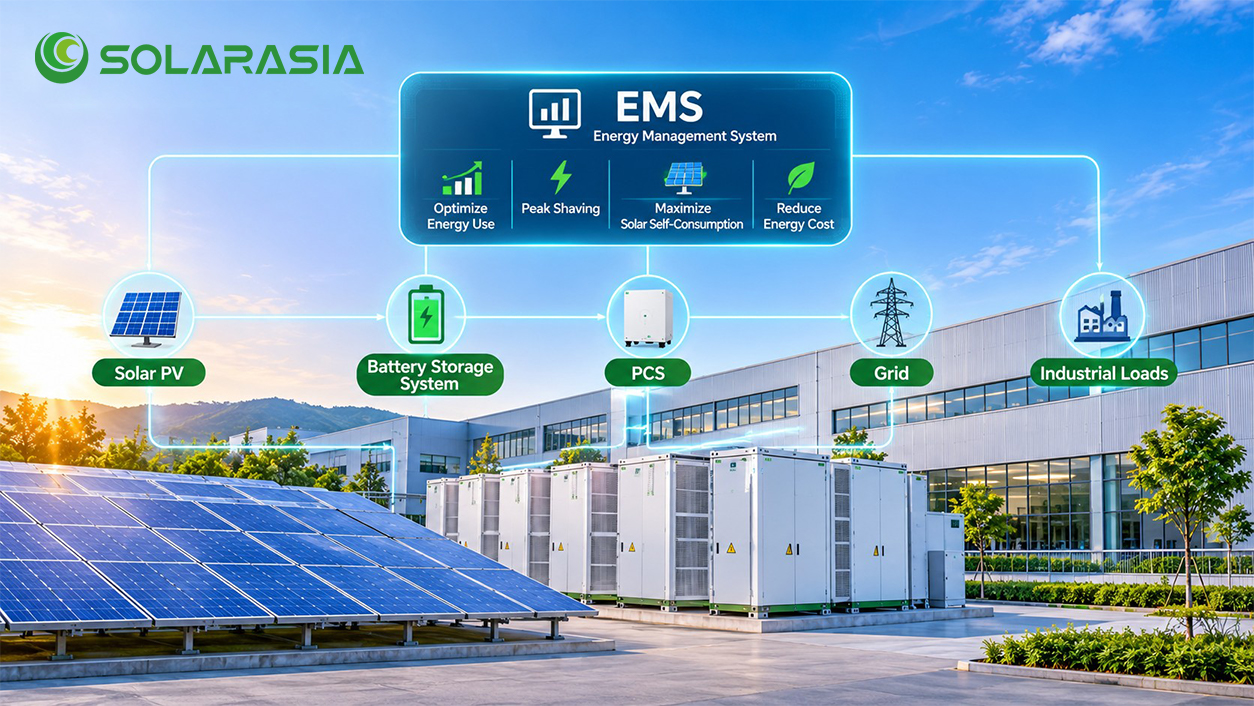
A BESS Energy Management System (EMS) is a control and monitoring platform that coordinates the operation of a battery energy storage system and its connected energy assets.
It collects operating information from different equipment, evaluates energy demand and system conditions, and sends control commands according to predefined strategies and operating limits.
In a commercial or industrial energy storage project, an EMS may coordinate:
Battery energy storage systems
Power Conversion Systems (PCS)
Battery Management Systems (BMS)
Solar PV inverters
Electricity meters
Grid connection equipment
Building or industrial loads
Backup power equipment, where applicable
The main purpose of an EMS is to manage energy flows according to the project's operational objectives.
For example, a factory may use an EMS to charge its battery when electricity prices are lower and discharge stored energy during peak tariff periods. Another facility may prioritize storing excess solar generation for use later in the day.
The exact functions depend on the EMS software, compatible equipment, project configuration, and local electricity market rules.
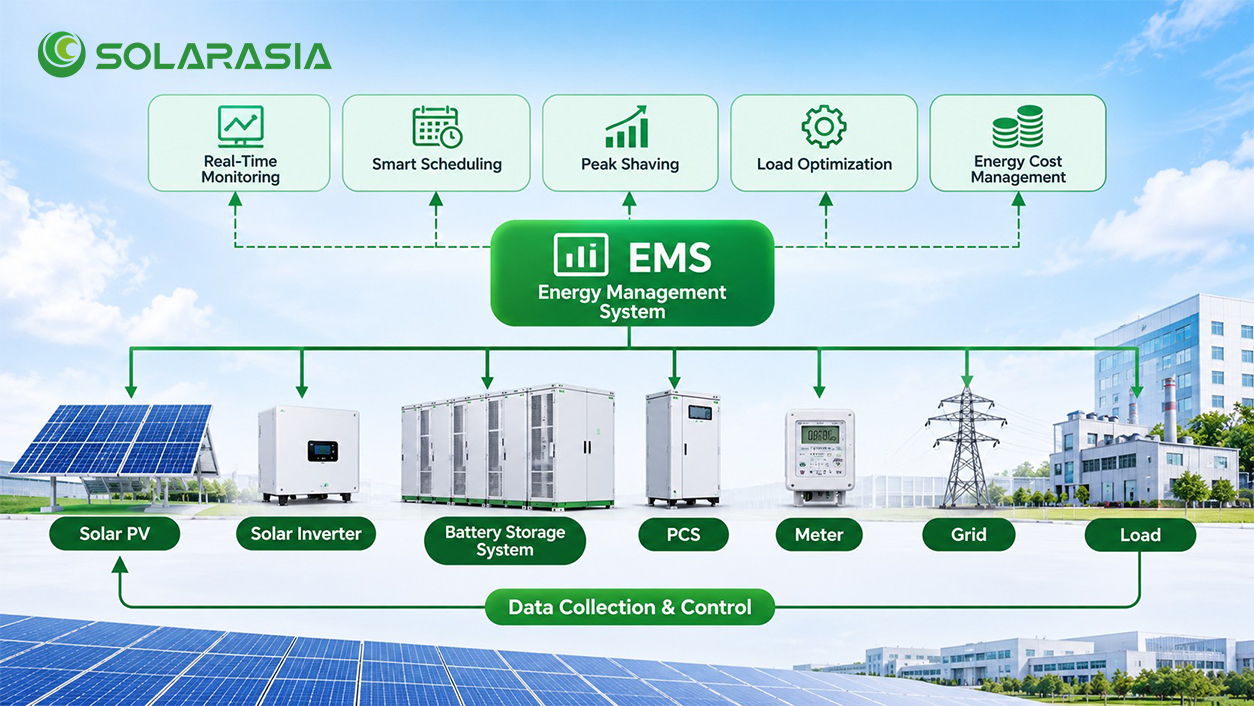
A BESS EMS generally follows a process involving data collection, operating strategy evaluation, control commands, and performance monitoring.
The EMS receives information from connected equipment, such as:
Battery State of Charge (SOC)
Battery State of Health (SOH), when available
Battery voltage and current
Battery temperature and operating status
PCS charging and discharging power
Grid import and export power
Solar PV generation
Facility electricity demand
Electricity tariff information
The availability and update frequency of these measurements depend on the connected devices and communication configuration.
The EMS evaluates the collected information against the project's operating requirements.
For example, it may identify:
Whether the facility is approaching its peak demand limit
Whether excess solar power is available
Whether electricity prices are entering a high-tariff period
Whether the battery has sufficient available energy
Whether equipment operating limits restrict charging or discharging
Some systems use fixed schedules and threshold-based logic. More advanced platforms may incorporate load forecasting, solar forecasting, or optimization algorithms.
Based on the selected strategy, the EMS sends operating commands to compatible equipment.
These may include:
Charging power commands
Discharging power commands
Active and reactive power setpoints
Operating schedules
Import or export limits
Power control instructions for compatible inverters
The PCS executes the applicable power conversion commands, while the BMS independently monitors battery conditions and enforces battery protection limits.
The EMS should not override battery safety protections or equipment operating limits.
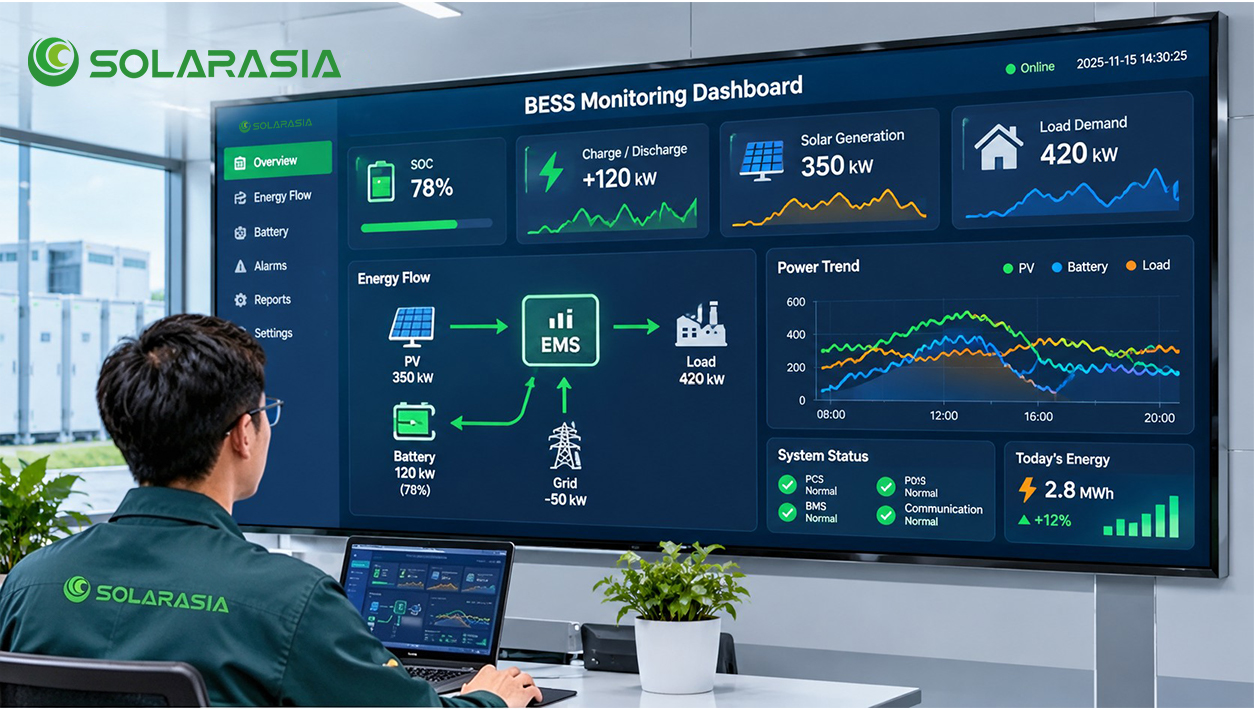
After issuing control commands, the EMS continues monitoring the system.
Operators can review:
Real-time charging and discharging power
Battery SOC
Grid import and export
Solar generation
Energy consumption
Historical operating records
Equipment alarms and operating status
Energy management performance
This information helps facility operators understand how the BESS is operating and whether its control strategy needs adjustment.
The functions of an EMS vary by manufacturer and project. However, several capabilities are particularly important for commercial and industrial battery storage applications.
Peak shaving is one of the most common applications of commercial BESS.
Industrial facilities may experience short periods of high electricity demand due to equipment startup, production cycles, or simultaneous operation of large electrical loads.
An EMS can monitor facility demand and instruct the battery system to discharge when demand approaches a predefined threshold.
For example, if a facility has a target grid demand limit of 300 kW and its demand rises toward that level, the EMS may command the battery PCS to supply part of the load.
The actual reduction depends on available battery power, stored energy, control response, and the facility's load profile.
Related Articles:Commercial Battery Energy Storage For Peak Shaving: How To Reduce Demand Charges
In regions with time-of-use electricity tariffs, electricity prices may vary throughout the day.
An EMS can manage battery charging and discharging according to tariff schedules.
A typical strategy may involve:
Charging the battery during lower-price periods.
Maintaining sufficient SOC before high-price periods.
Discharging the battery during selected high-price periods.
Monitoring energy consumption and battery operating limits.
This strategy may reduce electricity purchasing costs when tariff differences and system operating conditions make it economically beneficial.
Actual savings depend on electricity prices, round-trip efficiency, battery degradation, operating costs, and applicable utility rules.
For facilities with rooftop solar PV systems, an EMS can coordinate solar generation and battery charging.
When solar production exceeds the facility's immediate consumption, available surplus energy can be directed to the battery if the system configuration and operating limits allow it.
Stored energy can then be used when solar generation decreases or facility demand increases.
This can help businesses make better use of locally generated solar electricity.
An EMS can establish operating schedules based on electricity tariffs, facility demand, solar generation, and battery availability.
For example, a facility may configure:
Nighttime grid charging
Midday solar charging
Afternoon peak shaving
Evening battery discharge
Minimum SOC reserves
The best schedule depends on the site's electricity consumption pattern and project objectives.
Some commercial BESS projects use EMS control to maintain grid import within a specified limit.
When the facility's demand approaches the configured threshold, the EMS can request battery discharge to reduce grid power consumption.
Import and export control may also be required for sites with restricted grid export permissions.
These functions require compatible metering, control equipment, communication, and appropriate electrical design.
A remote monitoring platform allows authorized operators to review system performance without being physically present at the installation site.
Depending on the platform, monitoring functions may include:
Real-time system status
Battery SOC and operating information
Charging and discharging records
Historical energy data
Alarm notifications
Performance reports
Remote configuration and control
Remote access should be protected by appropriate authentication, access permissions, and cybersecurity measures.
EMS, BMS, and PCS are three important components of a battery energy storage system. They perform different functions and work together to support reliable system operation.
| Component | Full Name | Main Function |
|---|---|---|
| EMS | Energy Management System | Coordinates energy management strategies and system-level operation |
| BMS | Battery Management System | Monitors battery conditions and manages battery protection and operating limits |
| PCS | Power Conversion System | Converts electrical power between AC and DC and controls charging and discharging power |
The EMS focuses on system-level energy management.
It decides how the BESS should operate according to project objectives, energy demand, electricity tariffs, and available system information.
For example, the EMS may request battery discharge during a peak demand period.
The BMS focuses on battery-level monitoring and protection.
Its functions may include:
Cell and module voltage monitoring
Battery temperature monitoring
Current monitoring
SOC estimation
SOH estimation, depending on the system
Cell balancing
Protection against abnormal operating conditions
The BMS communicates battery operating information and allowable limits to other control systems.
The PCS manages electrical power conversion between the battery's DC side and the AC electrical system.
Its functions may include:
Battery charging
Battery discharging
DC-to-AC conversion
AC-to-DC conversion
Active power control
Reactive power control, where supported
The PCS receives power commands from the applicable control system and operates within its electrical and protection limits.
A simplified operating sequence is:
The EMS evaluates electricity demand and determines the required operating strategy.
The EMS sends a charging or discharging request to the PCS.
The BMS provides battery status and allowable operating limits.
The PCS executes the power command within the permitted operating range.
The EMS monitors the resulting system performance.
A reliable BESS requires proper communication and coordination among these components. Their specific control hierarchy varies by system architecture and manufacturer.
Selecting the right battery capacity and PCS power rating is important, but these specifications alone do not determine how effectively a battery storage system operates.
The EMS helps connect the system's hardware capabilities with the facility's energy management objectives.
An EMS coordinates battery operation with facility demand, solar generation, and electricity supply.
This helps the system respond to changing operating conditions instead of relying only on a fixed charging schedule.
For facilities with demand-based electricity charges, EMS-controlled battery discharge may help reduce short periods of high grid demand.
The achievable result depends on the battery's power rating, usable energy, control response, and load profile.
An EMS can coordinate battery charging with surplus PV generation, helping businesses use more of their available solar electricity when the system is properly configured.
A configurable EMS can support different strategies, such as peak shaving, time-of-use optimization, solar self-consumption, and backup reserve management.
The system's ability to combine these strategies depends on available battery capacity, equipment capabilities, and operating priorities.
Centralized monitoring helps operators review equipment status, identify alarms, and analyze historical energy data.
This can support maintenance planning and operational decision-making.
Not every BESS project requires the same level of energy management functionality.
A basic EMS may be sufficient for a relatively simple installation with fixed charging and discharging schedules. More complex industrial projects may require advanced monitoring, forecasting, optimization, and integration capabilities.
| Function | Basic EMS | Advanced EMS |
|---|---|---|
| System monitoring | Basic operating information | Detailed real-time and historical monitoring |
| Charging and discharging | Fixed schedules | Dynamic or optimized scheduling |
| Peak shaving | Basic threshold control | Load forecasting and demand optimization, if supported |
| Solar coordination | Basic PV and battery coordination | More advanced solar and load coordination |
| Tariff management | Scheduled operation | Tariff-aware optimization |
| Data analysis | Basic reports | Detailed performance analysis |
| Remote access | Depends on platform | May include advanced remote operation |
| Integration | Limited compatible devices | Broader integration, subject to interfaces |
The term "advanced EMS" is not a universal technical certification. Buyers should evaluate actual functions, control performance, supported protocols, and integration capabilities rather than relying only on product descriptions.
Choosing an EMS requires more than comparing software interfaces. It is important to confirm that the platform can work with the project's battery, PCS, meters, solar inverters, and operating requirements.
Start by identifying what the BESS needs to achieve.
Is the main purpose:
Peak shaving?
Time-of-use energy optimization?
Solar self-consumption?
Grid import limitation?
Backup reserve management?
A combination of several applications?
The EMS should support the actual operating strategy required by the facility.
Confirm that the EMS can communicate with the selected battery and PCS.
Important information includes:
Supported communication protocols
Communication interface
Data point mapping
Control command compatibility
Alarm and status feedback
Firmware and software compatibility
Common industrial communication technologies may include Modbus TCP, Modbus RTU, and other manufacturer-supported interfaces. Protocol support alone does not guarantee full compatibility; the actual register map and control implementation must also be verified.
An EMS needs reliable measurement data to make appropriate operating decisions.
For commercial projects, check whether the system can obtain the necessary information from:
Grid-side meters
Load-side meters
Solar generation meters
PCS measurements
Battery monitoring systems
The location of meters and the accuracy and update frequency of measurements can affect control performance.
For projects with multiple battery cabinets or remote installations, centralized monitoring can be useful.
Ask the supplier whether the EMS supports:
Web-based monitoring
Mobile access, if available
Alarm notifications
Historical data storage
User permission management
Remote troubleshooting
Data export
Also clarify where data is stored, who can access it, and how remote connections are secured.
An EMS may communicate with equipment through local networks, remote servers, or cloud platforms.
Before deployment, review:
User authentication
Role-based access
Secure communication
Network segmentation
Software update procedures
Remote access permissions
Data backup and recovery
Cybersecurity requirements should be considered during system design, not added only after installation.
If a business plans to add more battery cabinets, PV capacity, or energy management functions in the future, confirm whether the EMS can support the planned expansion.
Check the supported device count, communication capacity, licensing arrangements, and integration requirements.
To help a supplier recommend a suitable EMS and battery storage configuration, prepare the following project information:
| Information | Details |
|---|---|
| Project type | Factory, warehouse, commercial building, industrial facility |
| Existing solar PV | Installed capacity and inverter model, if available |
| Battery capacity | Required kWh or MWh |
| PCS power | Required kW or MW |
| Electricity tariff | Time-of-use or demand-based tariff details |
| Load profile | Daily or interval-based electricity consumption |
| Main application | Peak shaving, load shifting, solar self-consumption, backup |
| Grid information | Voltage, frequency, import and export requirements |
| Equipment | Existing BMS, PCS, inverter, and meter models |
| Monitoring needs | Local monitoring, remote monitoring, or centralized management |
| Project location | Country and installation conditions |
Providing a load profile and electricity tariff information can help the supplier evaluate whether the proposed EMS strategy is suitable for the project.
EMS stands for Energy Management System. It is a control and monitoring platform that coordinates battery storage operation with connected energy equipment, including PCS, BMS, solar inverters, meters, and facility loads.
EMS manages energy at the system level, including charging schedules, discharging strategies, and coordination with facility loads. BMS monitors battery conditions and manages battery protection and operating limits. Both are important but perform different functions.
A commercial BESS needs an appropriate control strategy. The level and form of EMS functionality depend on the system architecture and application. More complex projects involving peak shaving, solar coordination, and time-of-use optimization generally require more sophisticated energy management capabilities.
An EMS can help implement strategies such as peak shaving and time-of-use energy management. These strategies may reduce electricity costs when the tariff structure and operating conditions are suitable. Actual savings depend on demand patterns, electricity prices, battery efficiency, degradation, and operating costs.
Yes, an appropriately configured EMS can coordinate compatible solar inverters and battery PCS through supported communication interfaces and control functions. Compatibility should be confirmed using the equipment models, protocols, register maps, and system design.
Yes. An EMS can monitor facility demand and request battery discharge when demand approaches a configured threshold. The achievable peak reduction depends on the available battery power, usable energy, load profile, and control response.
EMS contributes to system-level monitoring and control, but it should not replace the BMS or dedicated battery protection equipment. The BMS and other protection systems are responsible for enforcing relevant battery operating limits and safety functions.
Many commercial BESS platforms support remote monitoring through web-based or other connected interfaces. Available functions depend on the supplier's platform, network configuration, user permissions, and communication infrastructure.
A commercial battery energy storage system is not simply a collection of batteries and power conversion equipment. It also needs an effective control strategy to coordinate energy generation, storage, and consumption.
A properly configured BESS Energy Management System helps manage charging and discharging, coordinate solar PV and battery operation, support peak shaving, and provide useful system monitoring.
When selecting a commercial BESS, buyers should evaluate the EMS alongside battery capacity, PCS power, BMS functions, communication compatibility, and project requirements.
At SOLARASIA, we support commercial and industrial energy storage projects with battery storage products and customized BESS solutions. Our team can help evaluate project requirements and discuss suitable system configurations for different applications.
Planning a commercial or industrial battery storage project? Contact SOLARASIA to discuss your BESS requirements and request a customized energy storage solution.


Address : Room 908-909, Building 2, No. 469 Huatuo Lane, Shushan District, Hefei City, Anhui Province


Please read on, stay posted, subscribe, and we welcome you to tell us what you think.
Copyright 2026 @ Anhui Solarasia Energy Technology Co.,Ltd .All Rights Reserved. Sitemap | Blog | XML | Privacy Policy
 Network Supported