
AC-Coupled vs DC-Coupled BESS: Which Is Better for Commercial and Industrial Projects?
Choosing the right battery energy storage system (BESS) architecture is an important decision for commercial and industrial (C&I) energy projects. Two common configurations are AC-coupled and DC-coupled battery energy storage systems. Both can integrate battery storage with solar PV generation and the electrical grid, but they differ in how energy flows between solar panels, inverters, batteries, and loads.
For businesses planning a new solar-plus-storage installation or adding batteries to an existing solar power system, understanding the differences between AC-coupled and DC-coupled BESS can help improve system design, operational flexibility, and long-term project economics.
So, which configuration is better for a commercial or industrial project?
The answer depends on the existing electrical infrastructure, project objectives, equipment compatibility, energy conversion requirements, and future expansion plans. This guide explains how both architectures work and how to choose the right configuration for your application.
An AC-coupled battery energy storage system connects the battery storage equipment to the AC side of the electrical system. Solar PV panels generate DC electricity, which is converted into AC electricity by a solar inverter. The battery system connects to the same AC bus through a bidirectional power conversion system (PCS).
In this configuration, the solar PV system and battery storage system generally have separate power conversion equipment.
A typical AC-coupled solar and battery storage system operates as follows:
Solar panels generate DC electricity.
The solar inverter converts DC electricity into AC electricity.
AC power supplies the facility's electrical loads.
Surplus AC electricity can be converted back into DC through the battery PCS to charge the battery.
When solar generation is insufficient or electricity demand increases, the battery discharges through the PCS and supplies AC power to the facility.
The system can also charge batteries from the grid when supported by the equipment configuration and operating strategy.
Solar PV modules
Grid-connected solar inverter
Battery energy storage system
Bidirectional power conversion system (PCS)
Energy management system (EMS)
Protection and distribution equipment
Monitoring and communication devices
One important feature of AC coupling is that the solar PV inverter and battery PCS can operate as separate systems while coordinating through an energy management platform.
This makes AC-coupled BESS a practical option for projects that already have an operating solar PV installation.
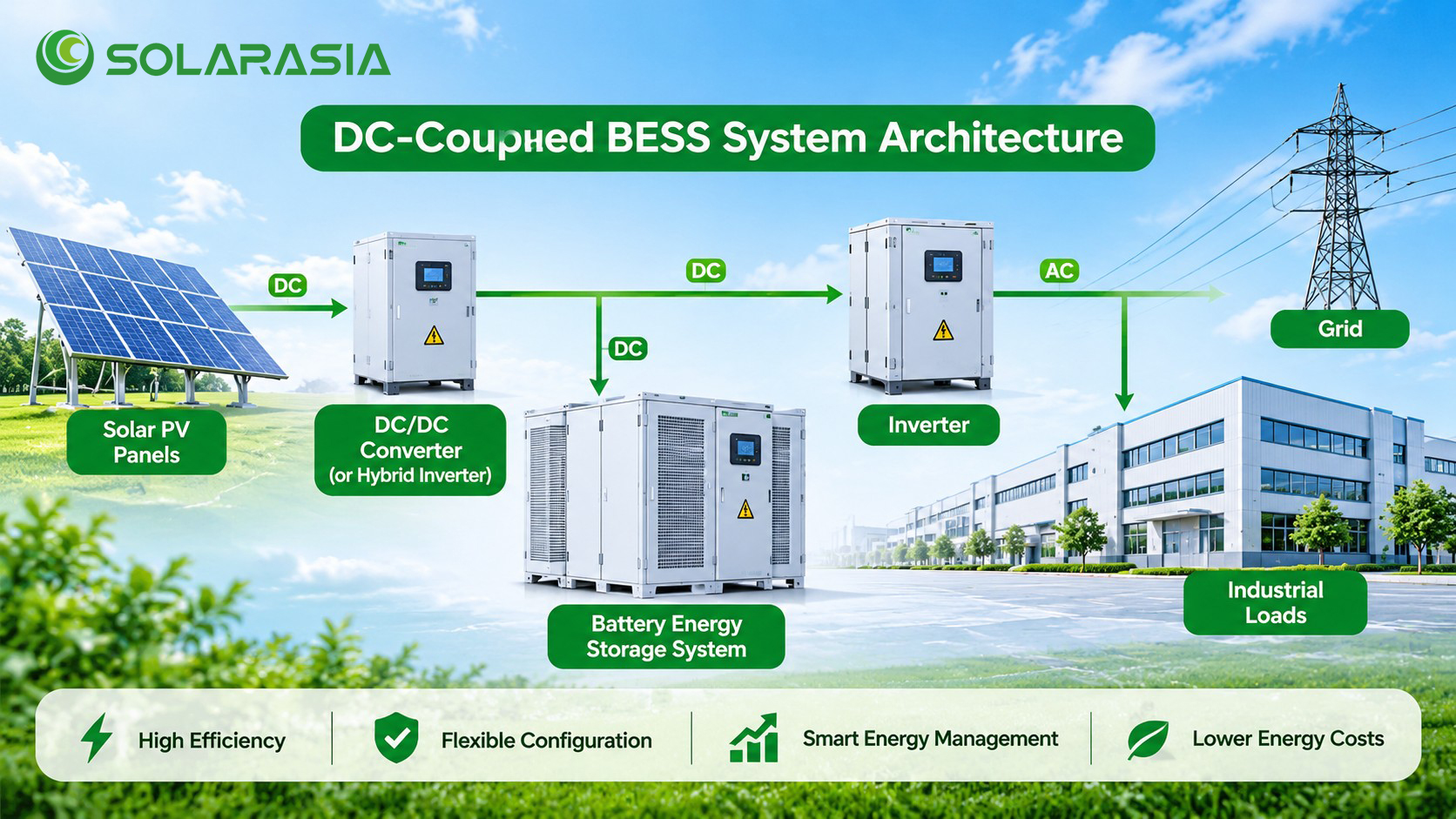
A DC-coupled battery energy storage system connects solar PV generation and battery storage on the DC side of the power conversion architecture.
Instead of converting solar electricity into AC before charging the battery, the system can transfer DC power from the PV array to the battery through compatible DC/DC conversion equipment or a hybrid inverter.
The battery and solar PV system share parts of the DC-side electrical architecture, depending on the system design.
A typical DC-coupled system operates as follows:
Solar panels generate DC electricity.
A DC/DC converter or compatible hybrid inverter manages the PV power.
Solar DC electricity can charge the battery through the DC-side power conversion path.
When the facility needs electricity, stored battery DC power is converted into AC through the inverter.
The inverter supplies the facility's AC loads or exports electricity to the grid when permitted.
Grid charging may also be possible, depending on the hybrid inverter and system configuration.
Solar PV modules
DC/DC converter or compatible hybrid inverter
Battery energy storage system
Battery management system (BMS)
Energy management system (EMS)
AC output and grid interface
Protection and monitoring equipment
A major characteristic of DC coupling is that solar power can charge the battery without first passing through a separate PV inverter to become AC electricity.
However, the actual conversion path and system efficiency depend on the inverter topology, operating conditions, and equipment specifications.
Both configurations can provide energy storage, peak shaving, load shifting, solar self-consumption, and other energy management functions. Their main differences relate to system architecture, equipment integration, installation, and energy conversion.
| Comparison | AC-Coupled BESS | DC-Coupled BESS |
|---|---|---|
| Connection point | AC side of the electrical system | DC side of the electrical system |
| Solar inverter | Generally separate from battery PCS | Often integrated into a hybrid inverter architecture |
| Battery charging from PV | Through AC-to-DC conversion | Can use a DC-side charging path |
| Equipment architecture | More independent PV and battery equipment | More integrated PV and battery architecture |
| Existing PV retrofit | Often easier to integrate | May require more system redesign |
| New solar-plus-storage project | Suitable | Suitable |
| System expansion | Can offer flexibility with compatible equipment | Depends on shared inverter and DC-side capacity |
| Energy conversion | May involve additional conversion steps | Can reduce conversion steps in certain operating modes |
| Design considerations | AC bus coordination and inverter compatibility | DC voltage, current, battery compatibility and inverter limits |
There is no universal winner. A suitable configuration should be selected based on the project's actual electrical design and operating requirements.
AC-coupled BESS is widely considered for commercial and industrial projects, particularly when battery storage is being added to an existing solar installation.
One of the biggest advantages of AC coupling is its suitability for solar PV retrofit projects.
If a factory, warehouse, or commercial building already has a grid-connected solar inverter, a compatible battery energy storage system can often be connected to the existing AC distribution system without replacing the entire PV inverter architecture.
This can help reduce disruption to an operating solar installation.
AC-coupled systems generally use separate solar inverters and battery PCS equipment.
This separation can provide flexibility when selecting equipment and planning system upgrades. The solar generation system and battery storage system can also be designed around their respective power requirements.
However, compatibility, communication, protection coordination, and control integration still need to be checked.
For some projects, AC coupling makes it easier to add battery storage capacity without redesigning the entire solar PV DC system.
The actual expansion capability depends on the available AC bus capacity, PCS ratings, protection devices, grid connection limits, and EMS configuration.
An AC-coupled BESS can support several common C&I applications:
Peak shaving and demand charge management
Time-of-use energy arbitrage
Solar self-consumption improvement
Backup power, when the system is designed for backup operation
Load management and energy optimization
These functions depend on the system's control strategy, utility rules, and equipment capabilities.
DC-coupled BESS is particularly relevant to new solar-plus-storage projects where PV generation and battery storage can be designed together from the beginning.
A DC-coupled architecture can allow solar electricity to charge the battery through a DC-side conversion path.
This avoids converting PV electricity into AC and then back into DC solely for battery charging.
Under suitable operating conditions, reducing conversion stages can improve the energy conversion path. However, actual system efficiency must be evaluated using the complete equipment specifications and operating profile.
DC-coupled systems can combine solar PV management, battery charging, and AC output functions through a compatible hybrid inverter or integrated power conversion architecture.
This can simplify certain aspects of system design and equipment coordination.
The trade-off is that the selected inverter and battery must meet the project's voltage, current, power, and communication requirements.
For a new commercial solar-plus-storage project, designing PV and battery equipment together can help optimize the DC-side architecture.
This is particularly useful when the project has a clear solar generation profile, battery charging strategy, and required AC output capacity.
When solar PV electricity is used to charge a battery through a DC-side path, the system may avoid some of the conversion steps found in an AC-coupled charging route.
Nevertheless, system efficiency is not determined by coupling type alone. Inverter efficiency, DC/DC conversion losses, battery charging efficiency, auxiliary consumption, and operating conditions all matter.
Efficiency is one of the most important considerations when selecting a commercial battery energy storage system.
It is tempting to assume that DC-coupled systems are always more efficient because solar electricity can charge the battery directly on the DC side. However, this is not necessarily true in every application.
The actual result depends on the complete energy conversion path.
A simplified solar-to-battery charging path is:
Solar PV (DC) → Solar Inverter (DC to AC) → Battery PCS (AC to DC) → Battery
When the battery discharges:
Battery (DC) → PCS (DC to AC) → AC Loads
A simplified solar-to-battery charging path is:
Solar PV (DC) → DC/DC Converter or Hybrid Inverter DC Path → Battery
When the battery discharges:
Battery (DC) → Inverter (DC to AC) → AC Loads
The DC-coupled path may reduce conversion stages during PV-to-battery charging. However, the final efficiency comparison should consider all conversion equipment and operating conditions.
When comparing AC-coupled and DC-coupled systems, evaluate:
Inverter conversion efficiency.
DC/DC converter efficiency, where applicable.
Battery charge and discharge efficiency.
Auxiliary power consumption, including cooling and control equipment.
Partial-load operating efficiency.
Energy losses under different charging and discharging conditions.
System standby consumption and operating strategy.
For a meaningful comparison, request a system-level efficiency analysis based on the same operating conditions, measurement boundaries, and project assumptions.
Do not compare an inverter's peak efficiency with the overall round-trip efficiency of an entire battery storage system. They measure different things.
The right configuration depends on whether the project is a new installation, a solar retrofit, or an integrated energy storage project.
Recommended starting point: AC-Coupled BESS
For a factory or commercial building that already has an operating solar PV system, AC coupling is often a practical option.
The battery system can potentially connect to the existing AC distribution architecture while allowing the original solar inverter to remain in operation.
Before selecting this configuration, engineers should evaluate:
Existing solar inverter specifications
AC distribution capacity
Grid connection limitations
Battery PCS power rating
Protection and communication compatibility
Required operating modes
Recommended starting point: Compare both configurations
For a new commercial or industrial solar-plus-storage project, both AC-coupled and DC-coupled configurations may be suitable.
The decision should consider:
PV installed capacity
Required battery energy capacity
Battery charging and discharging power
Daily energy consumption
Solar generation profile
Site electrical architecture
Future expansion plans
A complete technical design is more important than choosing a configuration based on a single efficiency claim.
Recommended starting point: AC-Coupled BESS is often practical
For industrial facilities that primarily need peak shaving, demand charge management, and load shifting, an AC-coupled BESS can be a suitable architecture.
The battery PCS connects to the facility's AC system and can be controlled according to load demand and electricity tariff periods.
However, a DC-coupled system can also support these applications when appropriately designed.
The most important factors are PCS power, battery energy capacity, control response, metering, and the facility's load profile.
Both AC-coupled and DC-coupled systems can be designed to support backup power, but backup capability is not automatically provided by either architecture.
The project must include the required grid-forming or backup-capable inverter functions, transfer equipment, protection coordination, and suitable control logic.
Engineers should also determine which loads need backup, the required backup duration, and whether the system must operate independently from the grid.
Before purchasing a commercial battery energy storage system, project owners and EPC contractors should evaluate the following factors.
If the facility already has an operating solar PV system, identify the inverter model, AC voltage, rated output, and available electrical connection capacity.
These details help determine whether an AC-coupled retrofit is practical.
For new projects, the PV and battery architecture can be evaluated together.
Battery energy capacity and power rating are two different specifications.
Battery capacity (kWh or MWh) determines how much energy the system can store.
Power rating (kW or MW) determines how quickly the system can charge or discharge.
For example, a commercial BESS rated at 100 kW / 215 kWh has a nominal power rating of 100 kW and a nominal energy capacity of 215 kWh.
The actual usable energy and operating duration depend on the battery configuration, permitted depth of discharge, operating limits, conversion losses, and system design.
Consider the primary purpose of the battery system:
Peak shaving
Load shifting
Solar self-consumption
Time-of-use optimization
Backup power
Grid services, where permitted
The EMS should support the required operating strategy and communicate properly with the PV inverter, PCS, BMS, meters, and other relevant equipment.
Compatibility is critical for reliable BESS operation.
Check the following:
Battery voltage range
PCS DC input voltage range
Battery BMS communication protocol
Inverter and EMS communication
AC voltage and frequency
Protection and isolation requirements
Environmental and installation conditions
A technically compatible system should be confirmed by the equipment manufacturers or qualified system integrators.
Consider the available installation space, ventilation, access for maintenance, cable routes, fire safety requirements, and local electrical regulations.
If the project may expand in the future, confirm whether additional battery cabinets or PCS units can be integrated without exceeding electrical and control system limits.
To receive a more accurate commercial battery energy storage system proposal, buyers should prepare the following project information:
| Project Information | Details to Provide |
|---|---|
| Project type | Factory, warehouse, commercial building, industrial facility |
| Existing solar PV system | Yes or No |
| Solar PV capacity | kW or MW |
| Battery energy capacity | kWh or MWh |
| Required power rating | kW or MW |
| Grid connection | Voltage and frequency |
| Main application | Peak shaving, backup, solar self-consumption, load shifting |
| Operating strategy | Daily charging and discharging requirements |
| Installation location | Country and project site conditions |
| Preferred architecture | AC-coupled, DC-coupled, or open to recommendation |
If the project already has a solar PV installation, providing the existing inverter model and electrical system information can help engineers evaluate the integration options.
A qualified BESS supplier should review these details before recommending a complete system configuration.
Related Articles:Commercial Energy Storage Vs. Industrial Solar: Which Solution Maximizes Your ROI In 2026?
The main difference is the connection point. AC-coupled battery storage connects to the AC side of the electrical system through a bidirectional PCS, while DC-coupled storage connects to the DC side of the solar and battery architecture through compatible DC/DC conversion or hybrid inverter equipment.
AC-coupled BESS is often a practical option for existing solar PV systems because the battery storage equipment can potentially be added to the AC distribution system without replacing the original solar inverter. Actual feasibility depends on electrical capacity, compatibility, and protection requirements.
Not in every situation. DC coupling can reduce conversion stages in certain PV-to-battery charging modes, but overall system efficiency depends on inverter performance, converter losses, battery efficiency, auxiliary consumption, and operating conditions.
Yes. An AC-coupled battery energy storage system can operate without solar panels if it is designed to charge from the grid or another compatible AC power source. The permitted charging strategy depends on equipment capabilities and local grid regulations.
Yes. DC-coupled systems can be used in commercial and industrial solar-plus-storage projects. The design must account for PV capacity, battery voltage, inverter power, energy management, and the facility's electrical requirements.
Both can be designed for backup applications. However, backup power requires appropriate inverter functionality, grid isolation or transfer equipment, protection coordination, and a suitable control strategy. Grid-connected battery storage does not automatically provide backup power during an outage.
It depends on the equipment architecture. AC-coupled systems may allow battery storage to be expanded independently of the existing PV inverter, while DC-coupled systems may be constrained by shared inverter and DC-side limits. The available expansion capacity must be verified during system design.
Look for a supplier that can evaluate your load profile, PV infrastructure, battery capacity, PCS rating, EMS requirements, installation conditions, and local standards. Ask for detailed technical specifications, system architecture diagrams, compatibility information, warranty terms, and after-sales support.
AC-coupled and DC-coupled battery energy storage systems both offer valuable solutions for commercial and industrial energy management.
AC-coupled BESS is often a practical starting point for retrofitting existing solar PV systems and integrating independent battery storage equipment. DC-coupled BESS can be attractive for new solar-plus-storage projects where PV and battery systems are designed together.
Neither architecture is universally better. The right choice depends on the project's electrical infrastructure, energy requirements, equipment compatibility, efficiency targets, and future expansion plans.
At SOLARASIA, we support commercial and industrial energy storage projects with battery storage products and customized BESS solutions. Whether you are planning a new solar-plus-storage installation or upgrading an existing energy system, our team can help evaluate the technical requirements and suitable system configuration.
Contact SOLARASIA to discuss your commercial battery energy storage project and request a customized BESS solution.


Address : Room 908-909, Building 2, No. 469 Huatuo Lane, Shushan District, Hefei City, Anhui Province


Please read on, stay posted, subscribe, and we welcome you to tell us what you think.
Copyright 2026 @ Anhui Solarasia Energy Technology Co.,Ltd .All Rights Reserved. Sitemap | Blog | XML | Privacy Policy
 Network Supported