
Commercial Battery Energy Storage System Safety: Fire Protection, Risk Prevention and Safety Requirements
Commercial and industrial battery energy storage systems (BESS) are becoming increasingly important for businesses looking to reduce electricity costs, improve energy efficiency, integrate renewable energy, and maintain a more reliable power supply.
However, as battery energy storage installations become larger and more widely deployed, system safety has become a major consideration for project developers, EPC contractors, facility owners, and energy storage buyers.
A commercial BESS is more than a collection of lithium batteries. It is an integrated electrical system involving battery modules, battery management systems (BMS), power conversion systems (PCS), thermal management equipment, fire detection, and protection devices.
Understanding how these components work together is essential for selecting a safe and reliable commercial battery energy storage solution.
In this guide, we will explain common BESS safety risks, fire protection technologies, thermal runaway prevention, BMS monitoring, and important safety requirements for commercial and industrial energy storage projects.
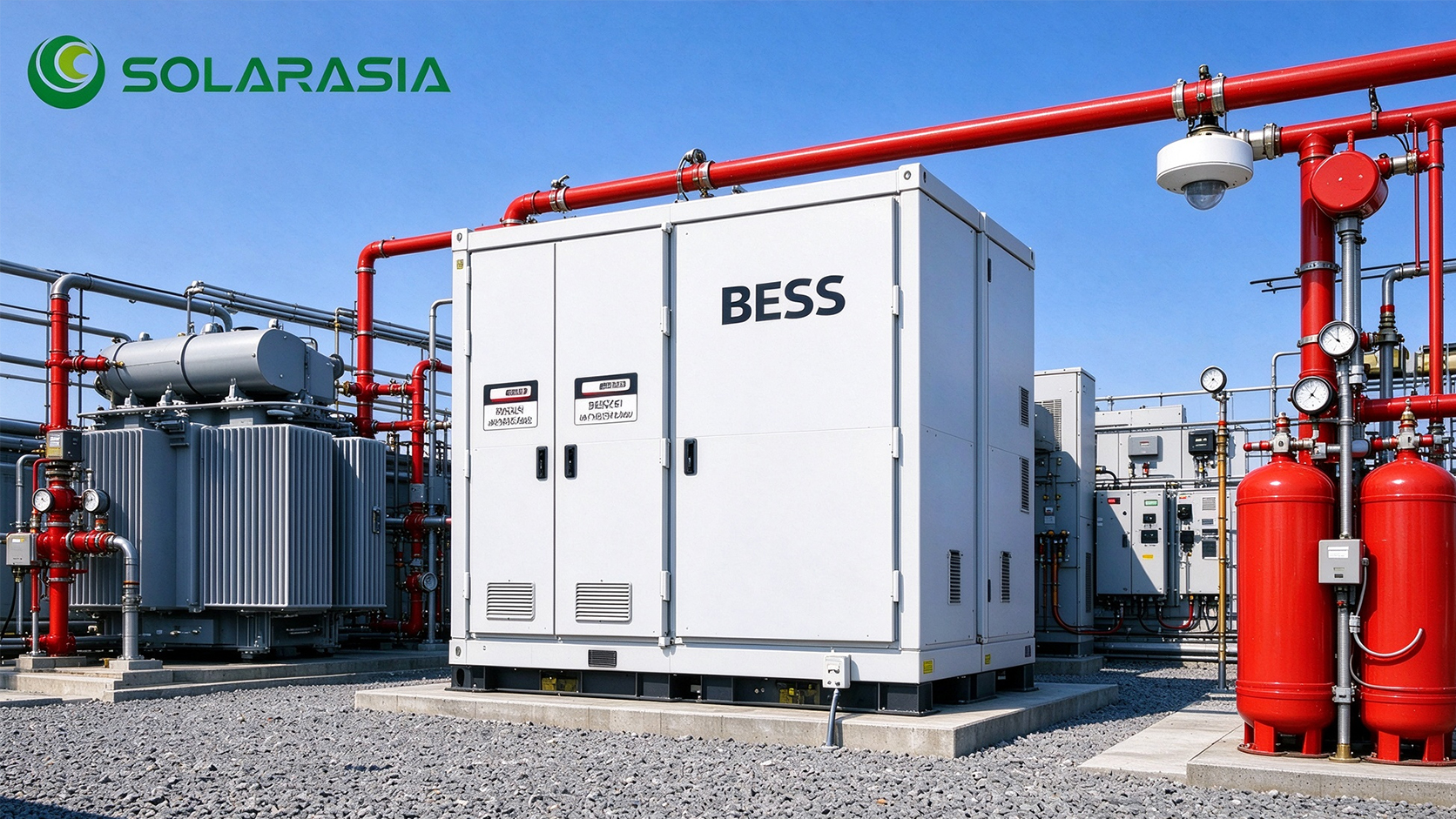
A commercial battery energy storage system operates with high electrical power and a substantial amount of stored energy. Its safety depends on battery quality, system design, electrical protection, environmental conditions, installation, and ongoing maintenance.
The main safety risks include the following.
Thermal runaway is one of the most important safety concerns in lithium battery energy storage systems.
It is a self-accelerating process in which an internal battery failure generates excessive heat. Under certain conditions, the reaction may release flammable gases and cause fire or propagation to neighboring cells.
Potential contributing factors include:
Internal short circuits
Mechanical damage to battery cells
Electrical abuse or abnormal operating conditions
Excessive temperatures
Manufacturing defects
Improper charging or discharging
Thermal runaway cannot be eliminated simply by choosing one battery chemistry. Risk reduction requires multiple layers of prevention, detection, isolation, and mitigation.
Electrical faults may occur in battery modules, cables, connectors, busbars, PCS equipment, or distribution systems.
Examples include:
Short circuits
Overcurrent
Overvoltage and undervoltage
Insulation failure
Loose electrical connections
Improper grounding
Suitable circuit protection, electrical isolation, grounding, cable selection, and professional installation are essential for reducing these risks.
Battery performance and safety are affected by operating temperature.
Excessive heat can accelerate battery aging, reduce performance, and increase safety risks. Poor ventilation, cooling system failure, high ambient temperatures, and improper equipment spacing may contribute to overheating.
Commercial BESS installations therefore require suitable thermal management according to battery specifications and local environmental conditions.
External conditions can also affect system safety.
Important considerations include:
Water ingress and flooding
Dust and contamination
Corrosive environments
Mechanical impact
Improper equipment foundations
Inadequate ventilation
Insufficient access for maintenance and emergency response
A professional site assessment should be completed before installing a commercial energy storage system.
Lithium iron phosphate (LiFePO4 or LFP) batteries are widely used in commercial and industrial energy storage applications.
One reason is their favorable thermal stability compared with several other common lithium-ion battery chemistries.
1. Good Thermal Stability
LiFePO4 chemistry generally offers better thermal stability than some other lithium-ion chemistries. This is an important advantage for stationary energy storage applications.
2. Long Cycle Life
LFP batteries can support frequent charging and discharging over many years when operated within the manufacturer's specified conditions.
3. Suitable for Stationary Energy Storage
LFP battery systems are widely adopted in commercial energy storage cabinets and containerized BESS projects.
4. High Energy Storage Efficiency
Modern LFP battery systems can provide efficient energy storage and discharge, supporting applications such as peak shaving, load shifting, and solar self-consumption.
No.
Although LiFePO4 batteries offer favorable thermal stability, they are still lithium-ion batteries and can experience thermal runaway under certain abnormal conditions.
A safe BESS project should never rely on battery chemistry alone. Battery quality, BMS protection, thermal management, electrical design, fire detection, and system-level safety engineering all matter.
A commercial battery energy storage fire protection system is designed to detect abnormal conditions, provide appropriate alarms, and activate protective or suppression measures according to the system design.
A comprehensive safety strategy generally includes several layers.
Early detection is important because abnormal battery conditions may develop before visible flames appear.
Depending on the design, monitoring and detection devices may include:
Smoke detectors
Heat detectors
Temperature sensors
Gas detection devices
Battery fault monitoring
Fire alarm control equipment
These devices can provide early warnings when abnormal conditions are detected.
Some commercial BESS installations use automatic fire suppression systems designed for battery enclosure applications.
Depending on project requirements, technologies may include:
Clean agent fire suppression systems
Aerosol fire suppression systems
Water-based suppression or cooling systems
Other engineered fire protection solutions
The appropriate solution depends on the battery chemistry, enclosure design, applicable fire codes, hazard assessment, and project requirements.
It is important to understand that extinguishing visible flames and controlling battery thermal runaway are not necessarily the same thing.
A suppression system should be part of a broader fire protection strategy. The design may also need to address heat removal, gas management, re-ignition risks, and emergency response.
When abnormal operating conditions are detected, the BESS control and protection architecture may initiate alarms, isolate affected equipment, or execute an emergency shutdown.
Typical protective functions may include:
Battery contactor control
DC circuit isolation
PCS shutdown
AC breaker operation
Emergency stop functions
Communication with the fire protection system
The exact sequence should be engineered and validated for the specific installation.
Battery faults may release gases that can create additional fire or explosion hazards.
Depending on the system design and applicable regulations, BESS installations may require dedicated ventilation, gas detection, pressure relief, or explosion mitigation measures.
These measures should be designed by qualified professionals rather than added as generic equipment without a project-specific risk assessment.
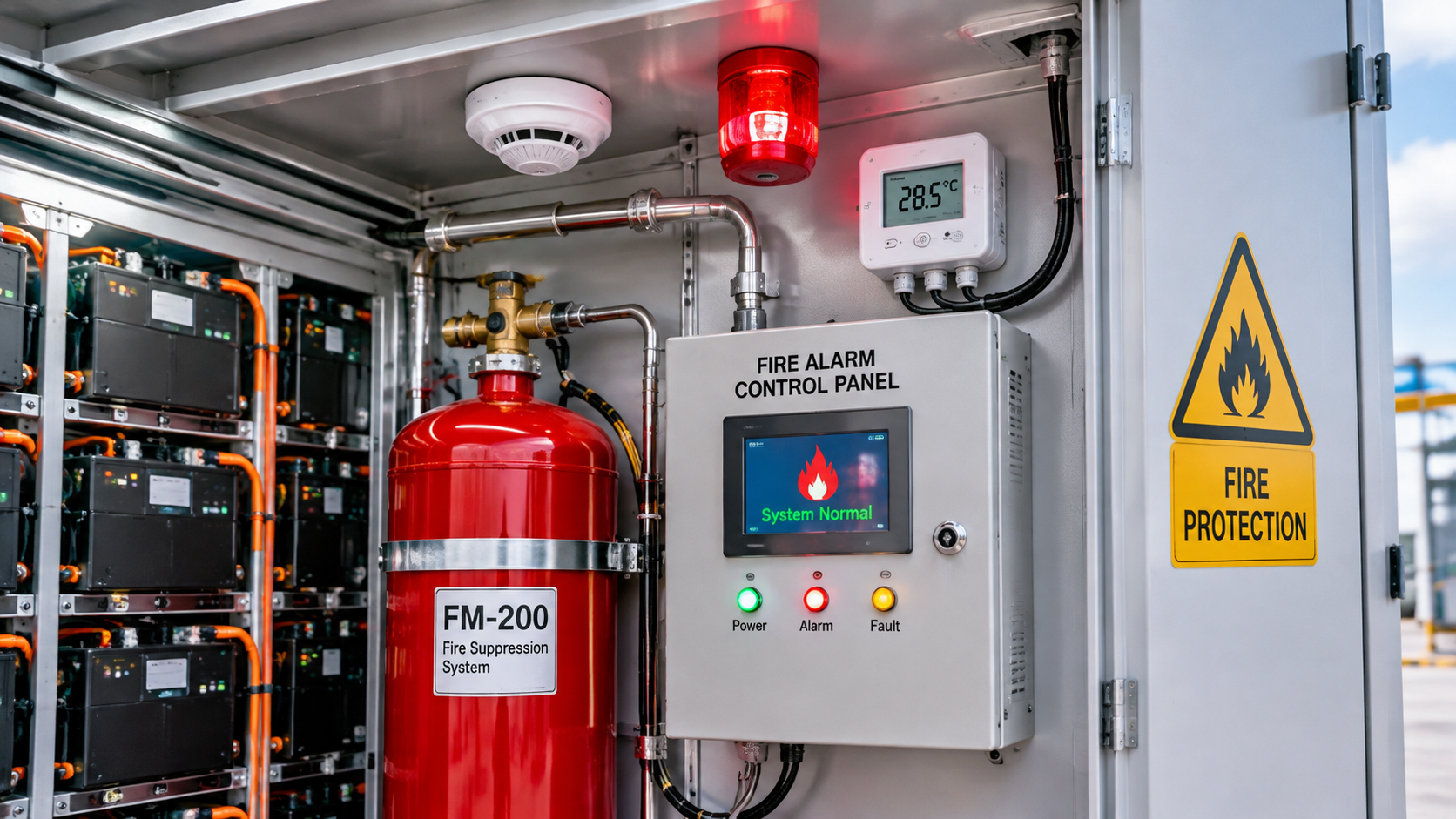
The Battery Management System (BMS) is one of the most important components in a lithium battery energy storage system.
It continuously monitors battery operating conditions and helps keep the battery within its specified operating limits.
Voltage Monitoring
The BMS monitors individual cell or module voltage to identify abnormal conditions such as overvoltage and undervoltage.
Temperature Monitoring
Temperature sensors monitor battery operating temperatures and help identify abnormal heating.
Current Monitoring
The BMS measures charging and discharging current to help prevent excessive current conditions.
Overcharge and Overdischarge Protection
The BMS can restrict or interrupt battery operation when voltage or other operating parameters exceed specified limits.
Cell Balancing
Cell balancing helps maintain more consistent voltage levels among battery cells and supports battery performance.
Fault Detection and Communication
The BMS communicates operating status and fault information to the PCS or EMS, depending on the system architecture.
Commercial BESS projects often contain many battery modules connected in series and parallel configurations.
Without appropriate monitoring and protection, abnormal conditions in individual cells or modules may remain undetected.
A properly designed BMS provides important battery-level monitoring and protection. However, it does not replace independent fire detection, electrical protection, thermal management, or emergency response measures.
Temperature management is another essential part of commercial battery energy storage safety.
Battery systems should operate within the temperature limits specified by their manufacturers.
Depending on the system size, battery configuration, and operating environment, thermal management may use:
Air cooling uses fans and ventilation to circulate air through the battery enclosure.
It can be suitable for certain battery systems with appropriate thermal design and environmental conditions.
Liquid cooling circulates coolant through dedicated cooling components to manage battery temperature.
It is commonly used in larger commercial and industrial energy storage systems where precise temperature control is important.
Temperature sensors and control systems monitor operating conditions and coordinate cooling equipment.
If abnormal temperatures are detected, the system may issue warnings, reduce operating power, or initiate protective actions according to its control logic.
When evaluating a commercial BESS, buyers should consider:
Operating temperature range
Cooling technology
Temperature monitoring points
Cooling system redundancy, where required
Environmental protection rating
Maintenance requirements
Alarm and fault response logic
The thermal management design should match the project's ambient temperature, installation environment, battery capacity, and operating profile.
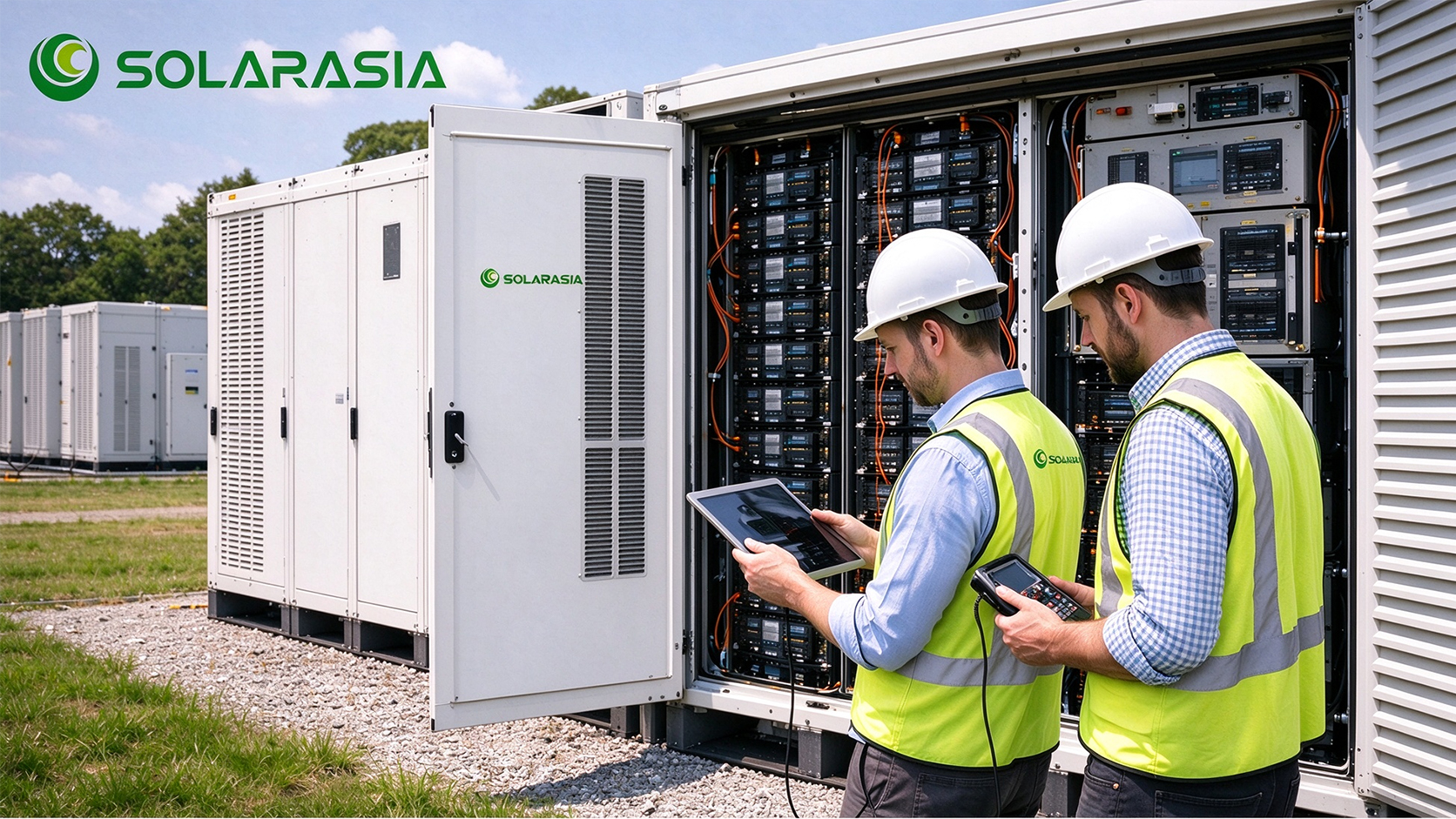
Safety standards and certifications help buyers evaluate the design, testing, and compliance of commercial battery energy storage systems.
However, requirements vary by country, project type, installation environment, and local authority.
Some commonly referenced standards and testing frameworks include:
| Standard or Framework | Main Focus |
|---|---|
| IEC 62619 | Safety requirements for industrial secondary lithium cells and batteries |
| IEC 62933-5-2 | Safety requirements for grid-integrated electrochemical energy storage systems |
| UL 9540 | Safety standard for energy storage systems and equipment |
| UL 9540A | Test method for evaluating thermal runaway fire propagation in battery energy storage systems |
| NFPA 855 | Installation of stationary energy storage systems |
| Local Electrical and Fire Codes | Installation, electrical protection, fire safety, and emergency requirements |
Before purchasing a commercial battery energy storage system, buyers should check:
Whether the battery cells and battery system have the relevant test reports and certifications.
Whether the complete energy storage system has been evaluated against applicable system-level requirements.
Whether the proposed installation meets local electrical and fire regulations.
Whether fire protection and emergency response arrangements are suitable for the project.
Whether the supplier can provide technical documentation and installation guidance.
A battery cell certificate does not automatically certify the complete BESS installation.
Similarly, a test report for one system configuration should not be assumed to cover every variation in battery capacity, enclosure design, or system integration.
Always verify the exact product model, configuration, certificate scope, and applicable market requirements.
Selecting a qualified supplier is an important step in reducing project risks.
When comparing commercial battery energy storage suppliers, do not focus only on battery capacity and equipment pricing.
Consider the following factors.
Ask about battery cell chemistry, manufacturer, specifications, quality control, and traceability.
A reliable supplier should be able to provide relevant technical documentation.
Check whether the system includes appropriate battery monitoring, voltage protection, temperature monitoring, current protection, and communication functions.
Ask the supplier to explain the fire detection and suppression configuration, including its design basis and applicable testing or compliance documentation.
Confirm whether the system uses air cooling or liquid cooling and whether the selected configuration is suitable for the local climate and project conditions.
Ask about factory testing, functional testing, protection verification, and commissioning procedures.
A commercial BESS is a long-term energy asset.
The supplier should be able to support system configuration, installation guidance, troubleshooting, spare parts, and after-sales communication.
Confirm that the proposed equipment and installation design can meet the applicable standards and regulatory requirements in the destination market.
A qualified BESS supplier should help buyers understand the system configuration and technical documentation needed for their projects.
At SOLARASIA, we provide commercial and industrial battery energy storage solutions for businesses, EPC contractors, distributors, and project developers.
Our product and solution portfolio covers different energy storage requirements, including commercial battery cabinets, lithium battery systems, and customized BESS configurations.
We focus on several important aspects of commercial energy storage projects:
Customized Energy Storage Solutions
We support system configuration according to project power requirements, energy capacity, application scenarios, and installation conditions.
Battery and System Integration
Battery selection, PCS compatibility, BMS communication, and system configuration are important considerations when developing a commercial energy storage solution.
Quality and Technical Documentation
We work with qualified manufacturing partners and provide relevant product specifications and technical documentation for project evaluation.
Technical and Project Support
Our team supports customers with product selection, technical communication, and project-specific configuration requirements.
Long-Term Customer Service
We aim to provide responsive support throughout the purchasing process and subsequent project communication.
Whether you are planning a commercial battery storage installation, a solar-plus-storage project, or an industrial BESS solution, SOLARASIA can help you evaluate a suitable configuration.
Contact our team to discuss your project requirements and request a customized commercial battery energy storage solution.
Commercial BESS installations can be designed to operate safely when appropriate battery technology, electrical protection, thermal management, fire detection, installation practices, and maintenance procedures are implemented. Safety depends on the complete system design and operation.
LiFePO4 batteries generally offer better thermal stability than several other common lithium-ion chemistries. However, they are not completely immune to thermal runaway or fire. Proper battery management and system-level safety measures remain essential.
A BESS fire protection system is a combination of detection, alarm, control, and suppression measures designed to identify and respond to fire-related hazards in battery energy storage installations. Its configuration depends on the battery system and applicable safety requirements.
A BMS helps reduce battery risks by monitoring voltage, current, temperature, and other operating conditions. It can trigger protective actions when abnormal conditions are detected. However, a BMS alone cannot guarantee that a battery fire will never occur.
Thermal runaway can result from internal short circuits, mechanical damage, electrical abuse, excessive temperatures, manufacturing defects, or other abnormal conditions. Once initiated, the process may generate heat and flammable gases.
Fire protection requirements depend on the project design, system size, installation location, battery technology, and local regulations. Buyers should work with qualified system designers and local authorities to determine the appropriate fire protection configuration.
Relevant standards may include IEC 62619, IEC 62933-5-2, UL 9540, and other applicable national or regional requirements. Buyers should verify the exact certification scope and whether it applies to the battery, complete energy storage system, or installation.
Inspection frequency depends on manufacturer recommendations, operating conditions, local regulations, and project maintenance requirements. Regular monitoring, preventive maintenance, and professional inspections should be included in the system's operation plan.
Safety is one of the most important considerations when selecting a commercial battery energy storage system.
From LiFePO4 battery technology and BMS monitoring to thermal management, electrical protection, and fire suppression, every component contributes to the overall safety of a BESS installation.
However, no single battery chemistry, monitoring device, or fire suppression system can guarantee complete protection. A reliable commercial BESS requires a coordinated, multi-layer safety design supported by proper installation, commissioning, and maintenance.
For businesses planning a commercial or industrial energy storage project, choosing a qualified supplier and verifying the complete system configuration are essential steps.
Looking for a commercial battery energy storage solution? Contact SOLARASIA to discuss your project requirements and get a customized BESS configuration.


Address : Room 908-909, Building 2, No. 469 Huatuo Lane, Shushan District, Hefei City, Anhui Province


Please read on, stay posted, subscribe, and we welcome you to tell us what you think.
Copyright 2026 @ Anhui Solarasia Energy Technology Co.,Ltd .All Rights Reserved. Sitemap | Blog | XML | Privacy Policy
 Network Supported