
What Is the Best Hybrid Solar Inverter for European Homes?
For many European homeowners, installing solar panels is no longer only about generating electricity during the day.
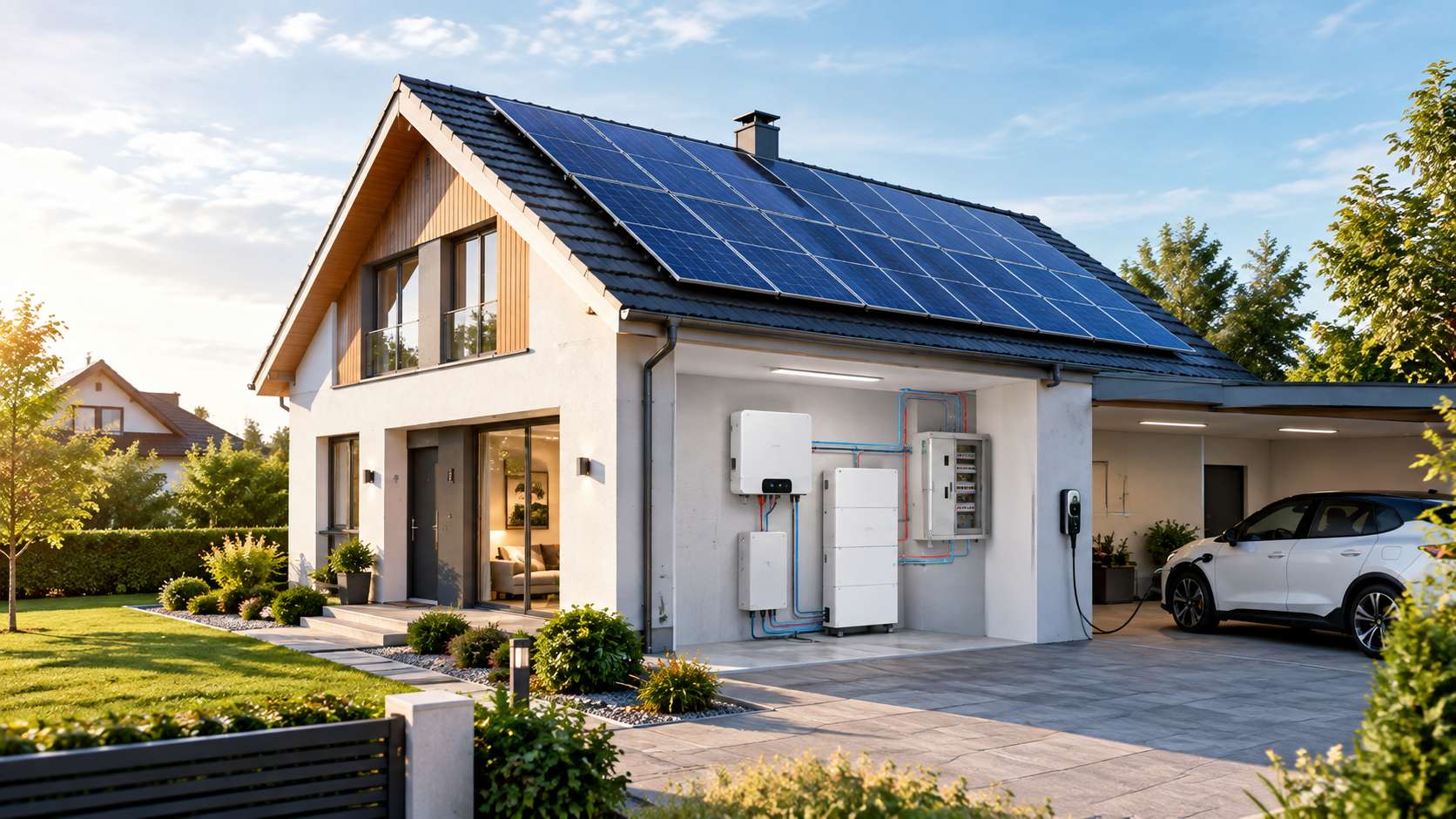
A modern residential solar system may also need to store excess solar energy, reduce grid electricity consumption, provide backup power, and intelligently manage household energy use.
This is where a hybrid solar inverter becomes important.
Unlike a conventional grid-tied inverter, a hybrid inverter can combine solar PV generation with battery storage and household loads in one energy management system. Depending on the model and system configuration, it can manage electricity from solar panels, batteries, the utility grid, and household appliances.
But what makes a hybrid inverter suitable for a European home?
Is a 5kW inverter enough?
Should you choose a single-phase or three-phase model?
What battery voltage should you use?
Does the inverter need backup capability?
And how important are MPPT range, efficiency, grid compatibility, and monitoring?
There is no single inverter that is the right choice for every European household. The appropriate model depends on the home's electrical system, solar array, battery capacity, energy consumption pattern, and local installation requirements.
This guide explains the main factors homeowners, installers, distributors, and solar professionals should consider when selecting a hybrid inverter for European residential applications.
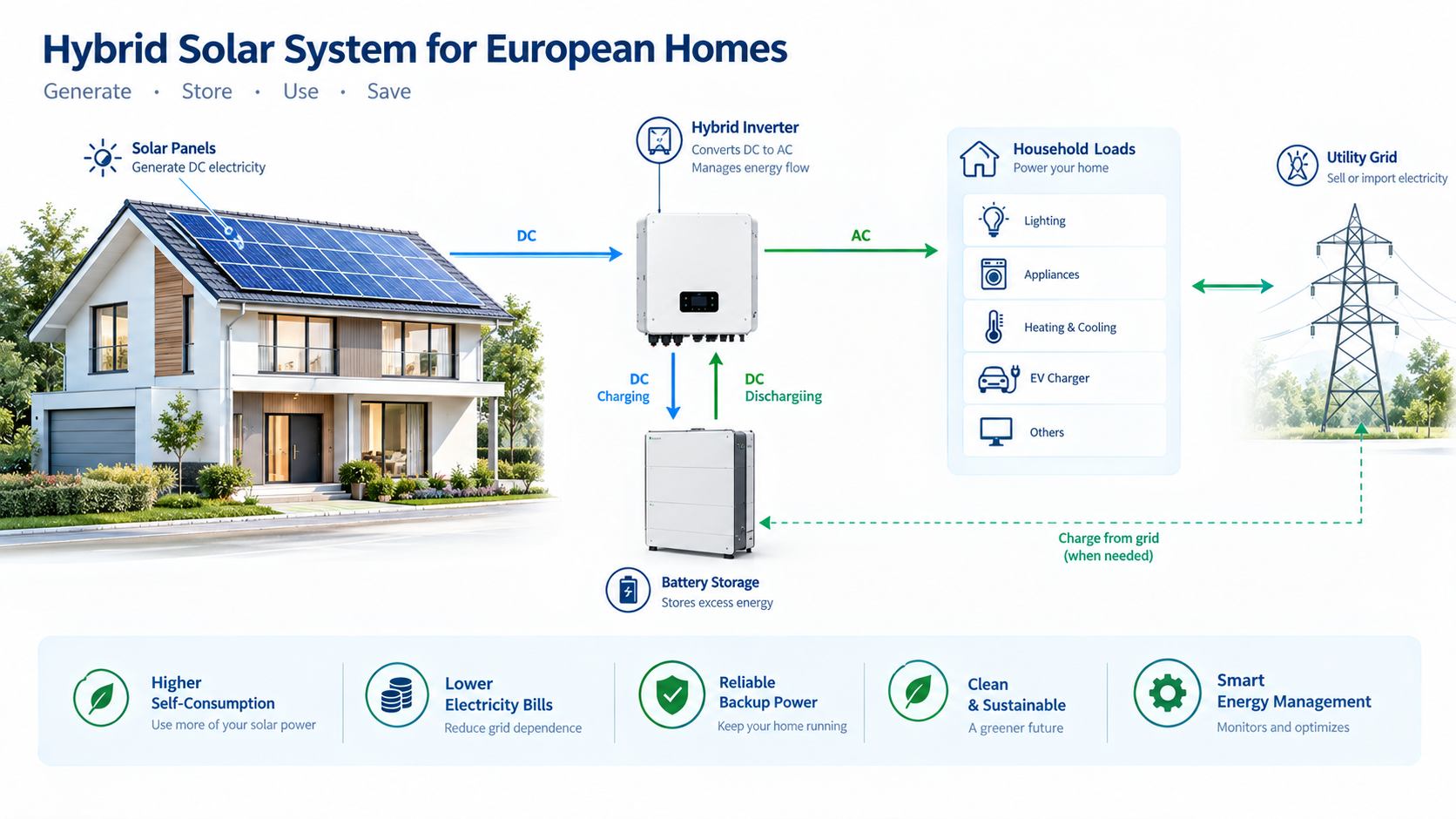
A hybrid solar inverter combines several functions within one system.
A typical residential hybrid solar system can work like this:
Solar Panels → Hybrid Inverter → Home Loads
while also supporting:
Solar Panels → Battery
and:
Battery → Hybrid Inverter → Home Loads
The grid can also remain connected to the system.
A simplified energy flow is:
Solar → Home → Battery → Grid
The actual priority depends on the inverter settings and energy management strategy.
During the daytime, solar energy can supply household loads first. Surplus energy can then be used to charge the battery or exported to the grid where permitted.
In the evening, stored battery energy can be discharged to reduce electricity purchased from the grid.
This makes a hybrid inverter particularly useful for households that want to combine rooftop solar with residential battery storage.
European residential electricity systems can vary considerably between countries and even between individual properties.
Some homes use single-phase electrical connections, while larger homes may have three-phase connections.
Household electricity consumption can also vary significantly.
For example, a home with:
may have substantially different power requirements from a small apartment.
At the same time, solar production is concentrated during daylight hours, while household electricity consumption may increase in the morning and evening.
Battery storage can help shift some solar energy from periods of high solar production to periods of higher household demand.
A hybrid inverter provides the control interface between these different energy sources.
When comparing hybrid inverters, there are several specifications that deserve attention.
The most important include:
Let's look at these factors in more detail.
The inverter's AC power rating should match the home's electricity demand and the planned PV system.
Common residential inverter sizes include approximately:
However, the correct size cannot be determined simply from the home's annual electricity consumption.
The designer should consider:
For example, a home with a 6kW solar array does not necessarily need exactly a 6kW inverter.
The PV array may be designed with some DC oversizing if the inverter manufacturer permits it.
This is particularly important in Europe.
Residential properties can have either single-phase or three-phase electrical connections depending on the country, property, grid connection, and local electrical design.
A single-phase inverter may be suitable for homes with a single-phase electrical connection and relatively moderate loads.
Typical applications can include:
A three phase hybrid inverter can be considered for homes with three-phase electrical systems and higher-power loads.
It can be particularly relevant for properties with:
Before selecting the inverter, installers should verify the home's actual electrical connection and local requirements.
A hybrid inverter needs to be compatible with the planned solar array.
Important specifications include:
For example, if a home uses high-power solar modules, the inverter needs to support the corresponding voltage and current characteristics.
The total PV capacity also needs to be within the inverter manufacturer's permitted input range.
This is especially important when using modern modules with power ratings of 500W, 600W, 650W, or higher.
MPPT stands for Maximum Power Point Tracking.
A hybrid inverter may have one or more MPPT channels.
The MPPT controller allows the inverter to track the operating point of the PV array as solar conditions change.
This becomes particularly useful for residential roofs with different orientations.
For example:
may receive different amounts of sunlight at different times.
Multiple MPPT inputs can provide greater flexibility when designing PV strings with different orientations or operating conditions.
When selecting a hybrid inverter, check:
Maximum DC voltage + MPPT voltage range + maximum input current + number of MPPTs
rather than looking only at the inverter's AC power rating.
One of the main advantages of a hybrid inverter is its ability to integrate battery storage.
However, not every hybrid inverter works with every battery.
Before purchasing the equipment, check:
Lithium iron phosphate, or LiFePO4, batteries are widely used in residential energy storage because of their characteristics and compatibility with modern battery storage systems.
The inverter and battery should be treated as a complete system.
The answer depends on household electricity consumption and the purpose of the battery.
For example, a homeowner may want the battery primarily for:
Store excess solar electricity during the day and use it at night.
Charge the battery when electricity costs are lower and discharge during higher-cost periods where the local tariff structure makes this useful.
Keep selected household loads operating during a grid outage, if the inverter and electrical system support backup operation.
Coordinate solar generation, battery charging, household demand, and grid electricity.
Therefore, battery capacity should be determined from actual energy consumption rather than choosing a battery only because it has a larger capacity.
Backup power is an increasingly important consideration for some homeowners.
Not every grid-connected hybrid inverter provides the same backup function.
Some systems can provide backup power to selected circuits, while others may be designed to support a larger portion of the home.
Before choosing a system, check:
A homeowner should also identify which loads actually need backup.
For example:
Priority backup loads:
High power loads such as EV chargers or electric heating may require much greater inverter and battery capacity.
This is one of the most important differences between simply buying a hybrid inverter and designing a complete residential system.
The inverter needs to be suitable for the electrical characteristics and applicable requirements of the installation location.
Depending on the country and project, installers may need to consider:
European markets are not one single regulatory environment.
Requirements can differ between countries and utilities.
Therefore, the inverter should be selected based on the actual installation country and applicable local requirements rather than using a generic "European" specification alone.
Efficiency is an important specification when comparing hybrid inverters.
However, homeowners and installers should avoid evaluating a product based only on a single maximum efficiency number.
The complete system may involve:
PV → Inverter → Battery → Inverter → AC Loads
Each conversion can introduce losses.
When evaluating a hybrid system, consider:
The actual energy performance depends on the complete system and operating conditions.
A modern residential energy storage system should be easy to monitor.
Depending on the product, monitoring may include:
Communication interfaces can include technologies such as:
For installers managing multiple residential systems, remote monitoring can also help with system maintenance and troubleshooting.
The installation location should also be considered.
An inverter installed in a garage has different environmental conditions from one installed outside.
Check:
For outdoor installations, the enclosure's environmental protection becomes especially important.
Another important consideration is whether the homeowner is installing a completely new PV system or adding storage to an existing solar system.
For a new PV project, a hybrid inverter can be selected from the beginning.
The designer can optimize:
Solar Panels + Hybrid Inverter + Battery
as one integrated system.
For an existing PV system, adding batteries may require a different architecture.
Possible approaches include:
The appropriate option depends on the existing system architecture.
There is no universal size.
A simplified example could look like this:
| Home Type | Typical Considerations |
| Small apartment | Lower PV and household demand |
| Small house | Moderate PV and battery system |
| Family house | Higher electricity demand and larger PV |
| Large villa | Higher simultaneous loads |
| House with EV + heat pump | Higher peak power requirements |
| Large three phase home | Three-phase inverter may be required |
These are application categories rather than fixed inverter recommendations.
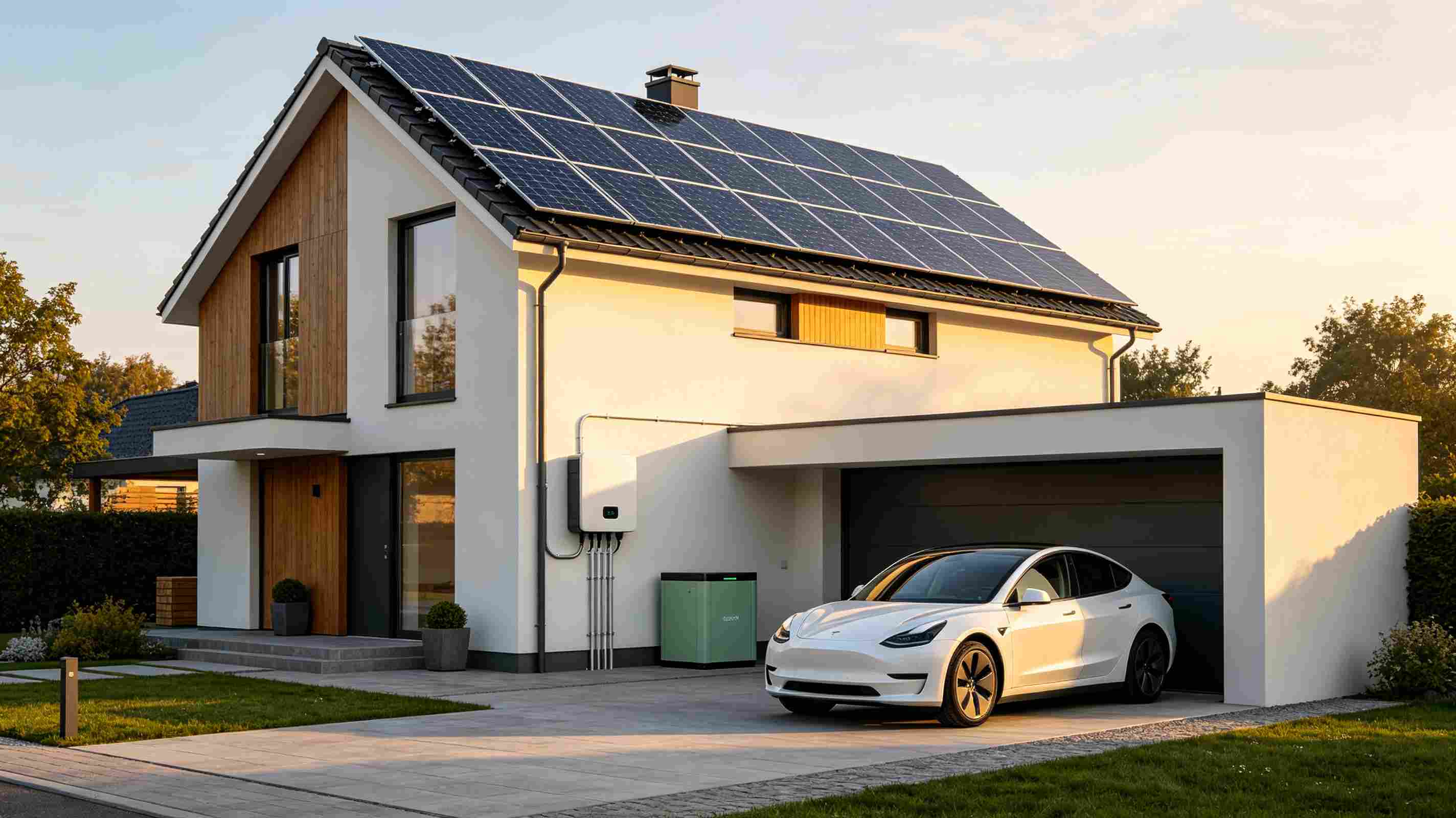
For a specific project, the installer should calculate the actual load profile and electrical requirements.
Instead of asking only:
"Which hybrid inverter is the best?"
it is more useful to ask:
"Which hybrid inverter is best suited to this home's electrical and energy requirements?"
A suitable product should be evaluated across several areas.
Can it handle the required PV power, voltage and current?
Can it work with the selected battery and desired storage capacity?
Is it suitable for single-phase or three-phase operation?
Does it provide the required backup functionality?
Is it suitable for the installation country's applicable requirements?
Does it provide the monitoring functions required by the homeowner or installer?
Can it be installed in the intended indoor or outdoor location?
Can the system be expanded with additional PV or battery capacity if required?
A traditional grid-tied inverter is primarily designed to convert PV DC electricity into AC electricity for household loads and grid interaction.
A hybrid inverter adds battery management capabilities.
| Feature | Grid-Tied Inverter | Hybrid Inverter |
|---|---|---|
| Solar PV | Yes | Yes |
| DC to AC Conversion | Yes | Yes |
| Battery Integration | Usually not directly | Yes |
| Energy Storage Management | Limited | Yes |
| Backup Capability | Depends on system | Often available |
| Solar Self-Consumption | Yes | Yes |
| Grid Interaction | Yes | Yes |
| Energy Management | Basic to advanced | Advanced |
The exact functionality depends on the inverter model.
A 10kW inverter is not automatically better suited to a home than a 6kW inverter.The inverter should match the actual electrical requirements.
A battery with the right capacity is not necessarily compatible with every inverter.
A three-phase home may require a different inverter architecture from a single-phase property.
Grid connection requirements can differ between European markets.
Real-world performance depends on the complete solar and storage system.
EV charging, heat pumps, and additional electrical loads can significantly change future energy requirements.
Before purchasing a hybrid inverter, check:
☐ Rated AC output
☐ Maximum PV input power
☐ Maximum DC voltage
☐ MPPT voltage range
☐ Maximum input current
☐ Number of MPPTs
☐ Battery voltage range
☐ Battery chemistry
☐ Maximum charge power
☐ Maximum discharge power
☐ Battery communication
☐ Compatible battery models
☐ Single-phase or three-phase
☐ Grid voltage
☐ Grid frequency
☐ Maximum AC current
☐ Backup output
☐ Indoor or outdoor installation
☐ IP rating
☐ Operating temperature
☐ Cooling method
☐ Noise level
☐ Wi-Fi/Ethernet
☐ Mobile monitoring
☐ Remote monitoring
☐ Energy management
☐ Smart meter compatibility
☐ EV integration if required
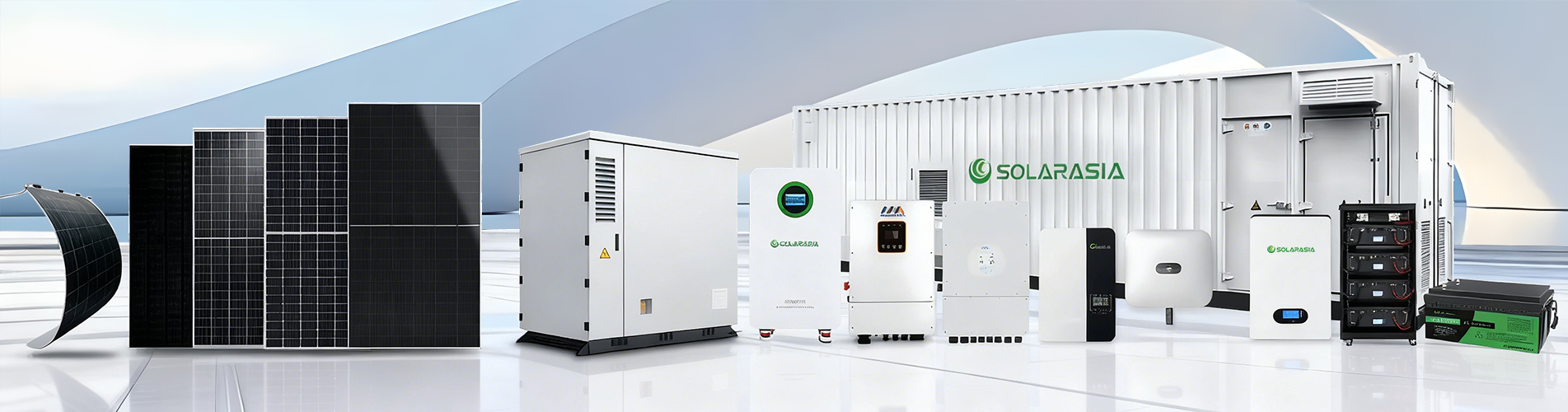
Anhui Solarasia Energy Technology Co., Ltd. provides photovoltaic and energy storage products for international residential and commercial applications.
Our product portfolio includes:
For European residential projects, equipment selection can be based on the home's PV capacity, battery requirements, electrical configuration, grid requirements, and installation environment.
For installers, distributors, wholesalers, and project developers, SolarAsia Power can support different residential solar and energy storage configurations according to project requirements.
There is no single hybrid solar inverter that is automatically the right choice for every European home.
The appropriate choice depends on the home's:
PV Capacity + Electricity Demand + Phase Configuration + Battery + Backup Requirements + Grid Requirements
For a small single-phase home, a compact hybrid inverter may be sufficient.
A larger property with a heat pump, EV charger, high household demand, and three-phase electrical connection may require a higher-power three-phase hybrid inverter.
Battery compatibility is equally important. The inverter and battery should be evaluated as a complete energy storage system rather than as two independent products.
For European homeowners and installers, the most important step is therefore not simply comparing inverter brands or maximum power ratings. It is checking whether the inverter is electrically, technically, and operationally suitable for the specific home and installation location.
A well designed home energy storage system can coordinate solar generation, battery storage, household consumption, and grid electricity to create a more flexible residential energy system.


Address : Room 908-909, Building 2, No. 469 Huatuo Lane, Shushan District, Hefei City, Anhui Province


Please read on, stay posted, subscribe, and we welcome you to tell us what you think.
Copyright 2026 @ Anhui Solarasia Energy Technology Co.,Ltd .All Rights Reserved. Sitemap | Blog | XML | Privacy Policy
 Network Supported