
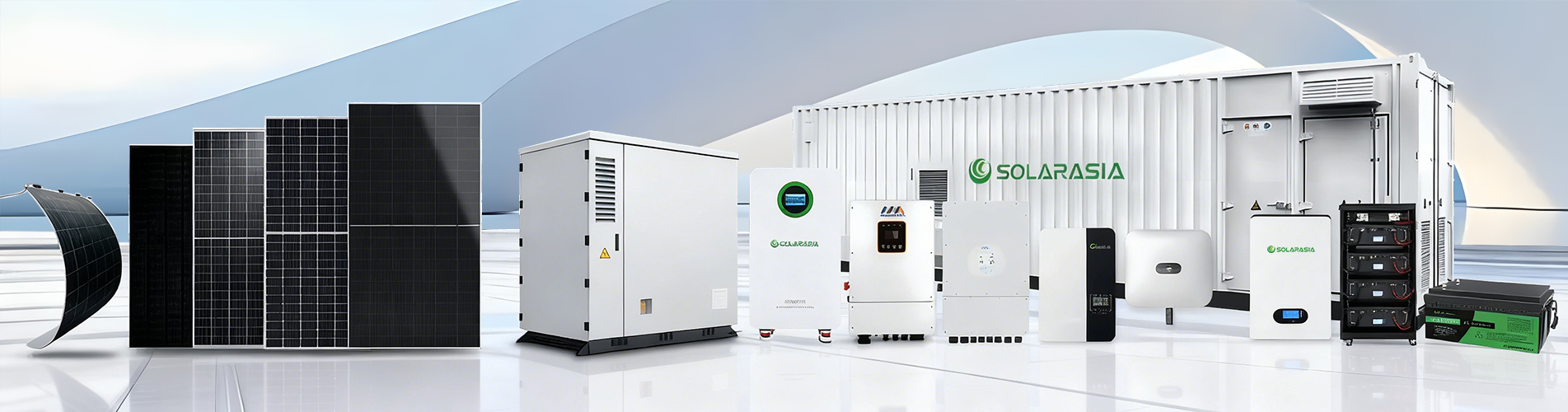
How to Match Solar Panels with a Solar Inverter
Choosing solar panels and a solar inverter separately is relatively easy. The more important question is whether these two components can work together correctly.
A solar panel produces DC electricity, while a solar inverter converts that DC electricity into AC electricity for building loads or grid connection. However, simply choosing a 10kW solar array and a 10kW inverter does not guarantee that the equipment is electrically compatible.
The voltage, current, PV input capacity, MPPT operating range, string configuration, and DC/AC ratio all need to be considered.
For residential systems, commercial rooftop projects, and larger industrial PV installations, proper solar panel and inverter compatibility can affect system performance, safety, reliability, and future expansion.
In this guide, SolarAsia Power explains how to match solar panels with a solar inverter and what specifications should be checked before purchasing or installing the equipment.
Solar panels and inverters work as a connected electrical system.
The basic energy flow is:
Solar Panels → DC Protection → Solar Inverter → AC Distribution → Loads / Grid
If the PV array is not properly matched with the inverter, several problems can occur.
For example:
Therefore, solar panel inverter matching should be based on the complete electrical specifications rather than panel wattage alone.
When matching solar panels with an inverter, there are six major areas to check:
Let's look at each one in detail.
The first step is to determine the total DC capacity of the solar array.
The calculation is simple:
Total PV Power = Number of Solar Panels × Panel Rated Power
For example, if a project uses 20 panels rated at 600W:
20 × 600W = 12,000W = 12kW DC
The project therefore has a 12kW solar array.
However, this does not automatically mean that a 12kW AC inverter is required.
Solar PV systems can be designed with a DC array larger than the inverter's AC output capacity, provided the inverter manufacturer allows the proposed PV input.
This leads to an important concept: the DC/AC ratio.
The DC/AC ratio compares the total rated capacity of the solar panels with the inverter's AC output rating.
DC/AC Ratio = Total PV Capacity ÷ Inverter AC Capacity
For example:
12kW PV ÷ 10kW inverter = 1.2
This means the PV array is 20% larger than the inverter's rated AC output.
A DC/AC ratio above 1 can be appropriate in some system designs because solar panels do not normally produce their nameplate power continuously throughout the day.
Actual PV output varies with:
However, the appropriate ratio depends on the inverter manufacturer's specifications and the project's operating objectives.
Voltage is one of the most important factors when matching solar panels with an inverter.
Every solar module has an open-circuit voltage, commonly abbreviated as Voc.
When solar panels are connected in series, their voltages add together.
For example, if one module has a Voc of 50V and four modules are connected in series:
50V × 4 = 200V
With ten modules:
50V × 10 = 500V
This means that increasing the number of panels in a series string increases the string voltage.
The resulting string voltage must remain within the inverter's maximum allowable DC voltage, including the effect of low-temperature conditions on module Voc.
This is particularly important in regions with cold climates.
Another important inverter specification is the MPPT voltage range.
MPPT stands for:
Maximum Power Point Tracking
The inverter tracks the PV array's operating point to extract available solar power efficiently.
Solar modules also have a voltage called Vmp, or voltage at maximum power.
When modules are connected in series, their operating voltages add together.
For example, if one module has a Vmp of 42V and ten modules are connected in series:
42V × 10 = 420V
The resulting operating voltage should fall within the inverter's MPPT voltage range under expected operating conditions.
This is why installers need to consider both:
when determining the number of modules per string.
Power and voltage are not the only considerations.
The current generated by the PV modules must also be compatible with the inverter's maximum input current.
A solar module normally has:
When PV strings are connected in parallel, the current increases.
For example, if one string operates at approximately 15A and two compatible strings are connected in parallel to the same input:
15A + 15A = 30A
The inverter's input current capability must be sufficient for the proposed configuration.
This becomes increasingly important with modern high-power solar modules, which may have higher operating currents than older generations of modules.
Therefore, when selecting an inverter for 600W, 650W, 700W, or higher-power modules, always check the actual module current against the inverter's input current specifications.
The number of MPPT inputs can affect how flexible the PV system is.
An inverter may have one or multiple MPPT channels.
Multiple MPPTs can be useful when different PV strings have different operating conditions.
For example, a commercial building may have panels installed on:
These sections can receive different levels of solar irradiance throughout the day.
If strings with significantly different orientations or shading conditions are connected improperly to the same MPPT, the system may not operate as effectively as a properly configured design.
Multiple MPPT inputs can provide more flexibility for these situations.
The inverter manufacturer normally specifies a maximum recommended or permitted PV input power.
For example, an inverter may have:
This means a PV array larger than 10kW may be possible, depending on the specific model.
But you should never assume that every 10kW inverter supports the same PV input capacity.
Always check the manufacturer's datasheet.
Important specifications include:
| Parameter | Why It Matters |
| Rated AC Output | Determines maximum rated AC power |
| Maximum PV Input Power | Limits the connected PV array |
| Maximum DC Voltage | Limits maximum string voltage |
| MPPT Voltage Range | Determines suitable operating voltage |
| Maximum Input Current | Limits PV string current |
| Number of MPPTs | Affects string configuration flexibility |
| Maximum Short-Circuit Current | Important for PV input compatibility |
There is no universal answer.
The number of panels depends on:
For example, a 10kW inverter may work with different numbers of panels depending on whether the project uses 450W, 550W, 600W, or 700W modules.
The calculation should therefore start with the actual module and inverter datasheets.
Suppose a project uses 600W solar panels.
If the design includes:
20 × 600W panels = 12kW DC
and the inverter is rated at:
10kW AC
then:
DC/AC Ratio = 12 ÷ 10 = 1.2
This could be a possible configuration if the inverter's maximum PV input power, voltage, current, and string requirements allow it.
The next step is to determine how the 20 modules should be arranged into strings.
For example, a designer may consider different string configurations based on the module's Voc and Vmp and the inverter's MPPT range.
The exact string arrangement cannot be determined from panel wattage alone.
Now consider a 650W module.
If 18 modules are installed:
18 × 650W = 11.7kW DC
With a 10kW inverter:
11.7 ÷ 10 = 1.17
The resulting DC/AC ratio is approximately 1.17.
Again, whether this is an appropriate configuration depends on the inverter's specifications and the project's design requirements.
The key point is that changing the module wattage changes the number of modules required to reach a specific PV capacity.
With 700W modules:
17 × 700W = 11.9kW DC
This gives:
11.9 ÷ 10 = 1.19
Compared with 600W modules, fewer panels are required to achieve a similar total PV capacity.
However, higher-power modules may also have different voltage and current characteristics.
Therefore, higher wattage does not automatically mean easier inverter compatibility.
The electrical specifications still need to be checked.
Solar panels can be connected in series or parallel.
When modules are connected in series:
Voltage increases
while current remains approximately the same.
For example:
10 panels × 40V = approximately 400V
This is useful for creating an appropriate operating voltage for the inverter.
When strings are connected in parallel:
Current increases
while voltage remains approximately the same.
For example:
2 strings × 15A = approximately 30A
The inverter input must therefore be able to handle the resulting current.
A proper PV design combines series and parallel connections to achieve an appropriate voltage and current range.
Temperature is an important factor that is sometimes overlooked.
Solar module voltage changes with temperature.
In general, module voltage increases under colder conditions and decreases as module temperature rises.
This means the maximum string voltage should not be calculated only using the module's standard test-condition Voc.
For projects in cold climates, the expected minimum ambient or module temperature should be considered when checking maximum string voltage.
At the same time, high temperatures can reduce module operating voltage.
Therefore, the string voltage should remain suitable for the inverter's MPPT range across the expected operating temperature range.
This is particularly important for international solar projects because climate conditions can vary significantly between markets.
If the calculated PV string voltage exceeds the inverter's maximum allowable DC voltage, the configuration is not suitable.
This is one of the most important safety checks during system design.
For this reason, installers should calculate the maximum possible string Voc under the project's expected low-temperature conditions.
Do not simply divide the inverter's maximum DC voltage by the panel's nominal voltage and assume the result is always safe.
Actual module Voc and temperature characteristics must be considered.
The opposite situation can also cause problems.
If the PV string voltage is below the inverter's required MPPT operating range, the inverter may not be able to operate at the desired point.
This can happen when too few modules are connected in series.
Therefore, designers need to determine both:
Minimum number of modules per string
and
Maximum number of modules per string
based on the inverter and module specifications.
The same principles apply to common residential and small commercial inverter sizes.
A 6kW inverter may be used with a PV array around or above 6kW depending on the manufacturer's permitted PV input capacity.
For example:
10 × 600W = 6kW
or
12 × 600W = 7.2kW
may be considered in different designs.
The actual configuration depends on the inverter specification.
A 10kW inverter may be used with:
16 × 600W = 9.6kW
20 × 600W = 12kW
or other configurations depending on the project's requirements and inverter limits.
Again, these examples demonstrate the calculation method rather than recommending a universal configuration.
For commercial and industrial PV systems, equipment matching becomes more complex because the system may contain hundreds or thousands of modules.
A commercial project may need to consider:
For these projects, the inverter should be selected as part of the complete electrical system rather than as an independent product.
For example, a large warehouse may use several commercial inverters instead of one large inverter.
This can provide greater flexibility in PV string design and equipment placement, depending on the project.
If the project includes battery storage, the matching process becomes more comprehensive.
A hybrid inverter may need to work with:
Solar Panels + Battery + Grid + Loads
In addition to checking PV compatibility, the system designer may need to verify:
This is particularly important for solar-plus-storage projects.
For commercial and industrial applications, a battery energy storage system may also require additional PCS, EMS, protection, and distribution equipment depending on the system architecture.
A 10kW PV array does not automatically require a 10kW inverter.Voltage, current and MPPT range also matter.
The maximum PV voltage must remain within the inverter's allowable DC voltage.
High-power modules may have higher operating currents.The inverter's maximum input current must be checked.
Module voltage changes with temperature.String calculations should account for expected temperature conditions.
Different solar modules may have different electrical characteristics.Mixing modules within the same string or MPPT should only be done when the design confirms compatibility.
Different roof orientations or shading conditions may require separate MPPT inputs.
A low equipment price does not necessarily mean the inverter is suitable for the project.
The complete system should be evaluated based on:
Before purchasing equipment, check the following:
☐ Rated power
☐ Voc
☐ Vmp
☐ Isc
☐ Imp
☐ Temperature coefficient
☐ Module dimensions
☐ Rated AC output
☐ Maximum PV input power
☐ Maximum DC voltage
☐ MPPT voltage range
☐ Maximum input current
☐ Maximum short-circuit current
☐ Number of MPPTs
☐ Grid voltage
☐ Single-phase or three-phase
☐ Number of panels
☐ Number of panels per string
☐ Number of strings
☐ DC/AC ratio
☐ Roof orientation
☐ Shading conditions
☐ Minimum and maximum temperatures
☐ Future expansion requirements
This checklist can help installers and project developers identify potential compatibility problems before equipment is purchased.
Anhui Solarasia Energy Technology Co., Ltd., operating under the SolarAsia Power brand, provides photovoltaic and energy storage products for international customers.
Our product portfolio includes:
For distributors, EPC contractors, installers, wholesalers, and project developers, SolarAsia Power can provide equipment and customized solutions based on different PV project requirements.
When selecting solar panels and inverters, our recommendation is to evaluate the complete system rather than choosing components based only on rated wattage.
A properly matched system should consider the PV array capacity, module electrical characteristics, inverter specifications, string design, grid requirements, and future expansion plans.
Matching solar panels with a solar inverter is more than simply comparing wattage.
A reliable PV system needs to consider:
PV Power + Voltage + Current + MPPT Range + String Design + DC/AC Ratio
The first step is to calculate the total PV capacity.
Next, check the inverter's maximum PV input power.
Then verify the PV string voltage against the inverter's maximum DC voltage and MPPT operating range.
After that, check the module current against the inverter's maximum input current.
Finally, consider temperature, roof orientation, MPPT configuration, grid requirements, battery storage, and future expansion.
For small residential systems, the process may be relatively straightforward.
For commercial and industrial PV projects, proper system design becomes increasingly important because the project may involve multiple inverters, hundreds of modules, different roof orientations, and complex electrical infrastructure.
By carefully matching the solar panels and inverter from the beginning, installers and project developers can create a PV system that is better aligned with the project's electrical requirements and long-term operating goals.


Address : Room 908-909, Building 2, No. 469 Huatuo Lane, Shushan District, Hefei City, Anhui Province


Please read on, stay posted, subscribe, and we welcome you to tell us what you think.
Copyright 2026 @ Anhui Solarasia Energy Technology Co.,Ltd .All Rights Reserved. Sitemap | Blog | XML | Privacy Policy
 Network Supported