
How to Buy Solar Panels in Bulk: A Complete Guide for Distributors and EPCs
Buying solar panels in bulk is very different from purchasing a small number of modules for a residential installation. For distributors and EPC contractors, a bulk order can involve hundreds or thousands of panels, multiple containers, strict project specifications, international shipping and significant financial commitments.
The right supplier therefore needs to offer more than competitive pricing.
When you buy solar panels in bulk, you should evaluate the complete procurement process, including module technology, specifications, certifications, warranty, supply capacity, packaging, logistics, lead time and after-sales support.
For distributors, product availability and market demand are also important. For EPCs, compatibility with the project design, energy yield and delivery schedule may be higher priorities.
This guide explains how professional buyers can approach bulk solar panel procurement and reduce common purchasing risks.
What Does Buying Solar Panels in Bulk Mean?
Bulk solar panel purchasing generally refers to purchasing photovoltaic modules in significant quantities for resale, distribution or large solar projects.
Unlike residential buyers who may purchase a relatively small number of panels, professional buyers may need:
The exact quantity that qualifies as a "bulk order" depends on the supplier, product and project.
For an EPC contractor, the order may be linked to one specific project. A distributor may instead purchase inventory for several future customers.
This difference should influence how the procurement process is managed.
Why Distributors and EPCs Buy Solar Panels in Bulk
For Solar Distributors
Distributors purchase modules in volume primarily to maintain inventory and serve downstream customers.
Their priorities may include:
A distributor may also need different module technologies to serve different markets.
For example, customers may request:
For EPC Contractors
EPC companies usually purchase solar panels according to project requirements.
Their priorities can include:
For EPC projects, choosing a cheaper module does not necessarily result in a lower total project cost.
A module must fit the complete system design.
Step 1: Define Your Solar Panel Requirements
Before contacting suppliers, define your requirements as clearly as possible.
At minimum, determine:
Required quantity
Estimate the number of modules needed.For EPC projects, this should be based on the system capacity and selected module power.For distributors, consider both immediate orders and planned inventory.
Required power
Determine whether you need:
Higher wattage can reduce the number of modules required for a specific system capacity, but module dimensions and installation requirements must also be considered.
Cell technology
Decide whether the project requires:
Application
Identify whether the panels will be used for:
This information allows suppliers to recommend products that are appropriate for the intended application.
Step 2: Choose the Right Solar Panel Technology
Modern solar buyers have more choices than ever.
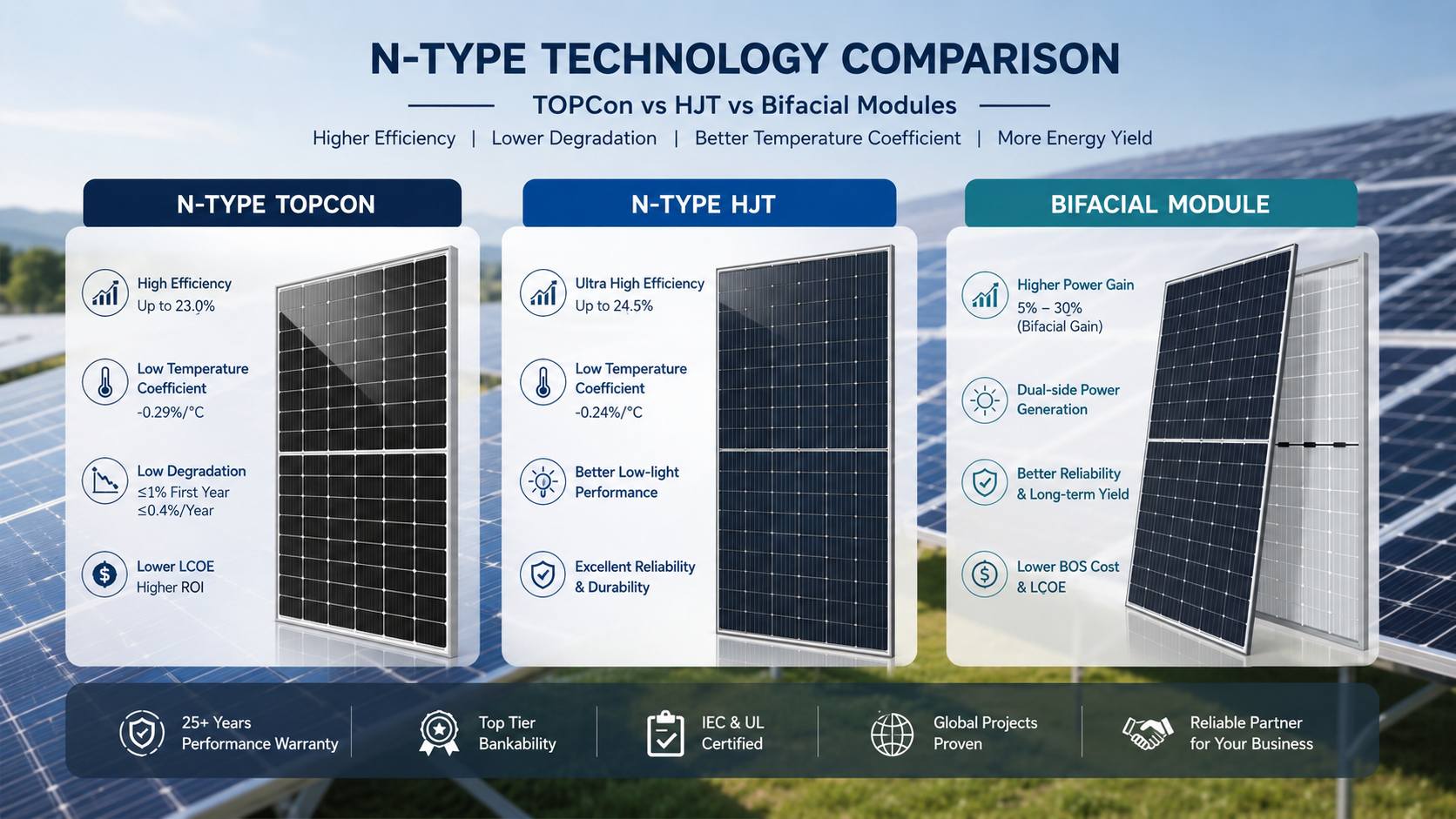
N Type TOPCon
TOPCon has become a major high-efficiency photovoltaic technology.
Potential advantages include:
TOPCon is widely used across residential, commercial and utility scale projects.
HJT
Heterojunction Technology combines crystalline silicon with thin amorphous silicon layers.
HJT modules can offer:
They can be particularly attractive for projects where energy yield and high efficiency are important.
Bifacial Solar Panels
Bifacial modules can generate electricity from both sides.They are particularly relevant for ground-mounted projects and installations where the rear side of the module can receive reflected sunlight.
However, actual bifacial energy gains depend on project conditions.
Step 3: Compare Solar Panel Specifications
Never compare bulk solar panels only by price per watt.
A professional procurement comparison should include the complete technical specification.
| Specification | Why It Matters |
| Rated power | Determines module output |
| Efficiency | Important when space is limited |
| Dimensions | Affects installation and logistics |
| Weight | Important for mounting and rooftop structures |
| Voc | Important for string design |
| Isc | Important for electrical design |
| Vmp | Used for system design |
| Imp | Used for inverter/string calculations |
| Temperature coefficient | Important in hot climates |
| Bifaciality | Relevant to bifacial systems |
| Connector type | System compatibility |
| Maximum system voltage | Electrical compatibility |
| Warranty | Long term risk management |
Two panels with the same wattage can have different dimensions, electrical characteristics and performance.
Therefore, always compare the actual datasheets.
Step 4: Evaluate Solar Panel Suppliers
Finding a supplier is one of the most important parts of bulk procurement.
A professional supplier should be evaluated across several areas.
Product Portfolio
Does the supplier offer the products you need?
A broad portfolio can make procurement easier when projects require different module types.
Manufacturing and Supply Capability
Ask about:
For large EPC projects, delivery delays can affect the entire construction schedule.
Technical Support
A good supplier should be able to provide relevant technical documentation and answer questions about:
International Experience
For cross-border procurement, experience with international shipments can be valuable.
Check whether the supplier regularly works with:
Step 5: Compare Bulk Solar Panel Pricing
Price is important, but it should not be the only purchasing criterion.
When comparing quotations, make sure you understand what is included.
For example, ask whether the quoted price covers:
The exact commercial terms depend on the agreed Incoterms and destination.
A professional comparison should therefore evaluate the total delivered cost, rather than simply comparing the factory price.
Step 6: Check Quality, Certifications and Warranty
Before placing a large order, verify the product documentation.
Depending on the destination market and project requirements, relevant documentation may include:
The exact certification requirements vary by country and project.
Do not assume that a certification listed for one module model automatically applies to every model from the same manufacturer.
Always verify the documentation for the exact product being purchased.
Step 7: Plan Packaging, Shipping and Delivery
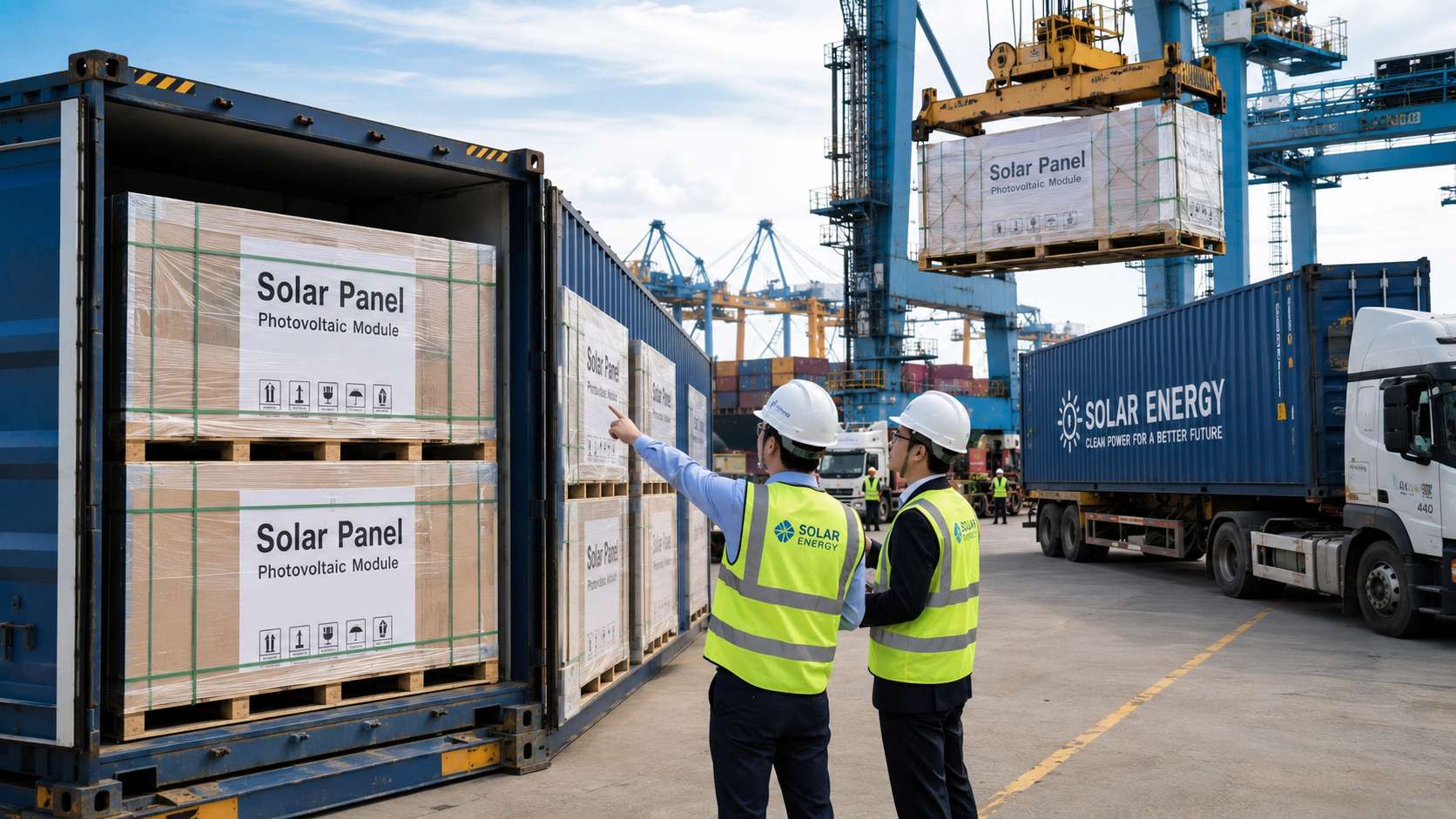
Bulk solar panels are sensitive cargo.
Packaging and transportation should therefore be considered before placing the order.
Important questions include:
How many modules fit in a container?
The answer depends on:
How are modules protected?
Check the supplier's packaging method and whether the packaging is designed for international transportation.
What is the delivery schedule?
For EPC projects, delivery should be aligned with:
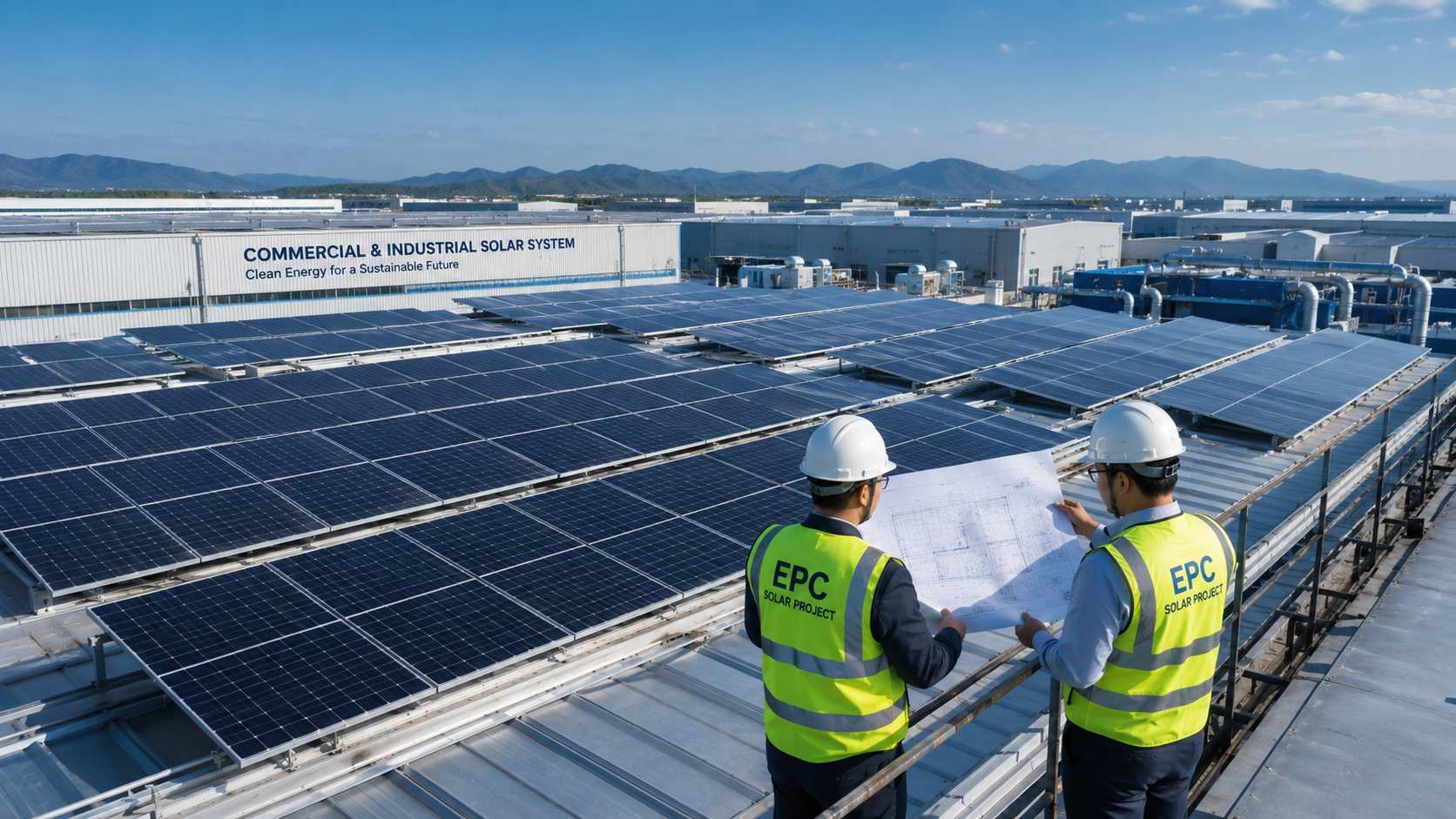
Receiving panels too early can create storage problems. Receiving them too late can delay construction.
Step 8: Review Samples and Technical Documents
For a new supplier, consider completing a verification process before committing to a large order.
Depending on the procurement situation, this can include:
For large projects, procurement teams may also conduct additional supplier due diligence.
The goal is to ensure that the product quoted is the same product ultimately delivered.
Common Mistakes When Buying Solar Panels in Bulk
Choosing Only by Price
The cheapest quotation may not provide the lowest total project cost.Module quality, efficiency, warranty, shipping and availability all affect the final economics.
Comparing Different Module Generations
A buyer may compare a new high-efficiency module from one manufacturer with an older module from another.
This can produce a misleading conclusion.
Always compare equivalent or reasonably comparable product generations.
Ignoring Module Dimensions
Higher wattage often comes with larger module dimensions.
Before ordering, confirm that the panels are compatible with:
Not Checking the Exact Datasheet
Brand-level comparisons are useful for initial research, but procurement decisions should be based on the specific product model.
Ignoring Lead Times
A competitively priced module is not useful if it arrives after the project's required installation date.
Failing to Clarify Commercial Terms
Always confirm:
before finalizing the order.
How to Choose Between Different Solar Panel Brands
Distributors and EPCs often compare brands such as:
There is no single brand that is automatically the best for every project.
Instead, compare:Technology + specifications + availability + price + warranty + logistics + project suitability.
For example, an EPC contractor working on a limited-space commercial rooftop may prioritize efficiency.
A utility developer may focus more heavily on:
A distributor may prioritize:
Solarasia Power for Bulk Solar Panel Procurement
Solarasia Power provides solar products and solutions for international customers, including distributors, EPC contractors and solar project buyers.
Its solar panel portfolio includes products from recognized manufacturers such as:
The product range covers different photovoltaic technologies and power classes, including:
This allows professional buyers to compare different products according to project requirements instead of relying on a single module type.
Explore Solar Asia Power Solar Panels:China Manufacturer Of High-Quality Solar Panels | Solarasiapower.com
For bulk procurement, buyers should provide the supplier with key information such as:
This makes it easier to evaluate suitable products and prepare a project-specific quotation.
Bulk Solar Panel Buying Checklist
Before placing an order, use this checklist:
| Item | Check |
| Project application | Residential / Commercial / Utility |
| Quantity | Confirm required modules |
| Module power | Confirm wattage |
| Technology | TOPCon / HJT / Other |
| Efficiency | Compare models |
| Dimensions | Confirm installation compatibility |
| Electrical parameters | Check system design |
| Certifications | Verify exact model |
| Warranty | Review terms |
| Packaging | Confirm international shipping protection |
| Lead time | Match project schedule |
| Incoterms | Confirm delivery responsibilities |
| Shipping | Confirm logistics plan |
| Supplier support | Confirm technical assistance |
| Final quotation | Check total commercial terms |
FAQs
How do I buy solar panels in bulk?
Start by defining the required quantity, module power, technology, application and delivery destination. Then compare qualified suppliers based on product specifications, certifications, warranty, price, supply capability and logistics.
What is the minimum quantity for bulk solar panel orders?
There is no universal minimum quantity. The minimum order depends on the supplier, manufacturer, product and commercial terms. Some suppliers can handle smaller wholesale orders, while larger projects may require container-level procurement.
Is it cheaper to buy solar panels in bulk?
Bulk purchasing can provide access to different commercial pricing arrangements, but the actual price depends on the product, quantity, market conditions, shipping terms and supplier. Buyers should compare the total delivered cost rather than assuming that a larger order is always cheaper.
What should distributors look for when buying solar panels?
Distributors should consider product demand, module technology, power classes, supplier reliability, availability, pricing, warranty, certifications, packaging and delivery capability.
What should EPC contractors consider when buying solar panels?
EPC contractors should prioritize technical compatibility, module specifications, efficiency, power output, temperature performance, warranty, certifications, delivery schedule and total project economics.
Which solar panel technology is best for bulk purchasing?
There is no universal answer. N-type TOPCon, HJT and bifacial technologies can all be suitable depending on the project. The best choice depends on efficiency requirements, budget, climate, available space and system design.
Should I buy 700W solar panels for a large project?
700W-class modules can be useful for large commercial and utility-scale projects, but buyers should evaluate module dimensions, weight, electrical characteristics, installation requirements and total system design in addition to rated power.
How should I compare solar panel suppliers?
Compare product quality, exact model specifications, certifications, warranty, supply capability, lead time, logistics, technical support and commercial terms. For international orders, also consider the supplier's experience with export shipments.
What documents should I request from a solar panel supplier?
Depending on the project and destination, buyers may request the current product datasheet, applicable certifications, test reports, warranty documents, packaging specifications and relevant compliance documentation.
Conclusion
Buying solar panels in bulk requires a different approach from purchasing a few modules for a small installation.
For distributors and EPC contractors, the purchasing decision should consider the complete supply chain:
Product technology → specifications → supplier → quality → price → warranty → logistics → delivery.
The lowest price is not necessarily the best deal, and the highest-efficiency module is not necessarily the best choice for every project.
A better strategy is to identify the project's requirements first and then compare suitable products and suppliers using consistent technical and commercial criteria.
Solarasia Power provides access to solar panel products from multiple established manufacturers, including Jinko, LONGi, Trina, JA Solar, Canadian Solar, Huasun and AIKO, giving professional buyers more options when sourcing solar modules for commercial, industrial and utility-scale projects.
Explore the Solar Asia Power solar panel range:
https://www.solarasiapower.com/solar-panel


Address : Room 908-909, Building 2, No. 469 Huatuo Lane, Shushan District, Hefei City, Anhui Province


Please read on, stay posted, subscribe, and we welcome you to tell us what you think.
Copyright 2026 @ Anhui Solarasia Energy Technology Co.,Ltd .All Rights Reserved. Sitemap | Blog | XML | Privacy Policy
 Network Supported