
Jinko vs LONGi vs Trina Solar Panels: Which One Should You Choose?
Choosing a solar panel manufacturer is an important decision for any photovoltaic project. For residential installations, commercial rooftops and utility scale solar farms, Jinko, LONGi and Trina Solar are three of the most recognizable names in the global PV market.
But comparing these brands is not as simple as asking which one is "best."
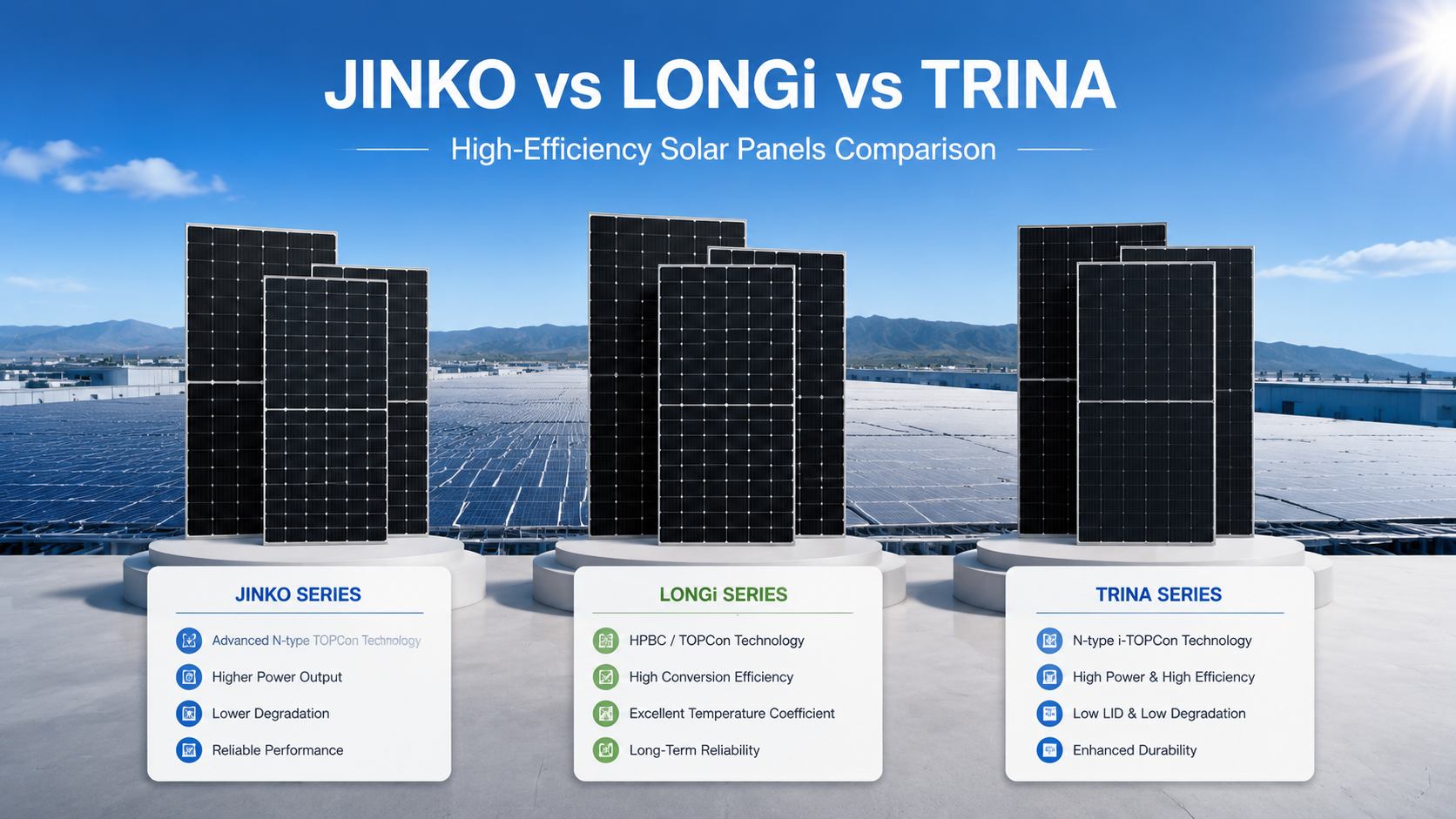
All three manufacturers offer multiple generations of modules, including high power N-type, TOPCon and bifacial solar panels. Specifications also vary between individual product series.
The right choice depends on the project's:
Solar Asia Power's solar panel portfolio includes products from Jinko Solar, LONGi Solar and Trina Solar, allowing buyers to compare solutions from these major manufacturers in one product category.
So, Jinko vs LONGi vs Trina—which one should you choose?
The answer depends on your project.
Jinko, LONGi and Trina at a Glance
Jinko, LONGi and Trina are all major global solar manufacturers, but their product portfolios and technology strategies are not identical.
| Factor | Jinko Solar | LONGi Solar | Trina Solar |
|---|---|---|---|
| Main product focus | High-efficiency PV modules | High-efficiency PV modules and silicon technologies | PV modules, smart energy and large-scale solutions |
| N-type technology | Strong | Strong | Strong |
| TOPCon products | Yes | Yes | Yes |
| Bifacial products | Yes | Yes | Yes |
| Commercial applications | Yes | Yes | Yes |
| Utility-scale applications | Yes | Yes | Yes |
| High-power modules | Yes | Yes | Yes |
| Best choice depends on | Project specification | Project specification | Project specification |
This table should be treated as a general comparison rather than a comparison of individual models. A specific Jinko module may have very different specifications from a specific LONGi or Trina module.
Jinko Solar Panels: Overview
Jinko Solar is one of the most established names in the global photovoltaic industry.
Its module portfolio includes high-efficiency N-type products designed for residential, commercial, industrial and utility-scale applications.
One of Jinko's well-known product families is Tiger Neo, which uses N-type TOPCon technology.
Jinko's N-type modules are available in different power classes and module formats, depending on the generation and market.
For buyers, the main reasons to consider Jinko include:
Solarasia Power currently lists Jinko Tiger Neo N-type modules, including 700W-class products, in its solar panel portfolio.
For large projects, Jinko can therefore be a strong option when the project requires high-power N-type modules.
LONGi Solar Panels: Overview
LONGi is another major solar manufacturer with a broad technology portfolio.
The company has historically been closely associated with monocrystalline silicon technology and has developed multiple generations of high-efficiency photovoltaic products.
LONGi's product portfolio includes N-type technologies and high-efficiency modules for different solar applications.
Depending on the product generation and market, buyers may encounter technologies such as:
LONGi products are used across residential, commercial and utility-scale projects.
For buyers comparing LONGi with Jinko or Trina, it is important to compare specific module models rather than brand names alone.
A newer LONGi module may have very different specifications from an older LONGi series.
Trina Solar Panels: Overview
Trina Solar is another major global photovoltaic manufacturer with a broad portfolio covering solar modules and energy solutions.
Its module portfolio includes high-power N-type products and bifacial modules for commercial and utility-scale projects.
Trina's Vertex product family is particularly relevant for large-scale applications, with different generations and power classes available depending on the market.
Solarasia Power currently lists Trina N-type TOPCon modules in its solar panel portfolio, including a 700W–725W bifacial product with listed efficiency up to 23.3%.
This makes Trina an interesting option for:
Again, the exact specifications should be confirmed from the current datasheet for the selected model.
Jinko vs LONGi vs Trina: Technology Comparison
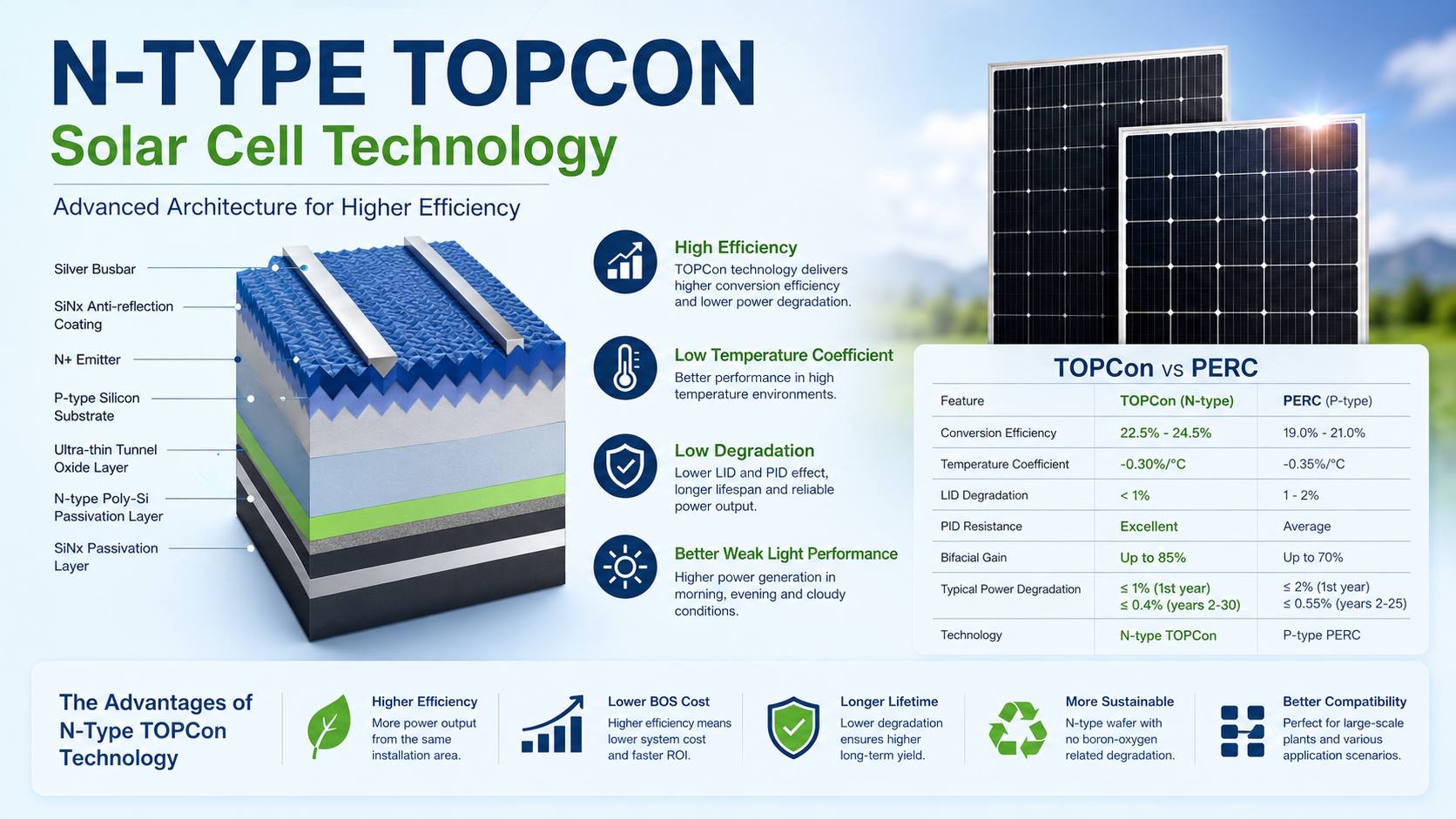
Technology is one of the most important areas to compare.
The industry has moved significantly beyond the older P-type PERC architecture toward high-efficiency N-type technologies.
Today, buyers commonly encounter:
Jinko, LONGi and Trina all offer high-efficiency N-type products, although the specific cell architecture depends on the model.
This means a buyer should not ask only:
"Which brand is better?"
A more useful question is:
"Which specific module technology and model provides the best value for my project?"
Efficiency and Power Output
Module efficiency tells you how effectively a module converts sunlight into electricity under standard test conditions.Power output, measured in watts, tells you the module's rated maximum power.These two specifications are related but not identical.For example, two modules may have similar efficiency but different dimensions and power outputs.When comparing Jinko, LONGi and Trina, consider:
Important when roof or land area is limited.
Important when calculating total system capacity.
Important for mounting design and logistics.
Important for rooftop structural considerations and installation.
Important for projects in hot climates.
Important for projects designed to capture rear-side irradiance.Therefore, comparing "700W vs 700W" is not enough.You should compare the complete datasheet.
N Type and TOPCon Solar Panels
N-type technology has become an important part of the modern solar market.
TOPCon is one of the most widely used N-type cell architectures in commercial PV manufacturing.
Jinko, LONGi and Trina all have N-type product lines, although their specific cell technologies and module generations differ.
For buyers, the advantages of modern N-type modules can include:
However, the actual performance depends on the individual module.
This is why product datasheets and warranty documents should always be reviewed before procurement.
Bifacial Solar Panel Options
Bifacial modules are increasingly common in commercial and utility-scale projects.
A bifacial panel can generate electricity from both the front and rear sides of the module.The actual benefit depends on the project design.
Factors include:
Jinko, LONGi and Trina all offer bifacial module options across different product generations.For a ground-mounted solar farm, bifacial performance can be an important consideration.For a conventional rooftop, however, the value of rear-side generation may be more limited depending on how the modules are installed.
Which Brand Is Best for Commercial Projects?
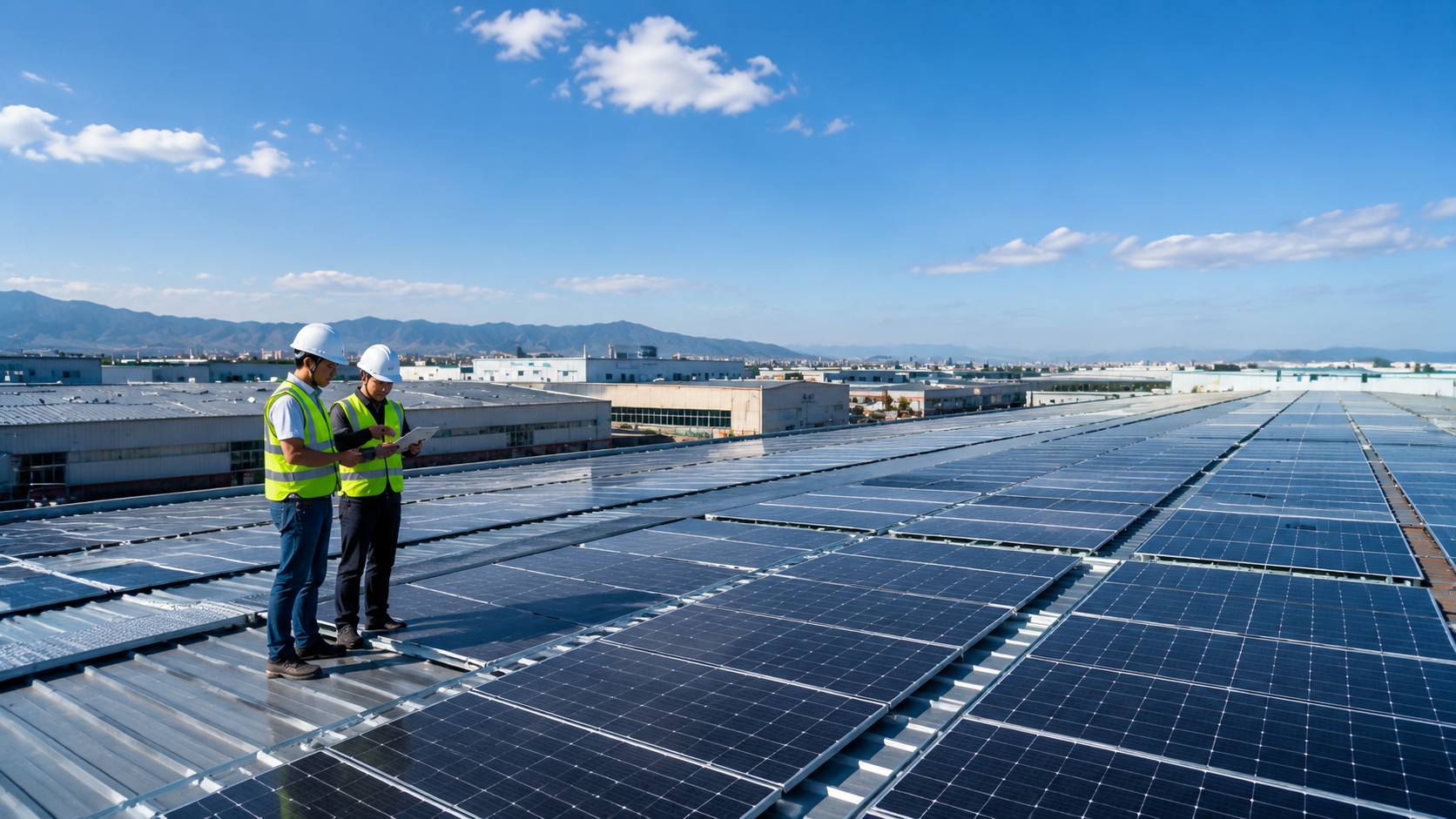
There is no single brand that is automatically best for every commercial project.For factories, warehouses and commercial buildings, consider the following:
Prioritize:
High efficiency + high power density
This can help maximize installed capacity within the available roof area.
If sufficient space is available, module price, installation cost and total project economics may become more important.
Pay close attention to:
Temperature coefficient + annual energy yield
Check whether the roof and mounting configuration can provide meaningful rear-side irradiance.
For distributors and EPC companies, supply consistency and documentation can be as important as module efficiency.
Which Brand Is Best for Utility-Scale Projects?
Utility-scale solar projects usually evaluate modules differently from residential systems.
The key metrics can include:
For a utility project, a module with slightly higher efficiency may not automatically produce the best project economics.
The developer should calculate:
Total project cost + expected lifetime energy production + operating costs
rather than choosing solely according to the brand name.
Jinko, LONGi and Trina all have product ranges designed for large scale PV applications, so the final selection should be based on the project's technical and commercial requirements.
Jinko vs LONGi vs Trina: How to Choose
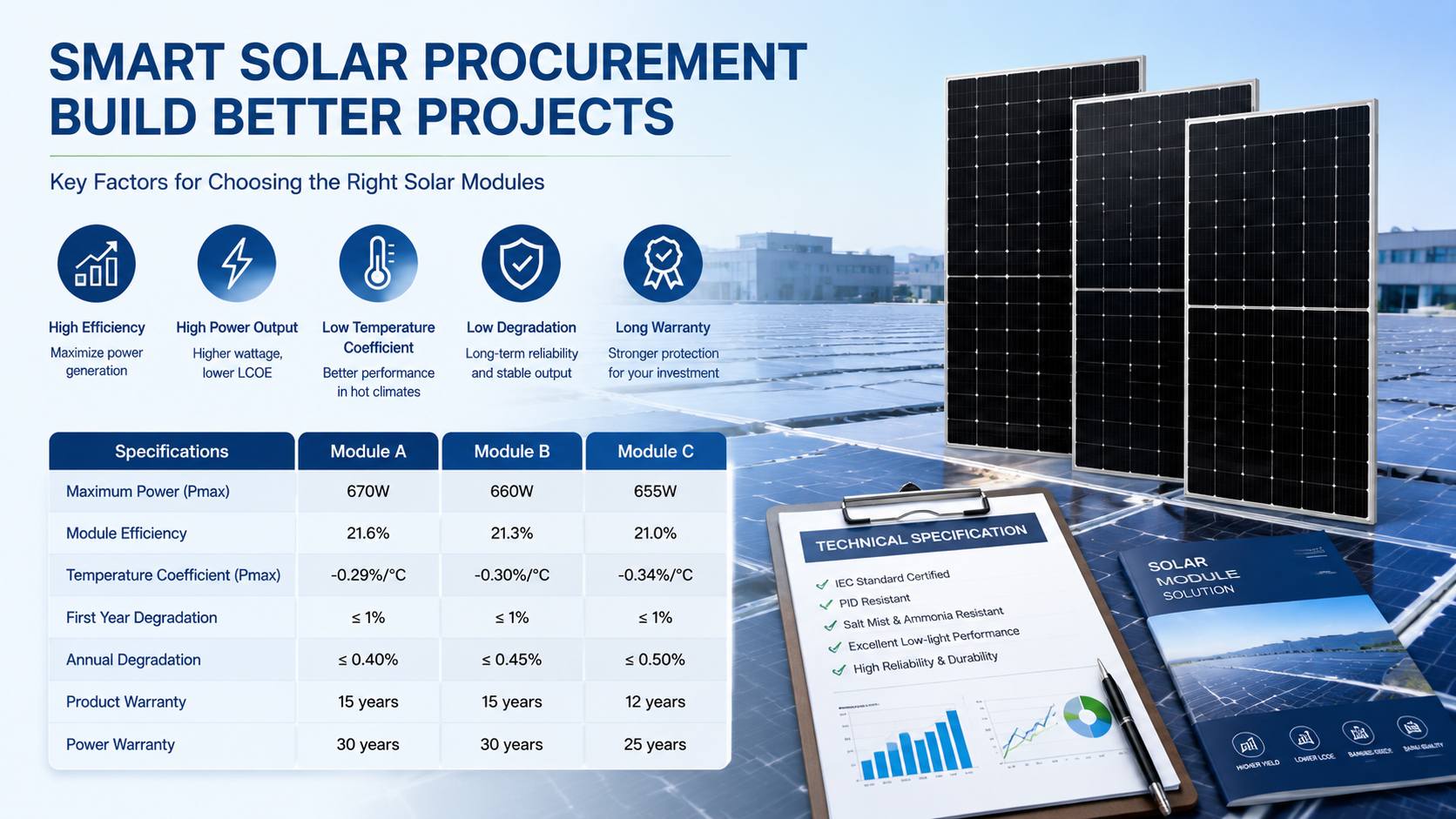
Instead of ranking the three manufacturers from first to third, use a project-based selection process.
Is it:
Your project type determines which module characteristics matter most.
For a small commercial rooftop, efficiency may be critical.For a large solar farm, land utilization and overall energy yield may become more important.
Compare:
Do not assume that one technology is universally better.
Compare:
This is much more meaningful than comparing brand names.
Look at:
The exact warranty terms vary by product and market.
For B2B buyers, supplier support matters.
Check:
Why Buy Solar Panels Through a Professional Supplier?
For international solar projects, buying directly from a recognized manufacturer is not always the only consideration.
A professional solar supplier can help customers compare products from multiple brands according to project requirements.
This can be particularly useful for EPC contractors and distributors who need to compare:
Jinko vs LONGi vs Trina vs other manufacturers
rather than being restricted to one brand.
A supplier with multiple product options can help buyers evaluate:
The goal should be to select the right module for the application rather than simply choosing the most recognizable brand.
Solarasia Power Solar Panel Options
Solarasia Power offers a broad range of solar panel products for international customers.
Its solar panel portfolio includes products from manufacturers such as:
The product range includes different technologies and power classes, including:
For buyers comparing Jinko, LONGi and Trina, the Solar Asia Power solar panel category provides a starting point for evaluating available products.
Explore Solar Asia Power Solar Panels:
https://www.solarasiapower.com/solar-panel
Jinko vs LONGi vs Trina: Quick Decision Guide
| Project Requirement | What to Prioritize |
|---|---|
| Small commercial rooftop | High efficiency |
| Large factory roof | High power + efficiency |
| Warehouse | Power density + installation |
| Utility solar farm | Energy yield + LCOE |
| Hot climate | Temperature coefficient |
| Bifacial project | Bifaciality + site design |
| Large procurement | Supply + documentation |
| Distributor | Product range + availability |
| EPC project | Datasheet + technical support |
| Space-constrained project | Highest practical efficiency |
The important point is that Jinko, LONGi and Trina can all be suitable choices.The winning product is the one that best matches the project's technical requirements and economics.
FAQs
Is Jinko better than LONGi?
Neither brand is universally better. Jinko and LONGi both offer high-efficiency solar panels across multiple product generations. Compare the exact models based on efficiency, power, temperature coefficient, degradation, warranty and price.
Is LONGi better than Trina Solar?
LONGi and Trina both offer advanced solar modules for residential, commercial and utility-scale applications. The better choice depends on the specific module and project requirements.
Is Jinko better than Trina Solar?
Jinko and Trina both provide high-efficiency N-type and bifacial module options. Buyers should compare specific models rather than selecting purely based on manufacturer name.
Which is better: Jinko, LONGi or Trina?
There is no universal winner. Jinko, LONGi and Trina are all strong options, and the best choice depends on the project type, module technology, efficiency, power output, price, availability and long-term energy yield.
Which solar panel brand is best for commercial projects?
Jinko, LONGi and Trina all offer products suitable for commercial projects. For a commercial buyer, module efficiency, power density, temperature performance, warranty, availability and total project economics are more important than brand ranking alone.
Are Jinko, LONGi and Trina solar panels N-type?
All three manufacturers offer N-type product lines, but the exact technology depends on the specific model and generation. Always check the current product datasheet.
Are Jinko, LONGi and Trina panels bifacial?
All three manufacturers offer bifacial products. Whether bifacial is beneficial depends on the mounting system, rear-side irradiance and project environment.
Which solar panel is best for a factory rooftop?
For a factory rooftop, look for high efficiency, appropriate module dimensions, suitable weight, strong temperature performance and high power density. The exact choice between Jinko, LONGi and Trina should be based on the project design.
Should I choose a 700W solar panel?
A 700W module can be useful for large commercial and utility projects, but wattage alone should not determine the purchase. Compare efficiency, physical dimensions, weight, electrical characteristics and total system design.
Conclusion
Jinko vs LONGi vs Trina is not a simple brand competition.
All three manufacturers offer modern photovoltaic modules for different applications, including residential, commercial, industrial and utility scale solar projects.
Jinko can be attractive for buyers looking for high-power N-type and TOPCon solutions. LONGi provides a broad portfolio of high efficiency photovoltaic technologies, while Trina offers high-power modules and solutions for large commercial and utility applications.
But the most important lesson is:
Don't choose a solar panel based only on its brand. Choose the specific module that provides the right combination of efficiency, power, temperature performance, degradation, warranty, availability and project economics.
Solarasia Power provides access to solar panel products from Jinko, LONGi, Trina and other major manufacturers, making it possible for commercial buyers and EPC companies to compare different technologies and product specifications in one place.
Explore the Solarasia Power solar panel range:
https://www.solarasiapower.com/solar-panel


Address : Room 908-909, Building 2, No. 469 Huatuo Lane, Shushan District, Hefei City, Anhui Province


Please read on, stay posted, subscribe, and we welcome you to tell us what you think.
Copyright 2026 @ Anhui Solarasia Energy Technology Co.,Ltd .All Rights Reserved. Sitemap | Blog | XML | Privacy Policy
 Network Supported