
HJT Solar Panels Explained: Efficiency, Benefits and Applications
The solar industry is continuously moving toward higher-efficiency technologies that can produce more electricity from limited installation areas. Among the latest N-type photovoltaic technologies, HJT solar panels have gained significant attention due to their high efficiency, excellent temperature performance, low degradation rate and strong bifacial capability.
HJT stands for Heterojunction Technology, a solar cell architecture that combines crystalline silicon with thin layers of amorphous silicon to improve energy conversion performance.
Compared with traditional P type PERC modules, HJT solar panels offer advantages in efficiency, temperature coefficient and long-term energy output. They are increasingly used in commercial rooftops, industrial solar systems, utility-scale projects and high-performance solar installations.
For solar distributors, EPC companies and project developers, understanding HJT technology helps determine whether these modules are suitable for future solar projects.
What Are HJT Solar Panels?
HJT solar panels are high-efficiency photovoltaic modules that use Heterojunction Technology, combining crystalline silicon with thin-film amorphous silicon layers to reduce energy losses and improve performance.
Unlike conventional solar cells that use a single silicon structure, HJT cells combine different semiconductor materials.
A typical HJT solar cell includes:
This unique structure creates an efficient interface between different materials, helping reduce electron losses during electricity generation.
HJT is considered one of the major next-generation solar technologies alongside:
How Does HJT Solar Technology Work?
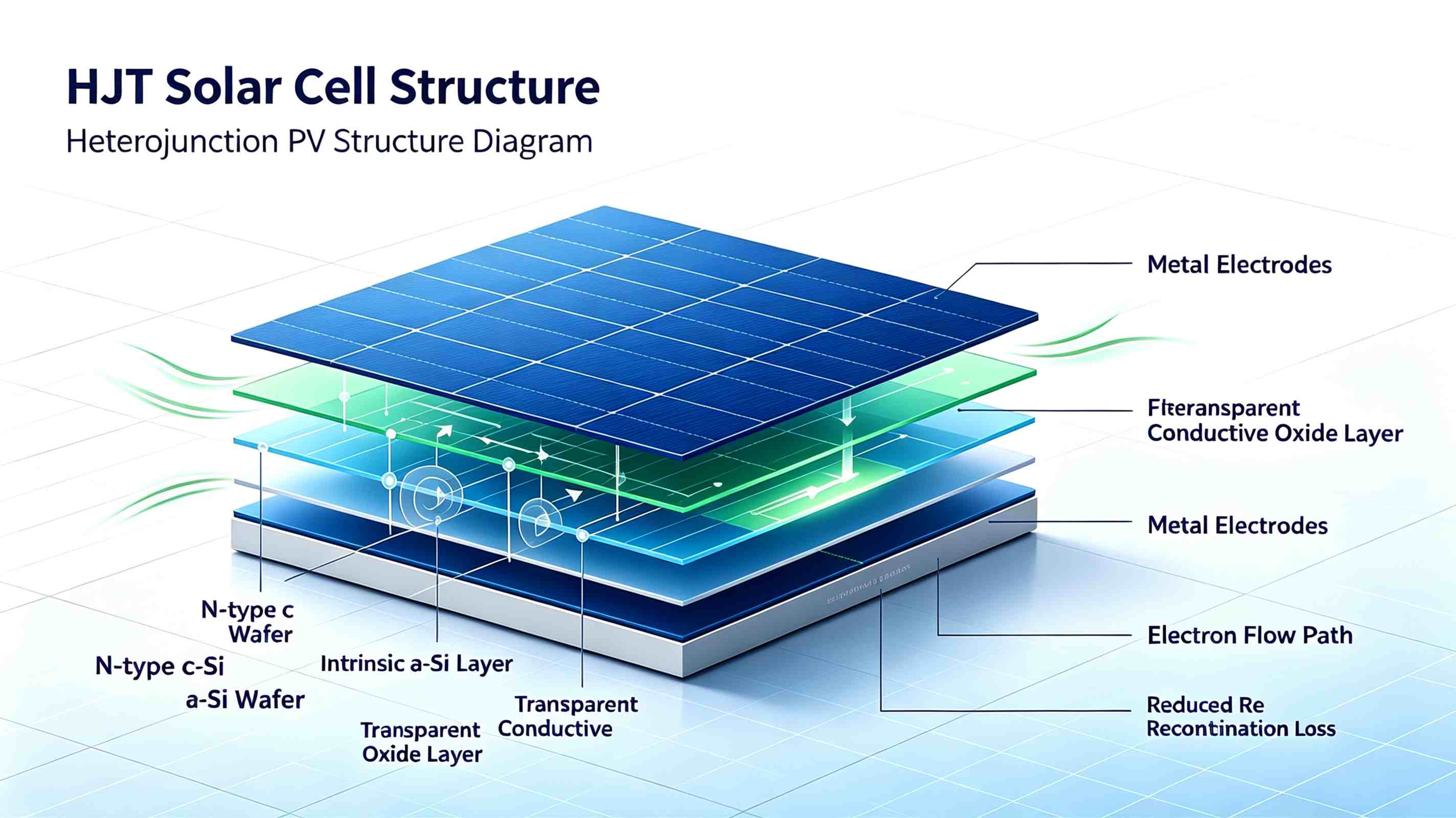
Solar panels generate electricity when sunlight creates electrical charges inside the solar cell.
However, some generated electrons are lost through recombination.HJT technology improves this process by using a heterojunction structure.
The thin amorphous silicon layers provide excellent surface passivation, reducing recombination losses. Meanwhile, the transparent conductive oxide layer helps collect electrical charges efficiently.
The result is:
The main advantage of HJT is the combination of crystalline silicon reliability with thin film passivation technology.
HJT Solar Panels vs TOPCon Solar Panels
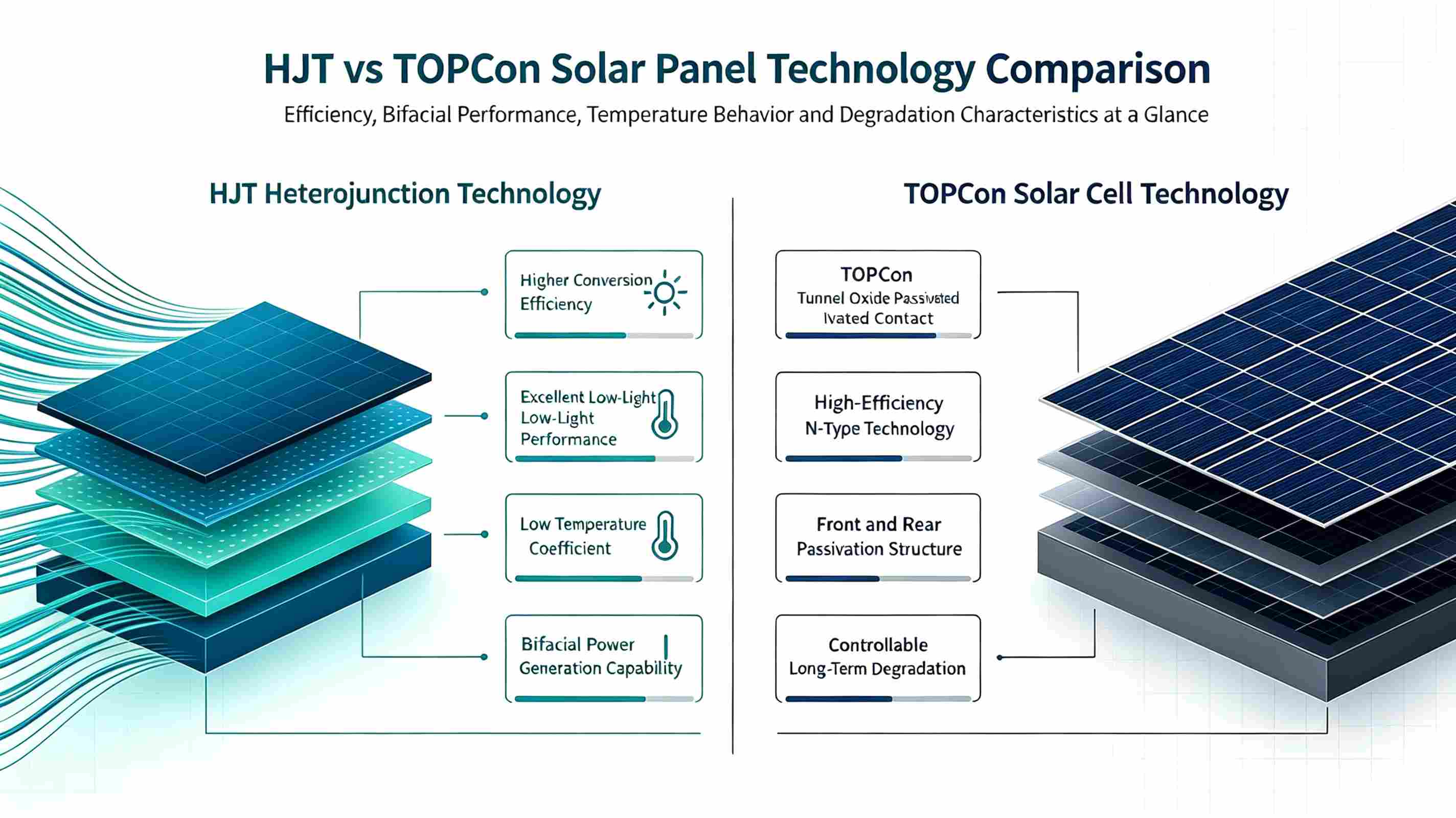
Both HJT and TOPCon are N-type high-efficiency solar technologies.
They have similar goals:
However, their structures are different.
| Feature | HJT Solar Panels | TOPCon Solar Panels |
|---|---|---|
| Cell type | N-type silicon + amorphous silicon layers | N-type silicon + passivated contact |
| Technology generation | Advanced N-type technology | Advanced N-type technology |
| Efficiency potential | Very high | Very high |
| Temperature performance | Excellent | Improved |
| Bifacial capability | Excellent | Excellent |
| Manufacturing process | Requires specialized equipment | Easier transition from PERC production |
| Typical applications | Premium projects, C&I, utility | Wide commercial adoption |
There is no universal winner between HJT and TOPCon.
The better choice depends on:
For example:
How Efficient Are HJT Solar Panels?
Efficiency is one of the biggest advantages of HJT technology.
Laboratory HJT cells have achieved very high efficiency levels, and commercial HJT modules are among the highest-efficiency crystalline silicon products available.
Solar Asia Power currently lists Huasun HJT solar modules with power ranges reaching 720W–760W and module efficiency up to approximately 24.5% depending on the product model.
Higher efficiency provides several benefits:
For commercial projects where roof space is limited, efficiency becomes an important economic factor.
Key Benefits of HJT Solar Panels
1. High Conversion Efficiency
The primary advantage of HJT technology is high efficiency.
Because HJT cells combine excellent passivation with efficient charge collection, they can achieve higher conversion performance compared with many conventional solar technologies.
This makes HJT suitable for:
2. Excellent Temperature Performance
Solar panels usually lose power as operating temperatures increase.
This is especially important in regions with:
HJT modules typically have a favorable temperature coefficient compared with many traditional modules.
This means they can maintain better output when operating under high temperatures.
For projects in:
temperature performance can significantly influence annual energy production.
3. Lower Degradation Rate
Solar panels produce electricity for decades, so long-term performance matters.HJT technology benefits from stable N-type silicon characteristics and advanced cell structure.Lower degradation can help maintain higher energy output throughout the system lifetime.
For commercial investors, this means:
However, buyers should always check the specific manufacturer's warranty documents because degradation values vary between products.
4. Strong Bifacial Performance
Many HJT modules are designed with bifacial capability.
A bifacial solar panel can generate electricity from:
This makes HJT suitable for:
The actual additional energy gain depends on:
5. Excellent Low-Light Performance
Solar systems do not only operate during perfect sunny conditions.
Energy production also occurs during:
HJT modules can provide strong performance under lower irradiance conditions because of their advanced cell structure.This can improve daily energy generation profiles.
HJT Solar Panels and Bifacial Technology
Bifacial HJT modules combine two advanced technologies:
This combination creates strong potential for high-energy-yield projects.
Typical applications include:
Large ground-mounted projects can benefit from:
Businesses can maximize electricity production from limited roof space.

Bifacial modules can take advantage of reflected light from surrounding surfaces.
HJT Solar Panels for Commercial Projects
Commercial and industrial solar projects often face space limitations.
Factories and warehouses usually need to maximize energy output while working within:
HJT panels can help by providing:
For companies with high daytime electricity demand, HJT systems can reduce grid dependence and improve energy management.
HJT Solar Panels for Utility Scale Solar Farms
Utility scale projects focus heavily on lifetime energy production.
Important factors include:
HJT modules can be attractive because they combine:
However, project developers should compare HJT with TOPCon and other technologies based on the complete project economics.
What Buyers Should Consider Before Purchasing HJT Solar Panels?
Before purchasing HJT modules, professional buyers should evaluate:
| Specification | Importance |
|---|---|
| Module efficiency | Determines energy density |
| Maximum power output | Affects system capacity |
| Temperature coefficient | Important in hot climates |
| Bifacial factor | Impacts additional generation |
| Degradation rate | Affects lifetime output |
| Module dimensions | Installation compatibility |
| Weight | Structural requirements |
| Warranty | Long-term protection |
| Certifications | Market compliance |
| Supplier capability | Delivery and technical support |
For international projects, choosing a reliable supplier is as important as selecting the right technology.
Solarasia Power HJT Solar Panel Solutions
Solarasia Power provides a wide range of solar panel solutions including:
The Solarasia Power product portfolio includes HJT modules from recognized manufacturers such as Huasun.
The listed Huasun HJT series provides:
These products are suitable for:
Internal link:
Solarasia Power Solar Panels:China Manufacturer Of High-Quality Solar Panels | Solarasiapower.com
FAQs
What does HJT mean in solar panels?
HJT means Heterojunction Technology. It combines crystalline silicon with thin amorphous silicon layers to improve solar cell efficiency and reduce energy losses.
Are HJT solar panels better than TOPCon?
HJT and TOPCon are both advanced N-type technologies. The better option depends on project requirements, cost, efficiency needs and long-term energy goals.
Are HJT solar panels bifacial?
Yes. Many commercial HJT modules support bifacial electricity generation, allowing power production from both front and rear sides.
What is the efficiency of HJT solar panels?
Commercial HJT module efficiency varies by manufacturer and model. Some modern HJT modules achieve efficiency above 24%.
Are HJT solar panels suitable for commercial projects?
Yes. Their high efficiency, temperature performance and long-term stability make them suitable for commercial, industrial and utility applications.
Do HJT panels perform better in hot climates?
HJT modules generally have strong temperature performance compared with many traditional technologies, making them suitable for hot regions.
How long do HJT solar panels last?
Like other high-quality photovoltaic modules, HJT panels are designed for long-term operation, commonly with 25-year or longer performance warranties depending on the manufacturer.
Conclusion
HJT solar panels represent one of the most advanced developments in modern photovoltaic technology.
By combining crystalline silicon with thin-film heterojunction layers, HJT modules achieve excellent efficiency, strong temperature performance, low degradation characteristics and powerful bifacial capabilities.
For commercial rooftops, industrial facilities and utility-scale projects, HJT technology provides an attractive solution where maximizing energy production and long-term reliability are important.
However, the best solar module depends on the complete project requirements, including:
Solarasia Power provides multiple high efficiency solar panel technologies, including HJT, TOPCon and other N-type modules, helping global customers select the right solution for different solar applications.


Address : Room 908-909, Building 2, No. 469 Huatuo Lane, Shushan District, Hefei City, Anhui Province


Please read on, stay posted, subscribe, and we welcome you to tell us what you think.
Copyright 2026 @ Anhui Solarasia Energy Technology Co.,Ltd .All Rights Reserved. Sitemap | Blog | XML | Privacy Policy
 Network Supported