
TOPCon Solar Panels Explained: Efficiency, Benefits and Applications
As solar projects become larger and available installation space becomes more valuable, TOPCon solar panels have become an important technology for high-efficiency photovoltaic systems.
TOPCon stands for Tunnel Oxide Passivated Contact. It is a passivated-contact solar cell architecture designed to reduce recombination losses while allowing efficient charge-carrier transport. The technology was developed at Fraunhofer ISE and has since moved from laboratory research into commercial PV manufacturing.
Today, N-type TOPCon modules are available in high-power formats for commercial rooftops, industrial facilities and utility-scale solar projects. Solar Asia Power's current product portfolio includes several N-type TOPCon options from manufacturers such as Trina and Jinko, including modules in the 700W-class range.
For project developers and solar distributors, the important question is not simply whether TOPCon is a newer technology. The better question is:
How does TOPCon affect efficiency, energy yield, degradation, installation economics and long-term project value?
What Are TOPCon Solar Panels?
TOPCon solar panels are photovoltaic modules that use Tunnel Oxide Passivated Contact technology at the solar-cell level.
The key feature is a very thin tunnel oxide combined with a silicon-based contact layer. This creates a passivated contact that helps reduce unwanted carrier recombination while maintaining efficient electrical transport. Fraunhofer ISE describes TOPCon as a charge-carrier-selective contact technology that combines strong passivation with efficient carrier transport.
In practical terms, this means TOPCon is designed to reduce some of the electrical losses that limit conventional crystalline-silicon cells.
Most commercial TOPCon modules today use N-type silicon, although the underlying TOPCon concept is broader than simply being synonymous with N-type.
This is why the terms are often seen together:N-type + TOPCon + bifacial + high-power module
For buyers, however, these terms describe different aspects of the product and should not be treated as interchangeable.
How Does TOPCon Technology Work?
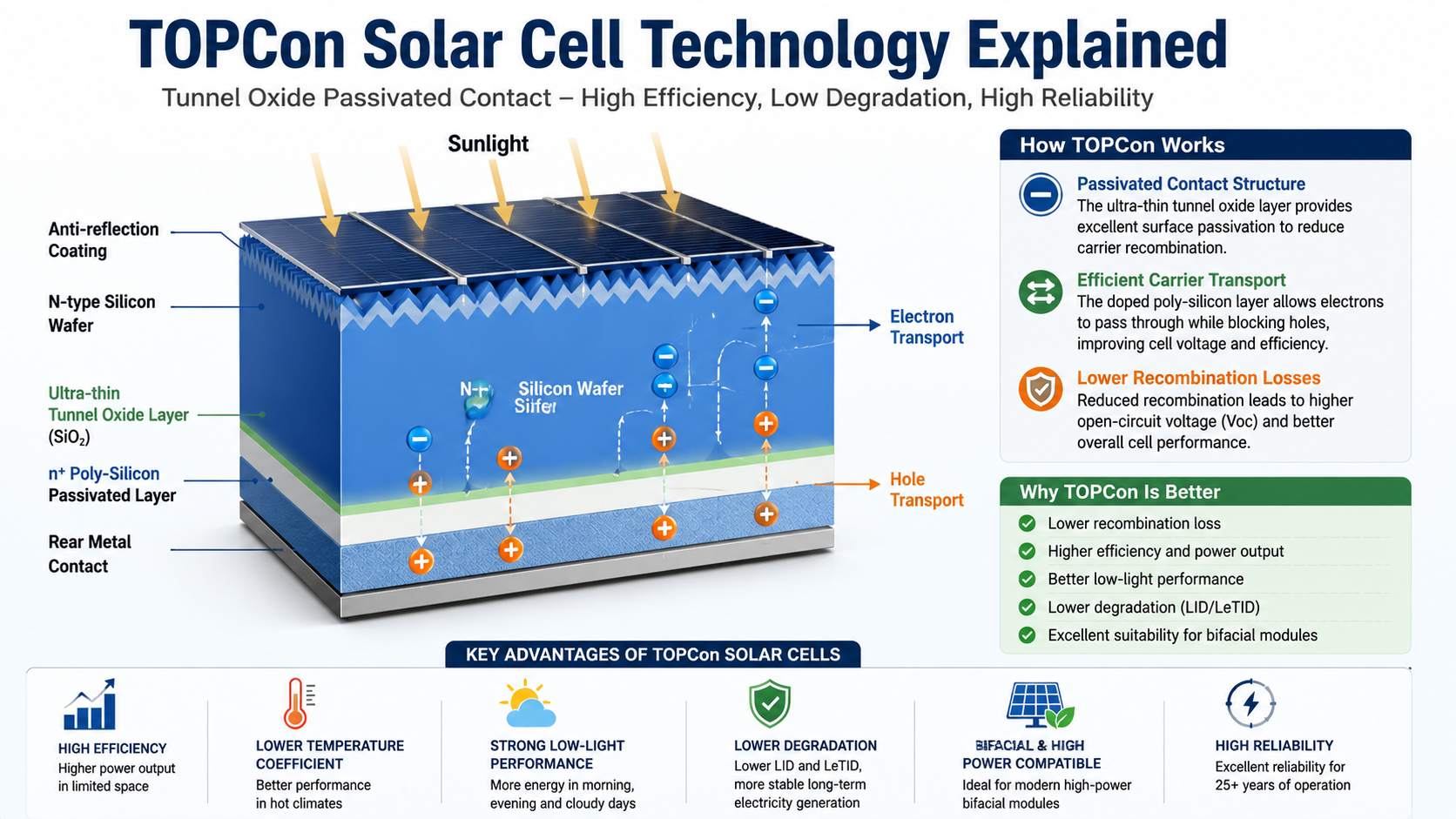
A simplified solar-cell structure contains several layers that help absorb sunlight, separate electrical charges and transport those charges to the external circuit.
One of the major challenges is recombination.
When electrons and holes recombine before being collected, some of the energy that could have been converted into electricity is lost.
TOPCon addresses this through a passivated contact structure.
The tunnel oxide layer is extremely thin. It helps passivate the silicon surface while allowing majority charge carriers to pass through the contact structure. This combination can improve voltage and reduce recombination-related losses.
Fraunhofer ISE has demonstrated the underlying potential of TOPCon through high-efficiency N-type silicon cells. Its research reports that TOPCon's passivated contact can achieve excellent carrier selectivity while maintaining low transport losses.
For module buyers, the result is more important than the microscopic structure:
Better cell-level electrical performance can contribute to higher module efficiency and energy yield.
TOPCon vs PERC: What Is the Difference?
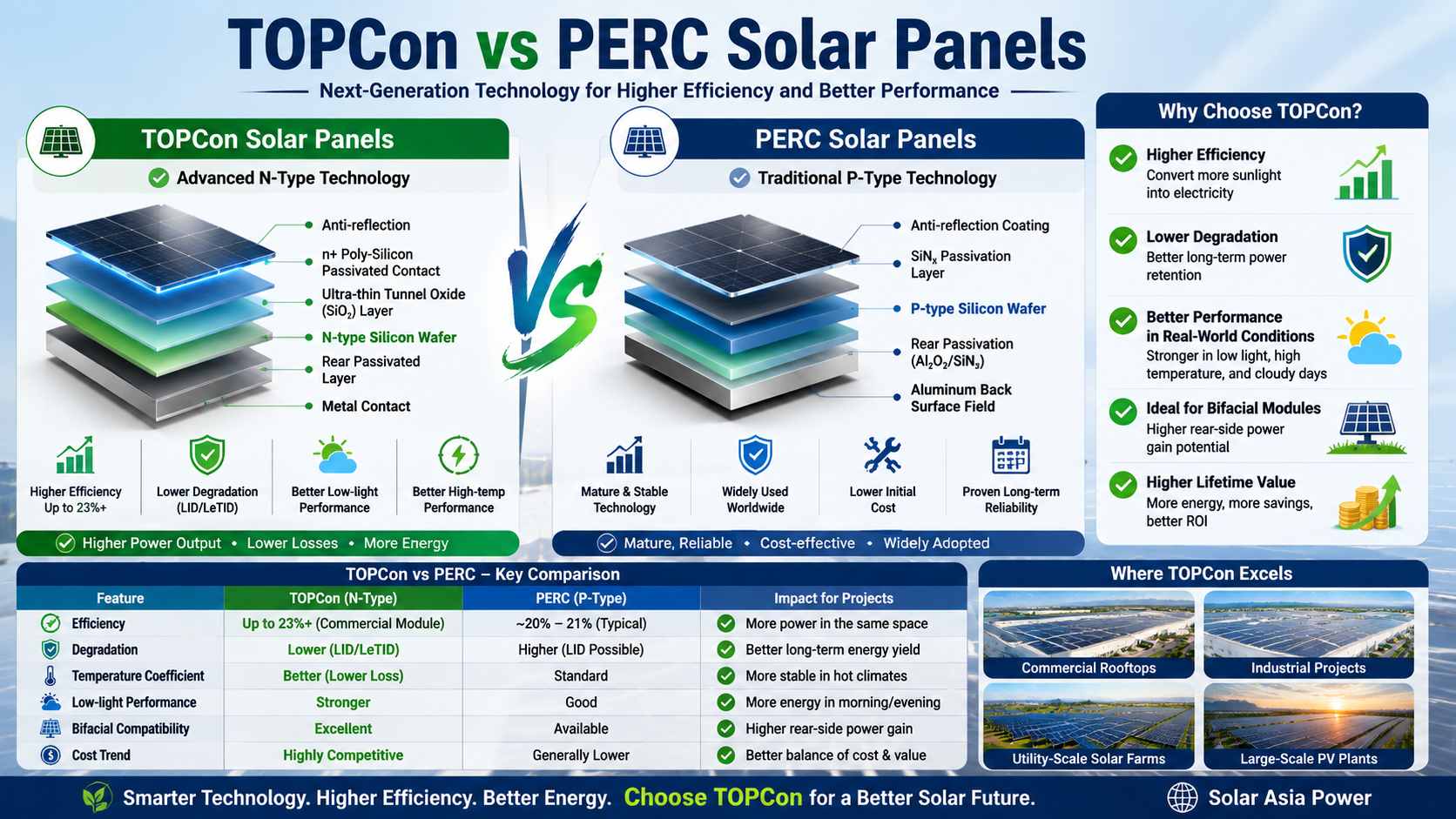
TOPCon and PERC are both crystalline-silicon solar-cell technologies, but they use different approaches to reduce losses.
PERC stands for Passivated Emitter and Rear Cell.
TOPCon uses a passivated contact structure with a tunnel oxide layer and is widely associated with N-type silicon in current commercial products.
| Feature | TOPCon | PERC |
|---|---|---|
| Common wafer type | N-type | Traditionally P-type |
| Cell architecture | Passivated contact | Passivated rear cell |
| Recombination control | Advanced passivated contact | Rear-side passivation |
| Commercial efficiency potential | High | Mature |
| Bifacial applications | Common | Available |
| Degradation characteristics | Product dependent | Product dependent |
| Current high-power market | Strong | Mature technology |
| Typical use | C&I and utility | Broad PV applications |
TOPCon's development is closely related to the industry's move toward higher-efficiency silicon technologies. Fraunhofer ISE notes that TOPCon addresses recombination losses through carrier-selective passivating contacts.
This does not mean every TOPCon panel is automatically better than every PERC panel. The module's complete specification, manufacturing quality, warranty, degradation characteristics and project economics still matter.
How Efficient Are TOPCon Solar Panels?
One of the biggest reasons to consider TOPCon is its potential for high module efficiency.
At the research level, TOPCon has demonstrated very high cell efficiencies. Fraunhofer ISE reported a 25.3% efficiency record for an N-type TOPCon silicon cell in its research project, demonstrating the technology's high-efficiency potential.
Commercial module efficiency is lower than laboratory cell efficiency and varies by manufacturer, cell format, module architecture and product generation.
For example, Solar Asia Power currently lists a Trina 700W–725W N-type TOPCon bifacial module with efficiency up to 23.3%. The site also lists Jinko Tiger Neo N-type TOPCon modules in the 700W, 705W and 710W range.
This makes TOPCon particularly interesting where available installation area is limited.
Higher efficiency means more rated power can potentially be installed within a given area.
Key Benefits of TOPCon Solar Panels
1. High Conversion Efficiency
The most obvious benefit is high efficiency.
For commercial rooftops, this can be especially valuable because the roof has a fixed physical area.
If two modules occupy a similar amount of space but one converts sunlight more efficiently, the higher-efficiency module can provide more installed capacity.
This can help businesses make better use of:
2. N-Type Silicon Advantages
Many commercial TOPCon products use N-type silicon.
N-type silicon has attracted significant attention because of its material properties and potential for high-efficiency cell architectures.
Fraunhofer ISE notes that N-type silicon has higher tolerance to certain impurities and that the lack of conventional light-induced degradation mechanisms associated with boron-oxygen defects is one reason N-type material has been attractive for high-efficiency solar cells.
However, buyers should always evaluate the actual manufacturer's degradation specification rather than assuming that every N-type product has identical performance.
3. Lower Degradation Potential
Solar panels gradually lose power over their operating life.
TOPCon modules can be designed with favorable degradation characteristics, but the exact rate depends on the product.
For example, manufacturers may specify:
These values should be checked in the manufacturer's product warranty.
For a 25- or 30-year project, even small differences in degradation can influence lifetime energy production.
4. Strong Low-Light Performance
Solar modules do not operate only under perfect midday sunlight.
They also generate energy during:
Some N-type TOPCon products are designed to perform well under lower irradiance.
Solar Asia Power's listed Jinko TOPCon product description specifically highlights improved low-light performance as one of the technology's benefits.
For project developers, the important metric is ultimately annual energy yield, not simply the laboratory efficiency number.
5. Suitable for Bifacial Applications
TOPCon technology is commonly used in bifacial solar modules.
A bifacial module can generate electricity from light reaching both its front and rear surfaces.
This can be particularly useful for:
The actual bifacial gain depends heavily on project conditions.
Factors include:
Therefore, a bifacial TOPCon module does not guarantee a fixed percentage of additional energy. The project needs to be modeled according to local conditions.
TOPCon Performance in Different Conditions
Choosing a solar panel based only on its STC efficiency is not enough.
Commercial buyers should also look at how the module performs under real operating conditions.
High Temperature
Solar modules generally experience lower voltage and power as cell temperature increases.
Therefore, the temperature coefficient is an important specification for projects in hot climates.
A module with a favorable temperature coefficient can potentially maintain more power during high-temperature operation.
Low Irradiance
Low-light behavior becomes important when solar irradiance is below standard test conditions.
TOPCon products can offer strong low-irradiance performance, but buyers should compare the actual datasheets rather than relying on technology labels alone.
Degradation
For a commercial solar project, degradation affects lifetime revenue.
A project developer should therefore compare:
Initial power + first-year degradation + annual degradation + warranty period
rather than simply comparing the initial wattage.
TOPCon Solar Panels for Commercial Projects
TOPCon is particularly relevant to commercial and industrial projects because these systems often have two competing requirements:
High energy production + limited installation space.
A factory roof may have a large surface area, but not every part of the roof can be used because of:
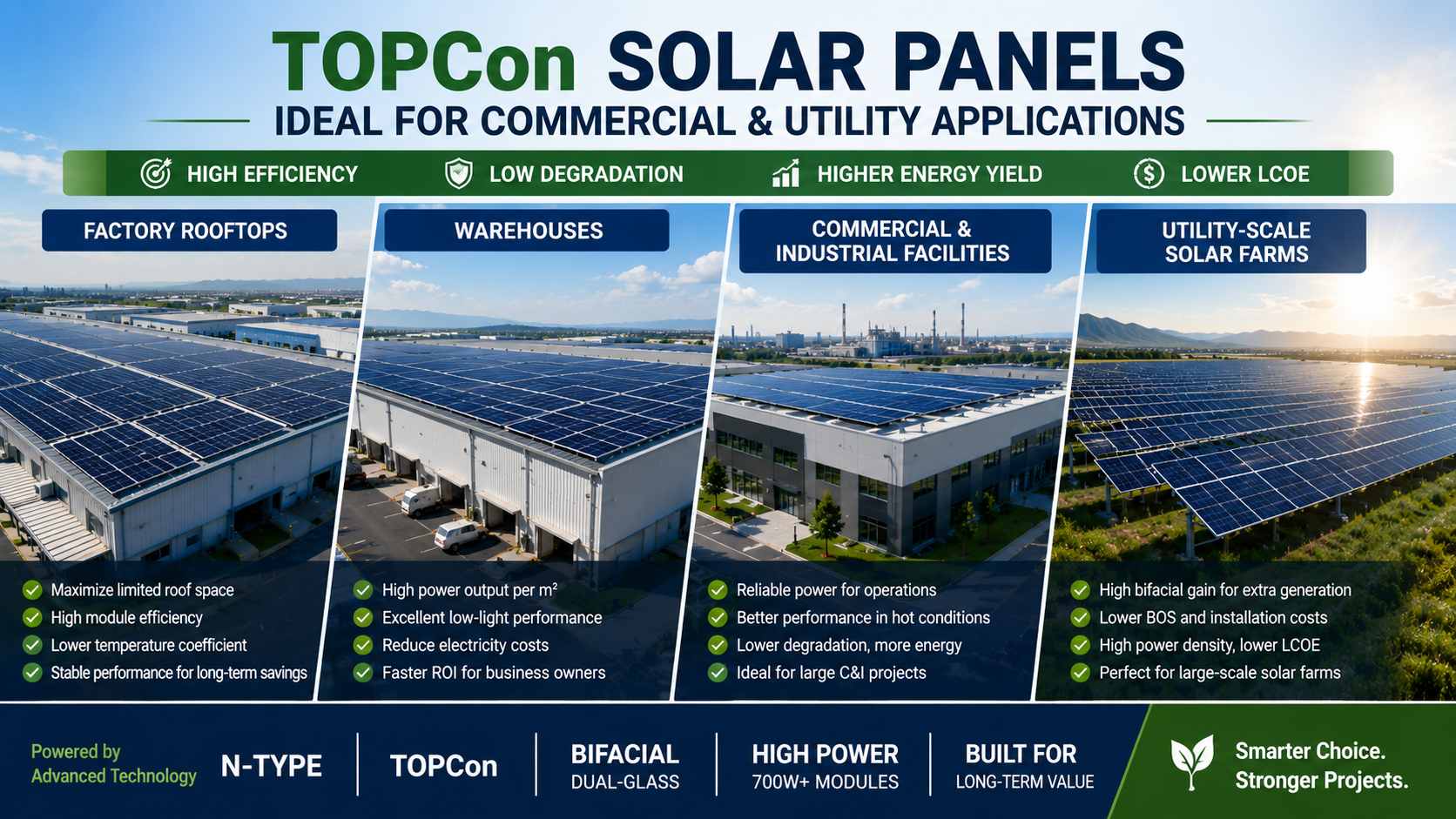
Higher-efficiency TOPCon modules can help maximize usable roof area.
Solar Asia Power lists Trina 700W–725W TOPCon bifacial modules as suitable for utility-scale and C&I applications, including large commercial PV projects.
Explore Solar Asia Power Solar Panels
TOPCon Solar Panels for Utility-Scale Projects
Utility-scale solar farms have different priorities.
Instead of maximizing energy from a single rooftop, developers are usually focused on:
High-power TOPCon bifacial modules can be attractive because they combine high output with bifacial generation potential.
Solar Asia Power's product range includes 700W-class Jinko and Trina N-type TOPCon modules alongside higher-power products using other N-type technologies.
This allows project developers to compare TOPCon against HJT and ABC technologies based on project requirements rather than selecting purely by nominal wattage.
TOPCon for Factory and Warehouse Rooftops
For factory and warehouse projects, power density can be particularly important.
Suppose a warehouse has a fixed usable roof area.
The project team needs to maximize the amount of electricity generated from that space without exceeding structural or electrical constraints.
A high-efficiency TOPCon module can help increase the installed capacity of the available area.
However, module dimensions and weight must still be checked.
A larger module is not automatically easier to install.
For rooftop projects, buyers should compare:
This is why commercial procurement should evaluate the entire module datasheet rather than just asking for the highest wattage.
What Should Buyers Check Before Purchasing TOPCon Panels?
Before selecting a TOPCon module for a commercial project, review these specifications:
| Specification | Why It Matters |
|---|---|
| Maximum power | Determines module output |
| Module efficiency | Important where space is limited |
| Cell technology | Confirms TOPCon/N-type architecture |
| Bifaciality | Important for bifacial projects |
| Voc | Determines string voltage |
| Isc | Important for electrical design |
| Vmp | Inverter/string compatibility |
| Imp | Current matching |
| Temperature coefficient | Hot-climate performance |
| Module dimensions | Roof and mounting compatibility |
| Weight | Structural and installation considerations |
| Degradation | Long-term energy production |
| Product warranty | Risk management |
| Performance warranty | Long-term output expectations |
| Mechanical load | Wind/snow requirements |
| Certifications | Market and project compliance |
PV module qualification should also be checked against the standards required by the target market. IEC 61215 addresses design qualification and type approval for terrestrial PV modules, while IEC 61730 covers PV module safety qualification.
Solar Asia Power's TOPCon Solar Panel Options
Solar Asia Power currently offers a range of solar panel technologies, including N-type, bifacial, monocrystalline and Tier 1 solar panels. Its category page lists products from Jinko, LONGi, Trina, Canadian Solar, JA Solar, Huasun and AIKO, among others.
For buyers specifically interested in TOPCon, several products are particularly relevant.
Solar Asia Power lists a Trina 700W–725W N-type TOPCon bifacial dual-glass solar panel, with listed maximum efficiency of up to 23.3%. The product is positioned for utility-scale and C&I solar projects.
View Trina TOPCon Solar Panels
The site also lists Jinko Tiger Neo N-type 700W, 705W and 710W bifacial modules using TOPCon technology. The product description highlights low LID/LeTID degradation and low-light performance.
View Jinko TOPCon Solar Panels
TOPCon is not the only high-efficiency N-type technology available.
Solar Asia Power also lists:
For example, the listed Huasun HJT series reaches up to 24.5% efficiency, while the listed AIKO ABC series reaches up to 24.9%.
This creates an opportunity for commercial buyers to compare TOPCon vs HJT vs ABC based on efficiency, power, bifacial performance, temperature behavior, degradation, cost and project-specific energy yield.
TOPCon Solar Panels Buying Checklist
Before placing a bulk order, commercial buyers should ask the supplier:
For international commercial projects, supplier capability is just as important as the module specification.
A competitive solar panel supplier should be able to provide consistent product documentation, technical support, logistics coordination and project-specific assistance.
FAQs
What does TOPCon stand for in solar panels?
TOPCon stands for Tunnel Oxide Passivated Contact. It is a passivated-contact solar-cell technology designed to reduce recombination losses and improve charge-carrier selectivity.
Are TOPCon solar panels better than PERC panels?
TOPCon offers a higher-efficiency technology path and is widely used in modern N-type modules. However, whether a specific TOPCon panel is better for a project depends on efficiency, degradation, cost, energy yield and other technical specifications.
Are TOPCon solar panels N-type?
Most current commercial TOPCon products use N-type silicon, which is why "N-type TOPCon" is a common product description. However, TOPCon refers specifically to the passivated-contact architecture rather than simply the wafer type.
Are TOPCon solar panels bifacial?
Many commercial TOPCon modules are bifacial. Bifaciality can provide additional energy from rear-side irradiance, but the actual gain depends on the mounting system and site conditions.
Are TOPCon panels good for commercial solar projects?
Yes. Their high efficiency, high-power formats and availability as bifacial modules make TOPCon a strong option for commercial rooftops, industrial facilities and utility-scale projects.
What efficiency can TOPCon solar panels reach?
Efficiency varies by cell and module design. Research TOPCon cells have exceeded 25%, while commercial module efficiency varies by manufacturer and product. For example, Solar Asia Power lists a Trina 700W–725W TOPCon product with efficiency up to 23.3%.
Is TOPCon better than HJT?
Neither technology is universally better. TOPCon and HJT have different manufacturing approaches and performance characteristics. Buyers should compare actual module efficiency, temperature coefficient, bifaciality, degradation, price and lifetime energy yield.
What should I consider when buying TOPCon solar panels?
Consider efficiency, power, dimensions, weight, electrical characteristics, bifaciality, temperature coefficient, degradation, warranty, certifications, supplier reliability and total project economics.
Conclusion
TOPCon solar panels are one of the key high-efficiency technologies for modern crystalline-silicon PV systems.
Their passivated-contact architecture is designed to reduce recombination losses while maintaining efficient charge-carrier transport. Combined with N-type silicon, bifacial module designs and large-format wafers, TOPCon can provide a strong combination of efficiency, power output and long-term performance.
For commercial and industrial projects, TOPCon can be especially attractive when installation space is limited and high energy production is important.
For utility-scale projects, high-power bifacial TOPCon modules can also help optimize module count, land utilization and BOS economics.
However, the best solar panel is not necessarily the one with the highest wattage or efficiency.
A professional procurement decision should compare:
Efficiency + power + bifaciality + degradation + temperature performance + dimensions + BOS + lifetime energy yield + total cost.
Solar Asia Power currently offers Trina 700W–725W and Jinko 700W–710W N-type TOPCon modules, alongside HJT and ABC technologies, allowing commercial buyers and EPC companies to compare different high-efficiency module solutions for their projects.
Explore Solar Asia Power's Solar Panel Range


Address : Room 908-909, Building 2, No. 469 Huatuo Lane, Shushan District, Hefei City, Anhui Province


Please read on, stay posted, subscribe, and we welcome you to tell us what you think.
Copyright 2026 @ Anhui Solarasia Energy Technology Co.,Ltd .All Rights Reserved. Sitemap | Blog | XML | Privacy Policy
 Network Supported