
700W vs 800W Solar Panels: Which Is Better for Commercial Projects?
When planning a large commercial or utility-scale solar project, 700W vs 800W solar panels can look like a simple comparison. An 800W module produces more rated power than a 700W module, so it may appear to be the obvious choice.
But commercial solar design is more complicated than comparing the number printed on the module.
An 800W panel can provide higher power per module and potentially reduce the number of modules needed for a given DC capacity. However, module dimensions, weight, efficiency, electrical characteristics, mounting compatibility, inverter design, installation logistics and site conditions all affect the final result.
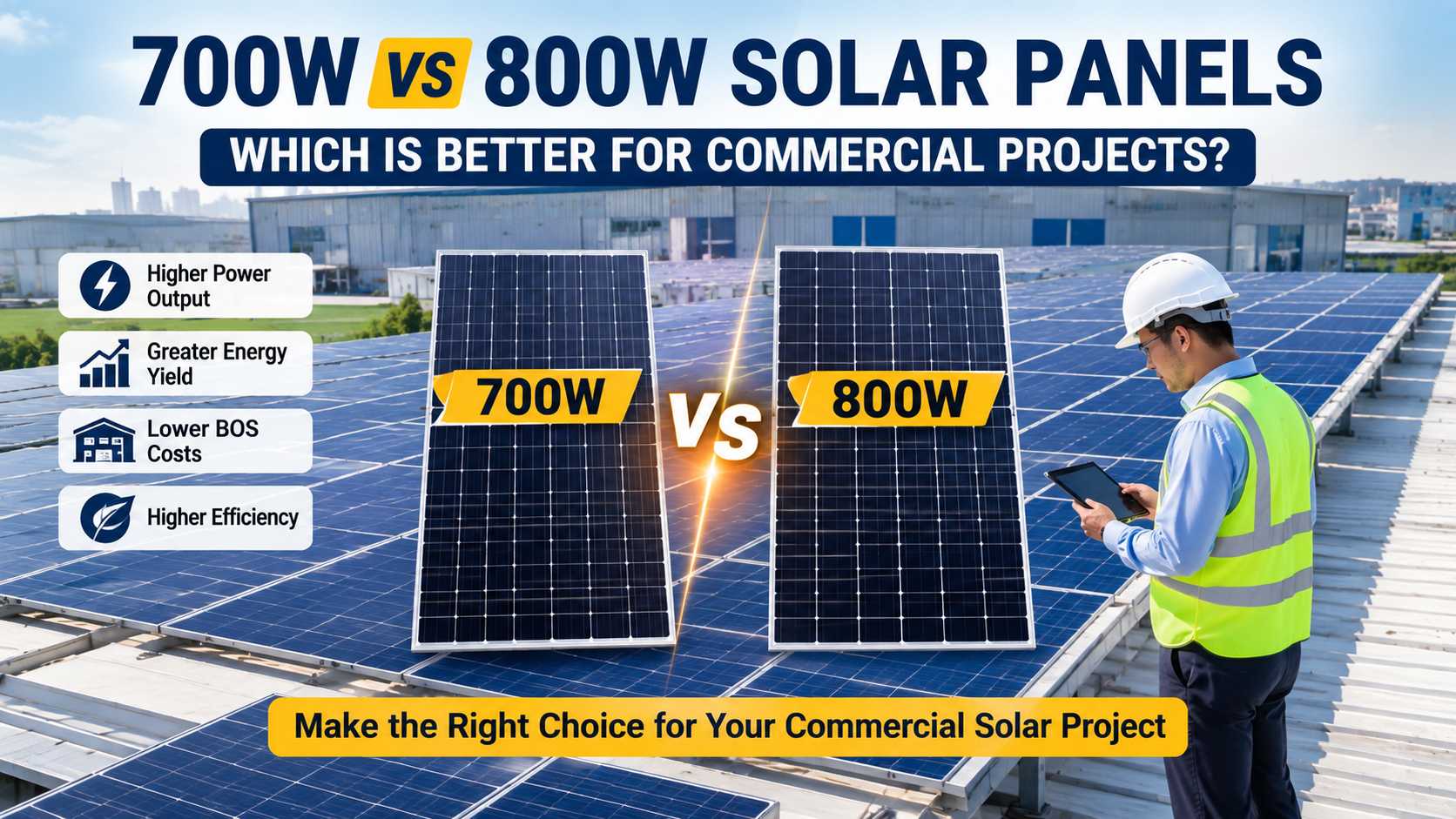
For some large ground mounted projects, 800W class modules can be attractive. For other commercial rooftops or projects with specific structural and installation constraints, a 700W class module may provide a better overall solution.
Solarasia Power's current portfolio already covers this high power range, including Trina 700W–725W N-type TOPCon modules, Jinko 700W–710W N-type bifacial modules, and AIKO 765W–800W N-type ABC bifacial modules.
What Does 700W or 800W Mean?
The wattage of a solar panel refers to its rated maximum power output under standardized test conditions.
A 700W module is rated at approximately 700 watts under the applicable test conditions, while an 800W module is rated at approximately 800 watts.
In simple terms:
800W ÷ 700W = 1.143
So an 800W panel has approximately 14.3% more nameplate power per module than a 700W panel.
However, this does not mean that an 800W panel will always produce 14.3% more electricity in real-world operation.
Actual energy production depends on factors such as:
This distinction is critical when comparing commercial modules.
700W vs 800W Solar Panels at a Glance
| Factor | 700W Solar Panel | 800W Solar Panel |
|---|---|---|
| Rated power | 700W | 800W |
| Power per module | High | Very high |
| Number of modules for same DC capacity | Higher | Lower |
| Potential installation efficiency | High | Very high |
| Module size | Depends on model | Depends on model |
| Module weight | Depends on model | Depends on model |
| Logistics | Potentially easier | May require additional planning |
| Commercial rooftop suitability | Strong | Site dependent |
| Large ground-mounted projects | Strong | Strong |
| BOS optimization potential | Good | Potentially better |
| Design complexity | Moderate | Can be higher |
| Best use case | Flexible commercial design | Large-scale high-density systems |
The key point is that module wattage should be evaluated together with the physical and electrical specifications of the module.
Why Are Higher Watt Solar Panels Becoming Popular?
One major reason is the increasing scale of commercial and utility solar projects.
Large projects may require tens of thousands of modules. If each module provides more power, fewer modules can potentially be required to reach the same DC capacity.
For example, consider a simplified 10 MW DC project:
That is a difference of roughly 1,786 modules.
This is a theoretical comparison and does not account for project-specific DC sizing, module availability, inverter limits or layout constraints.
Nevertheless, it illustrates why higher-power modules can attract attention from large-scale EPC companies and project developers.
Fewer modules can potentially influence:
The actual savings must be calculated from the complete project design rather than assumed from module wattage alone.
700W Solar Panels: Advantages and Limitations
A 700W solar panel can be an excellent choice for commercial projects, particularly when the module has a strong combination of efficiency, reliability and electrical characteristics.
Solarasia Power currently lists Jinko Tiger Neo N-type bifacial modules in the 700W, 705W and 710W range. It also lists Trina N-type TOPCon modules beginning at 700W.
Advantages of 700W Modules
A 700W class module can offer:
The Jinko product listed by Solar Asia Power uses N-type TOPCon technology, with the product description highlighting lower LID/LeTID degradation and improved low-light performance.
Potential Limitations
The main disadvantage is simple:You may need more modules to reach the same total system capacity.
More modules can increase the number of mounting points, electrical connections and handling operations.
However, whether this creates a meaningful cost disadvantage depends on the specific module dimensions and system architecture.
800W Solar Panels: Advantages and Limitations
The main attraction of an 800W solar panel is its extremely high power density per module.
Solarasia Power currently lists an AIKO N-type ABC bifacial module in the 765W–800W range, with the listed product information stating efficiency up to 24.9%. The site positions this module for utility-scale and commercial solar installations.
Advantages of 800W Modules
An 800W module can potentially provide:
For a utility-scale project, these characteristics can be particularly attractive.
Potential Limitations
However, 800W does not automatically mean “better.”
Higher power modules can also have larger physical dimensions and greater weight, depending on the product.
That can affect:
Therefore, the actual datasheet is more important than the wattage label.
Compare Energy Density and Installation Space
For commercial projects, available space can be more important than module wattage.
Imagine two modules:
If the 800W module achieves its higher output without a proportionally large increase in physical area, it can provide greater power density.
That can be valuable for:
However, efficiency should be evaluated alongside module dimensions.
For example, Solar Asia Power lists the AIKO 765W–800W N-type ABC product with reported efficiency up to 24.9%, while its listed Trina 700W–725W N-type TOPCon product has reported efficiency up to 23.3%.
This shows why the comparison should not simply be:
700W vs 800W
It should be:Power + efficiency + dimensions + technology + project conditions.
Compare BOS and Installation Costs
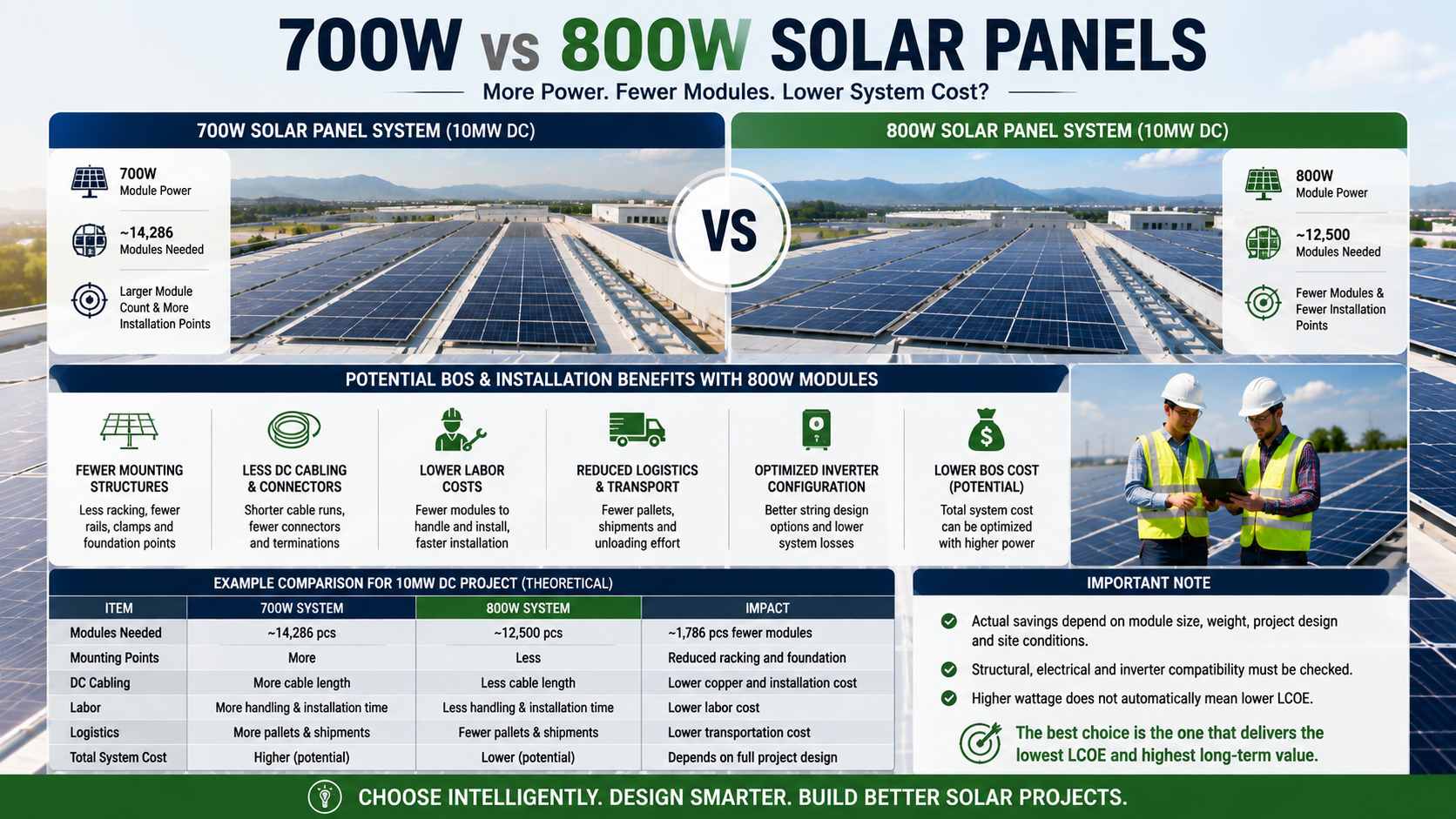
BOS means Balance of System.
It covers the equipment and installation components outside the PV modules themselves.
Depending on the project, BOS can include:
A higher power module may reduce the total module count.
That can potentially reduce some BOS costs.
For example, if a project requires 10 MW of DC capacity, using 800W modules instead of 700W modules theoretically reduces the number of modules from about 14,286 to 12,500.
But there is an important caveat:Fewer modules do not automatically mean lower total project cost.
If the 800W module requires a different mounting structure, larger installation equipment or more complex logistics, some of the potential savings may be offset.
That is why EPC companies should compare the complete system quotation rather than only the module price.
Does 800W Always Mean Higher Energy Yield?
No.
This is one of the most important points in the 700W vs 800W solar panels comparison.
Rated power is measured under standardized test conditions. Real-world energy yield depends on many additional variables.
Consider two hypothetical modules:
The 800W module could have the higher nameplate output while not necessarily delivering the best project-level economics.
Buyers should compare:Annual kWh generated per installed kW
and, where relevant:Annual kWh generated per square meter
rather than looking only at STC wattage.
For commercial procurement, the most useful question is:
Which module produces the best lifetime energy yield at the lowest total project cost?
N-Type and Bifacial Technology Matter More Than Wattage Alone
The modern high-power module market is increasingly centered on advanced cell technologies.
Solarasia Power's current product portfolio includes both N-type and bifacial categories.
For example:
This is important because a buyer should not compare only:700W vs 800W
but also:TOPCon vs HJT vs ABC
and:monofacial vs bifacial
and:efficiency vs degradation vs temperature coefficient.
For bifacial modules, project design also needs to consider rear-side irradiance, mounting height, surface reflectivity and shading.
700W vs 800W for Different Commercial Projects
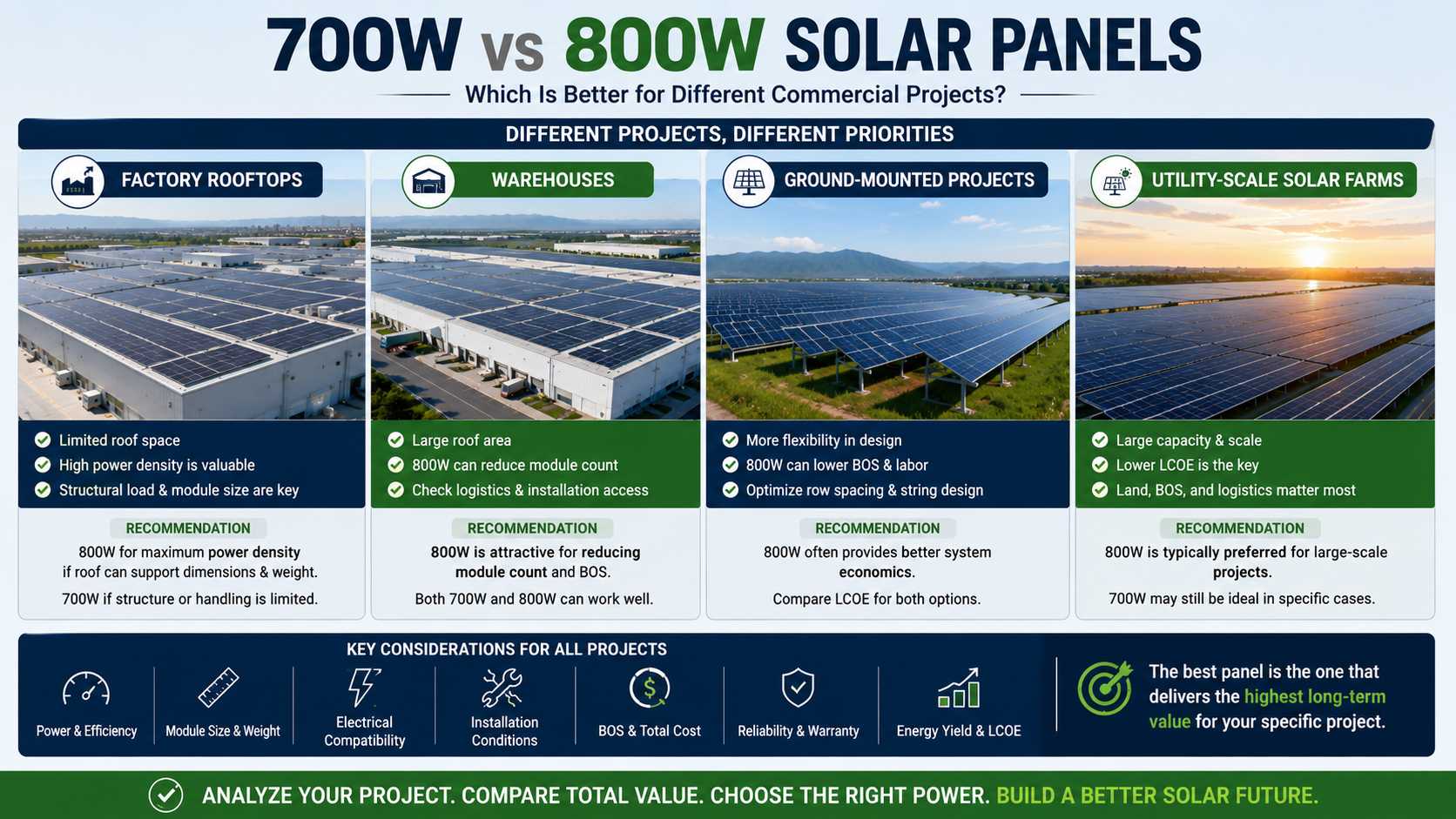
Factory Rooftops
For factory rooftops, both 700W and 800W modules can work well.
However, structural loading and module dimensions become particularly important.A factory roof with limited usable space may benefit from a high efficiency 800W module.A roof with tighter structural or installation constraints may be better suited to a slightly smaller module.
Recommendation: Compare efficiency, dimensions, weight and roof structure before selecting based on wattage.
Warehouses
Large warehouses often have expansive roofs, making high-power modules attractive.
An 800W module can potentially increase installed capacity while reducing the number of modules required.But roof structure, mounting layout and installation access should still be checked.
Recommendation: 800W is attractive when the warehouse structure and layout can accommodate the module format.
Ground Mounted Solar Projects
Ground mounted projects are among the strongest candidates for high-wattage modules.
There is generally more flexibility in:
This can make 800W class modules particularly interesting for large-scale projects.
Recommendation: Compare 700W and 800W using detailed energy-yield and LCOE modeling.
Utility Scale Solar Farms
For utility-scale projects, the focus should be on the total system economics.
Important metrics include:
In this environment, 800W-class modules can have significant advantages, but only when the module's electrical and mechanical characteristics fit the project.
How to Choose Between 700W and 800W Panels
A practical decision process looks like this.
Step 1: Determine the Required DC Capacity
Start with the project's energy requirements and system design.
Do not select the panel first.
Step 2: Check Available Installation Area
Measure usable rooftop or land area.
If space is limited, higher-efficiency and higher-power-density modules may have an advantage.
Step 3: Compare Module Dimensions
Never compare wattage without comparing dimensions.
An 800W module may be physically larger than a 700W module.
Step 4: Compare Efficiency
Efficiency tells you how much power the module produces relative to its area.
This is particularly important for commercial rooftops.
Step 5: Check Electrical Characteristics
Review:
These specifications must be compatible with the inverter and system design.
Step 6: Evaluate Bifacial Gain
If using bifacial modules, estimate whether the site can provide meaningful rear-side generation.
Step 7: Compare BOS Costs
Calculate the impact of module count on mounting, cabling, labor and other system components.
Step 8: Compare Lifetime Economics
Finally, compare:
Total investment → annual energy production → degradation → operating costs → expected project return
This is much more useful than comparing module prices alone.
Solarasia Power's 700W–800W Solar Panel Options
Solarasia Power is already positioned to support this comparison because its solar panel portfolio covers a wide range of module technologies, manufacturers and power classes. The category includes bifacial, monocrystalline, N-type, P-type and Tier 1 solar panels.
For the 700W-class segment, the site currently lists:
Trina 700W–725W N-type TOPCon bifacial modules, with the listed product information stating up to 23.3% efficiency and applications in utility-scale and C&I solar projects.
It also lists:
Jinko Tiger Neo 700W, 705W and 710W N-type bifacial modules, using TOPCon technology.
For the higher-power segment, Solar Asia Power lists:
AIKO N-type ABC bifacial modules from 765W to 800W, with the listed product information stating efficiency up to 24.9%.
The portfolio also includes Huasun HJT bifacial modules from 720W to 760W, providing another high-efficiency option between the typical 700W and 800W categories.
Explore Solar Asia Power Solar Panels
Commercial Solar Panel Selection Checklist
Before purchasing 700W or 800W solar panels, commercial buyers should check the following:
| Specification | What to Evaluate |
|---|---|
| Rated power | 700W, 800W or other available rating |
| Efficiency | Power output relative to module area |
| Cell technology | TOPCon, HJT, ABC, etc. |
| Bifaciality | Relevant for bifacial projects |
| Dimensions | Roof and mounting compatibility |
| Weight | Structural and installation requirements |
| Voc / Isc | Electrical system compatibility |
| Temperature coefficient | Performance in hot climates |
| Degradation | Long-term power retention |
| Mechanical load | Wind and snow requirements |
| Certifications | Required market and project standards |
| Warranty | Product and performance coverage |
| Supplier capability | Availability and delivery |
| Total cost | Module + BOS + installation |
| Energy yield | Expected annual production |
| LCOE | Long-term project economics |
PV module standards should also be verified for the target market and project. IEC 61215 covers design qualification and type approval testing for terrestrial PV modules, while IEC 61730 addresses PV module safety qualification. IEC 62941 provides a quality-system framework for PV module manufacturing.
FAQs
Is an 800W solar panel better than a 700W solar panel?
Not automatically. An 800W panel provides about 14.3% more rated power per module, but the better choice depends on efficiency, dimensions, weight, electrical characteristics, installation conditions, BOS costs and lifetime energy yield.
How many 800W panels are needed for a 1MW solar system?
A simple calculation gives 1,250 panels for exactly 1MW of nominal DC capacity: 1,000,000W ÷ 800W = 1,250. Actual project design may use a different DC capacity and must account for module availability and system constraints.
How many 700W panels are needed for a 1MW solar system?
A simple calculation gives approximately 1,429 panels for 1MW of nominal DC capacity: 1,000,000W ÷ 700W ≈ 1,429. Actual system sizing depends on the project's design.
Are 800W solar panels suitable for factory rooftops?
They can be, particularly when roof space is limited and the structure can accommodate the module dimensions and weight. Structural engineering and installation logistics should be checked before selection.
Are 700W solar panels good for utility-scale projects?
Yes. 700W-class N-type modules are already available for large commercial and utility applications. Solar Asia Power, for example, lists Trina 700W–725W and Jinko 700W–710W products for large-scale applications.
Do higher watt solar panels reduce BOS costs?
They can potentially reduce some BOS costs because fewer modules may be needed for the same nominal DC capacity. However, the final result depends on mounting systems, module dimensions, cabling, installation labor and other project-specific factors.
Are 800W solar panels more efficient than 700W panels?
Not necessarily. Wattage and efficiency are different specifications. A panel can have higher rated power because it is physically larger rather than because it has significantly higher efficiency.
Should commercial buyers choose N-type solar panels?
N-type modules are worth considering for new commercial projects because many current high-power products use technologies such as TOPCon, HJT or ABC. The final choice should be based on the complete technical datasheet and project requirements.
Conclusion
So, 700W vs 800W solar panels—which is better for commercial projects?
The answer depends on the project.
800W solar panels are potentially better when:
700W solar panels may be better when:
The most important lesson is that commercial solar buyers should not choose panels based on wattage alone.
A better comparison is:
Power + efficiency + technology + dimensions + energy yield + BOS + reliability + total project economics.
Solarasia Power currently offers products across this range, from 700W-class Jinko and Trina N-type modules to AIKO 765W–800W N-type ABC bifacial modules, giving EPC contractors, distributors and project developers multiple options for different commercial and utility scale applications.
View Solar Asia Power's Solar Panel Products


Address : Room 908-909, Building 2, No. 469 Huatuo Lane, Shushan District, Hefei City, Anhui Province


Please read on, stay posted, subscribe, and we welcome you to tell us what you think.
Copyright 2026 @ Anhui Solarasia Energy Technology Co.,Ltd .All Rights Reserved. Sitemap | Blog | XML | Privacy Policy
 Network Supported