Hybrid Solar Inverter vs Off Grid Inverter
Sep 23, 2026
Solar inverters are one of the most important components of a photovoltaic system. They convert the DC electricity generated by solar panels into usable AC electricity and manage how energy flows between the solar array, household loads, batteries, and the electrical grid.
However, not every solar inverter is designed for the same application.
Two commonly discussed options are hybrid solar inverters and off grid inverters. Although both can work with solar panels and batteries, their system architecture, grid connection capabilities, backup functions, and intended applications can be quite different.
A hybrid inverter is generally designed to coordinate solar power, battery storage, household loads, and the utility grid. An off grid inverter is primarily designed for systems that operate independently of the utility grid and therefore need battery storage and other equipment to maintain a stable power supply.
Understanding the difference between these two inverter types can help homeowners, installers, distributors, and solar project developers select equipment that fits the actual application.
What Is a Hybrid Solar Inverter?
A hybrid solar inverter is designed to manage multiple energy sources within one system.
A typical residential hybrid system can include:
Solar Panels + Hybrid Inverter + Battery + Household Loads + Utility Grid
The inverter can coordinate electricity from the PV array and battery while also interacting with the grid.
During the day, solar energy can be used to power household loads. Excess energy can be directed toward battery charging or grid export, depending on the system configuration and local regulations.
At night, the battery can supply energy to household loads, reducing the need to purchase electricity from the grid.
A hybrid inverter can therefore provide several functions within one energy management system.
What Is an Off Grid Inverter?
An off grid inverter is designed for a system that operates independently of the utility grid.
A typical off grid system may include:
Solar Panels + Off Grid Inverter + Battery + Loads
The battery plays an important role because there is no utility grid available to provide electricity when solar generation is insufficient.
During sunny periods, solar energy can supply loads and charge the battery.
When solar production falls, the battery can supply electricity to the inverter and connected loads.
Depending on the system architecture, a generator can also be integrated as an additional energy source.
Off grid inverter systems are commonly used where grid electricity is unavailable, unreliable, or too expensive to extend to a remote location.
Hybrid Solar Inverter vs Off Grid Inverter: Quick Comparison
Feature
Hybrid Solar Inverter
Off Grid Inverter
Solar PV Input
Yes
Yes
Battery Integration
Yes
Yes
Utility Grid Connection
Typically supported
Normally designed without grid dependence
Grid Tied Operation
Supported by many models
Generally not the primary function
Backup Power
Model dependent
Core system function
Battery Required
Depends on model and operating mode
Generally essential
Energy Management
Solar, battery, grid and loads
Solar, battery and loads
Generator Integration
Some models
Common in off grid systems
Main Applications
Homes, villas, small commercial systems
Remote homes, cabins, telecom and off grid sites
Grid Export
Model and local requirements dependent
Not normally applicable
System Architecture
Grid connected or backup capable
Standalone
The exact functions vary by inverter model, so the manufacturer's datasheet should always be checked before system design.
How Does a Hybrid Solar Inverter Work?
A hybrid inverter acts as an energy management hub.
A simplified energy flow can be:
Solar Panels → Hybrid Inverter → Home Loads
with additional energy paths:
Solar Panels → Battery
Battery → Hybrid Inverter → Home Loads
Grid → Hybrid Inverter → Home Loads
and, where supported:
Solar Panels → Grid
This allows the system to adapt to changing energy production and consumption.
For example, during a sunny afternoon, the solar array may produce more electricity than the house needs. The system can use the excess energy to charge the battery.
Later in the evening, solar production falls while household consumption increases. The battery can then discharge to support the loads.
This energy shifting function is one of the main reasons hybrid systems are used in residential solar-plus-storage projects.
How Does an Off Grid Inverter Work?
An off grid inverter must maintain an independent AC power supply because the utility grid is unavailable or intentionally disconnected.
The basic energy flow is:
Solar Panels → Charge Controller / MPPT → Battery → Off Grid Inverter → Loads
Depending on the inverter architecture, the MPPT solar charger may be integrated into the inverter.
During the day, solar energy can power the loads and charge the battery.
When solar generation is low, the battery supplies DC energy to the inverter, which converts it into AC electricity.Because the system does not rely on the utility grid, battery capacity and energy management are particularly important.
For locations with extended periods of poor weather, a generator may also be integrated to provide additional energy when the battery reaches a low state of charge.
The Main Difference: Grid Connection
The most fundamental difference between the two inverter types is their relationship with the utility grid.
Hybrid Inverter
A hybrid inverter is generally designed to work with a grid-connected system while also supporting battery storage.
Depending on the model, it may:
Import electricity from the grid
Export surplus solar energy
Charge the battery from solar
Charge the battery from the grid
Supply household loads from the battery
Provide backup power during grid outages
The exact functions depend on the inverter and local grid requirements.
Off Grid Inverter
An off grid inverter is designed to create and maintain its own AC power network.The system does not depend on the utility grid for normal operation.This makes it suitable for remote locations where grid electricity is unavailable.
Battery Requirements Are Also Different
Both systems can use batteries, but the role of the battery is different.
For a hybrid system, the battery is generally used to improve energy management.
For example:
Solar Generation → Battery → Evening Loads
This can increase solar self-consumption and reduce grid electricity use.
For an off grid system, the battery is usually a fundamental part of the power system.
It needs to provide energy when:
The sun is not available
Solar production is low
Household demand exceeds PV generation
Weather conditions reduce solar production
This means an off grid system often requires careful battery sizing based on daily energy consumption and the desired backup period.
Why Battery Sizing Matters More in Off Grid Systems
Consider a remote home that consumes approximately 10kWh of electricity per day.
The solar system needs to generate enough energy not only for daily loads but also to recharge the battery.
The battery must also provide energy during periods without sufficient solar generation.
For an off grid system, designers may therefore need to consider:
Daily energy consumption
Peak power demand
Battery usable capacity
Solar irradiation
Seasonal changes
Consecutive cloudy days
Generator availability
Battery depth of discharge
Inverter efficiency
An off grid system needs to be designed around the complete energy balance rather than simply selecting an inverter based on its output power.
Hybrid Inverter vs Off Grid Inverter for Backup Power
Backup power is one area where the two systems can appear similar.
A hybrid inverter can provide backup power when the utility grid fails, provided that the inverter supports backup operation and the system has an appropriate battery.
However, a hybrid system normally remains connected to the grid during normal operation.
An off grid system does not rely on the grid in the first place.
This creates an important distinction:
Hybrid system: Grid-connected system with battery and backup capability.
Off grid system: Independent power system designed to operate without the utility grid.
For homeowners who experience occasional grid outages, a hybrid inverter with battery storage can provide a backup solution.
For remote properties without grid access, an off grid inverter may be more appropriate for the overall system architecture.
Can a Hybrid Inverter Work Without the Grid?
Some hybrid inverters can operate in backup or standalone modes, but this depends entirely on the inverter's design.
A hybrid inverter may require:
Battery storage
Backup output
Automatic transfer equipment
Appropriate electrical protection
Compatible loads
Not every hybrid inverter can create an independent AC network during a grid outage.
Therefore, installers should check whether the selected model supports:
Backup / EPS / UPS / Island Mode
and what loads can be supplied during an outage.
Can an Off Grid Inverter Be Connected to the Grid?
This depends on the specific inverter architecture.
A conventional off grid inverter should not simply be connected to a utility grid as if it were a grid-tied inverter.
Grid-connected systems require appropriate synchronization, protection, anti-islanding functions, and compliance with applicable grid requirements.
Some modern inverter products combine multiple operating modes, so the product classification and manufacturer's specifications should be checked carefully.
Do not assume that an inverter described as "off grid" has the same grid connection capabilities as a certified hybrid or grid-tied inverter.
Power Rating: 5kW, 6kW, 8kW or 10kW?
The same power-rating principle applies to both inverter types.
The correct inverter size should be based on the system's actual load requirements.
For a residential project, designers should consider:
Normal household consumption
Maximum simultaneous loads
Starting current of motors
Air conditioning
Water pumps
Refrigerators
Heat pumps
EV chargers
Backup loads
For example, a home may have an average load of only a few kilowatts but several appliances that operate simultaneously.
Therefore, average energy consumption and peak power demand should be evaluated separately.
For an off grid system, this calculation becomes especially important because the inverter needs to create the local AC supply without relying on the utility grid.
PV Input and MPPT Considerations
Both hybrid and off grid inverters can include MPPT solar charging functions.
When selecting an inverter, check:
Maximum PV input power
Maximum DC voltage
MPPT voltage range
Maximum PV input current
Number of MPPTs
Maximum short-circuit current
This is particularly important when using modern high-power solar panels.
For example, a PV system using 600W or 700W modules may have different current and voltage characteristics from a system using older 400W modules.
The inverter should therefore be matched with the actual module specifications.
You can learn more about this process in our guide:
How to Match Solar Panels with a Solar Inverter
This is a useful internal link because PV voltage, current, MPPT range, and string design are important for both hybrid and off grid systems.
Hybrid Solar Inverter vs Off Grid Inverter for Different Applications
The application often determines which inverter architecture makes sense.
Residential Homes Connected to the Grid
A hybrid inverter can be used when the homeowner wants to combine:
Rooftop solar
Battery storage
Grid electricity
Backup power
Energy management
This is common for residential solar-plus-storage projects.
Remote Homes
A remote home without utility grid access may require an off grid system.
The system can combine:
Solar + Battery + Off Grid Inverter
and potentially a generator for additional backup.
Cabins and Vacation Properties
Small cabins or vacation properties located away from the grid can also use off grid solar systems.
The system size depends on:
Occupancy
Lighting
Appliances
Heating
Water pumps
Internet equipment
Seasonal usage
Commercial and Industrial Applications
Commercial applications can use hybrid inverter systems when grid connection and energy storage are both required.
For larger projects, however, the architecture may move beyond a conventional residential hybrid inverter toward:
Commercial energy storage systems
PCS
EMS
BESS
Grid-connected energy storage
Solar-plus-storage systems
The appropriate architecture depends on system capacity and project objectives.
Generator Integration
Generator integration can be important in off grid applications.
For example, a remote property may use:
Solar → Battery → Loads
with a generator available when battery state of charge becomes low.
This provides an additional energy source during:
Extended cloudy periods
Winter conditions
High energy demand
Unexpected increases in consumption
Some hybrid inverter systems can also integrate generators, depending on the product design.
Therefore, generator compatibility should be checked if this is part of the project requirements.
Common Mistakes When Choosing Between Hybrid and Off Grid Inverters
Mistake 1: Assuming They Are the Same
Both inverter types can work with solar panels and batteries, but their system architectures can be different.
Mistake 2: Choosing Based Only on Power
A 10kW inverter is not automatically suitable simply because the home has a large solar array.PV input, battery requirements, peak loads, and grid configuration also matter.
Mistake 3: Ignoring Battery Capacity
An inverter cannot compensate for an undersized battery in an off grid system.
Mistake 4: Ignoring Grid Requirements
A grid connected hybrid system needs to meet applicable electrical and grid requirements.
Mistake 5: Assuming Every Hybrid Inverter Provides Backup
Backup operation is model dependent.Always check the manufacturer's specifications.
Mistake 6: Selecting an Off Grid Inverter for a Grid-Tied Application
A conventional off grid inverter should not be treated as a standard grid-tied inverter.The complete electrical architecture must be verified.
How to Choose the Right Inverter for Your Solar System
A simple decision process can help.
Step 1: Is Utility Grid Power Available?
Yes: Consider a grid-tied or hybrid architecture.
No: An off grid system may be required.
Step 2: Do You Need Battery Storage?
Yes: Consider a hybrid or battery-compatible off grid system.
No: A conventional grid-tied inverter may be sufficient for a grid-connected PV project.
Step 3: Do You Need Backup Power?
If yes, confirm that the selected inverter supports backup operation and determine which loads need to remain powered.
Step 4: Determine Peak Load
Calculate the maximum simultaneous power demand rather than relying only on average daily consumption.
Step 5: Match the PV Array
Check:
PV Power + Voltage + Current + MPPT Range
Step 6: Match the Battery
Check:
Battery Voltage + Capacity + Charge/Discharge Current + Communication
Step 7: Check Local Requirements
For grid connected projects, verify the applicable local grid and electrical requirements.
Hybrid Solar Inverter vs Off Grid Inverter: Which Specifications Should You Compare?
When comparing products, use the following checklist.
Specification
Hybrid Inverter
Off Grid Inverter
Rated AC Power
Important
Important
Maximum PV Input
Important
Important
MPPT Range
Important
Important
Maximum DC Voltage
Important
Important
Battery Voltage
Important
Important
Battery Capacity
Important
Important
Maximum Charge Current
Important
Important
Maximum Discharge Current
Important
Important
Grid Connection
Important
Usually not required
Backup Output
Model dependent
Core function
Generator Input
Model dependent
Common
Monitoring
Usually available
Model dependent
Three Phase Operation
Model dependent
Model dependent
The exact specifications should always be verified against the product datasheet.
Hybrid Solar Inverter and Off Grid Inverter: Key Takeaways
The fundamental difference can be summarized simply:
Hybrid Solar Inverter
Designed to coordinate:
Solar + Battery + Grid + Loads
It is particularly suitable for grid-connected homes and solar-plus-storage systems where energy management and backup power are required.
Off Grid Inverter
Designed primarily for:
Solar + Battery + Loads
without relying on the utility grid.
It is particularly suitable for remote homes, cabins, isolated facilities, and other applications without reliable grid access.
Neither architecture is universally suitable for every project.
The correct choice depends on whether grid power is available, how much energy the property consumes, whether battery storage is required, whether backup power is needed, and what type of solar system is being designed.
Solarasia Power Hybrid and Solar Energy Solutions
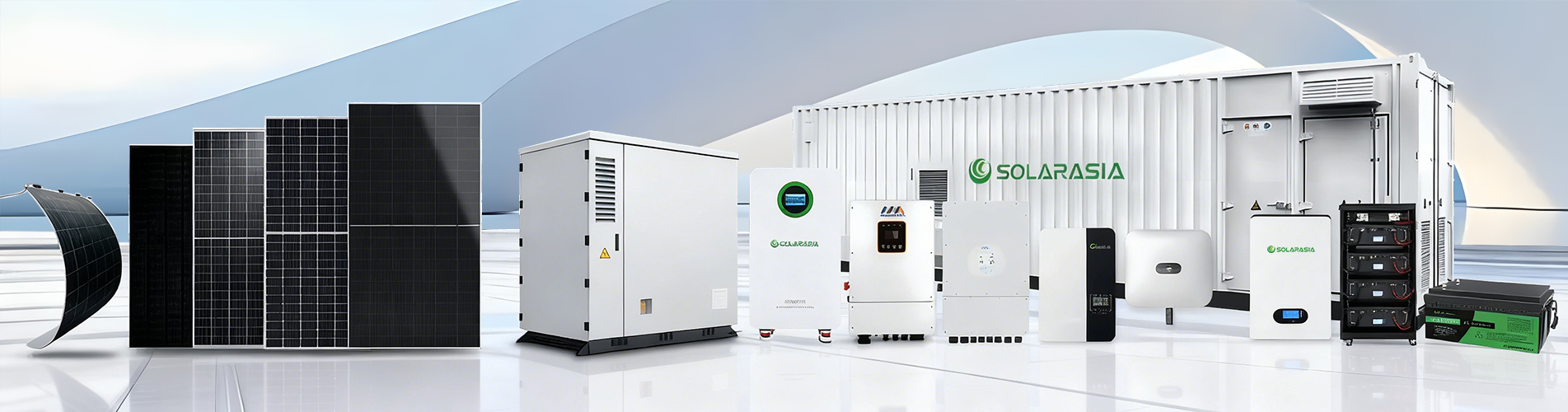
Anhui Solarasia Energy Technology Co., Ltd. provides solar photovoltaic and energy storage products for residential, commercial, and industrial applications.
Our product portfolio includes:
Hybrid solar inverters
Grid-tied solar inverters
Solar panels
Lithium batteries
Residential energy storage systems
Commercial and industrial BESS
Customized solar power solutions
For distributors, installers, EPC contractors, wholesalers, and project developers, SolarAsia Power can support different solar and energy storage configurations according to project requirements.
Whether the project requires a grid-connected residential hybrid system or an independent off grid solar solution, the inverter should be selected together with the PV array, battery, electrical loads, and overall system architecture.
Conclusion
Understanding the difference between a hybrid solar inverter and an off grid inverter is essential when designing a solar-plus-storage system.
A hybrid solar inverter is generally designed for systems that can interact with the utility grid while also managing solar generation and battery storage.
An off grid inverter is designed to provide an independent AC power supply for systems that do not rely on the utility grid.
The right choice depends on the project rather than simply the inverter's power rating.
Before purchasing an inverter, evaluate:
Grid Availability + PV Capacity + Battery + Peak Loads + Backup Requirements + Installation Environment
For a grid connected European home with rooftop solar and battery storage, a hybrid architecture may be considered.
For a remote property without grid access, an off grid architecture may be more appropriate.
Once the system requirements are clear, the inverter can then be matched with the appropriate solar panels, battery storage, and electrical equipment to create a complete and reliable renewable energy system.






 Network Supported