
On Grid vs Off Grid vs Hybrid Solar System: Which Solution Is Right for Your Project?
Choosing the right solar system is one of the most important decisions when planning a renewable energy project. Different applications require different solutions depending on electricity demand, grid availability, budget, and energy independence goals.
The three main solar system types are on-grid solar system, off-grid solar system, and hybrid solar system. Each solution has unique advantages and limitations.
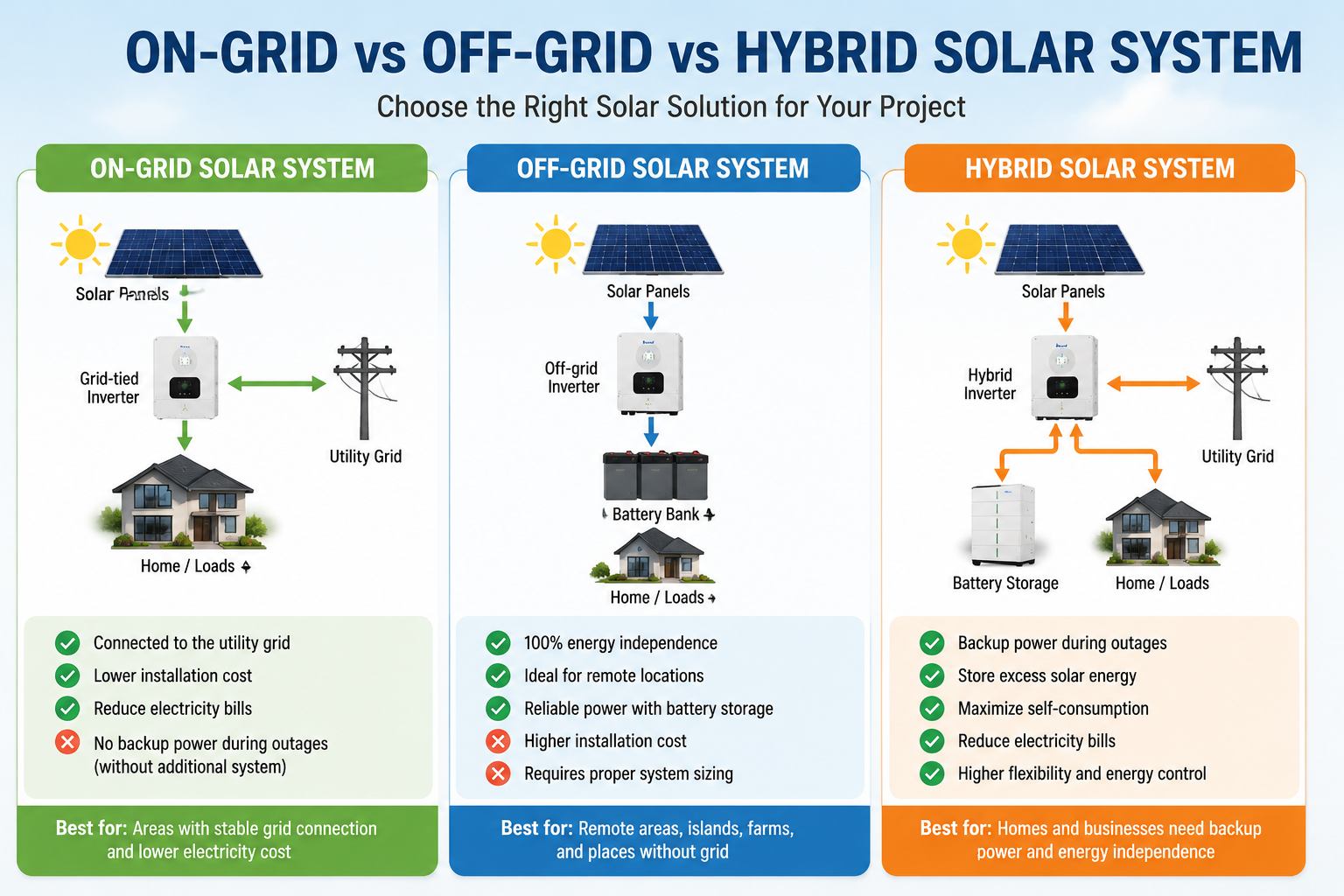
For residential, commercial, and industrial projects in Europe and the Middle East, understanding these differences helps customers select the right combination of solar panels, solar inverter, solar battery, and energy storage system.
Understanding the Three Main Types of Solar Systems
A solar system usually consists of:
The main difference between system types is how they interact with the electricity grid and whether they include energy storage.
| Solar System Type | Grid Connection | Battery Storage | Main Purpose | |
| On-grid solar system | Connected to utility grid | Usually no | Reduce electricity costs | |
| Off-grid solar system | Independent from grid | Required | Energy independence | |
| Hybrid solar system | Connected with grid | Usually included |
|
What Is an On Grid Solar System?
An on grid solar system is connected directly to the local electricity grid. Solar panels generate electricity during daylight hours, and the solar inverter converts the power into usable electricity.
When solar production is higher than consumption, excess electricity can be sent to the grid depending on local regulations and available programs.
When solar production is insufficient, electricity can be supplied from the grid.
Advantages of On-Grid Solar Systems
Lower Initial Investment
Because most on-grid systems do not require batteries, the installation cost is generally lower compared with storage-based systems.
Simple Operation
On-grid systems usually have a simpler design:
Solar panels → Solar inverter → Building loads → Grid
This makes installation and maintenance easier.
Suitable for Stable Grid Areas
On grid systems are suitable for locations where grid electricity is reliable.
Limitations of On Grid Solar Systems
The main limitation is that traditional grid connected solar systems normally cannot provide electricity during grid outages unless additional backup solutions are installed.
What Is an Off Grid Solar System?
An off-grid solar system operates independently without relying on the electricity grid.
These systems use solar panels and battery storage to provide electricity for locations where grid connection is unavailable or expensive.
Typical applications include:
Advantages of Off-Grid Solar Systems
Complete Energy Independence
Off grid systems allow users to generate and store their own electricity.
Suitable for Remote Areas
They are ideal where extending power lines is difficult or costly.
Reliable Power Supply
With properly sized battery storage, off-grid systems can provide electricity day and night.
Limitations of Off-Grid Solar Systems
Off grid systems require careful design because battery capacity must match energy demand.
Important factors include:
What Is a Hybrid Solar System?
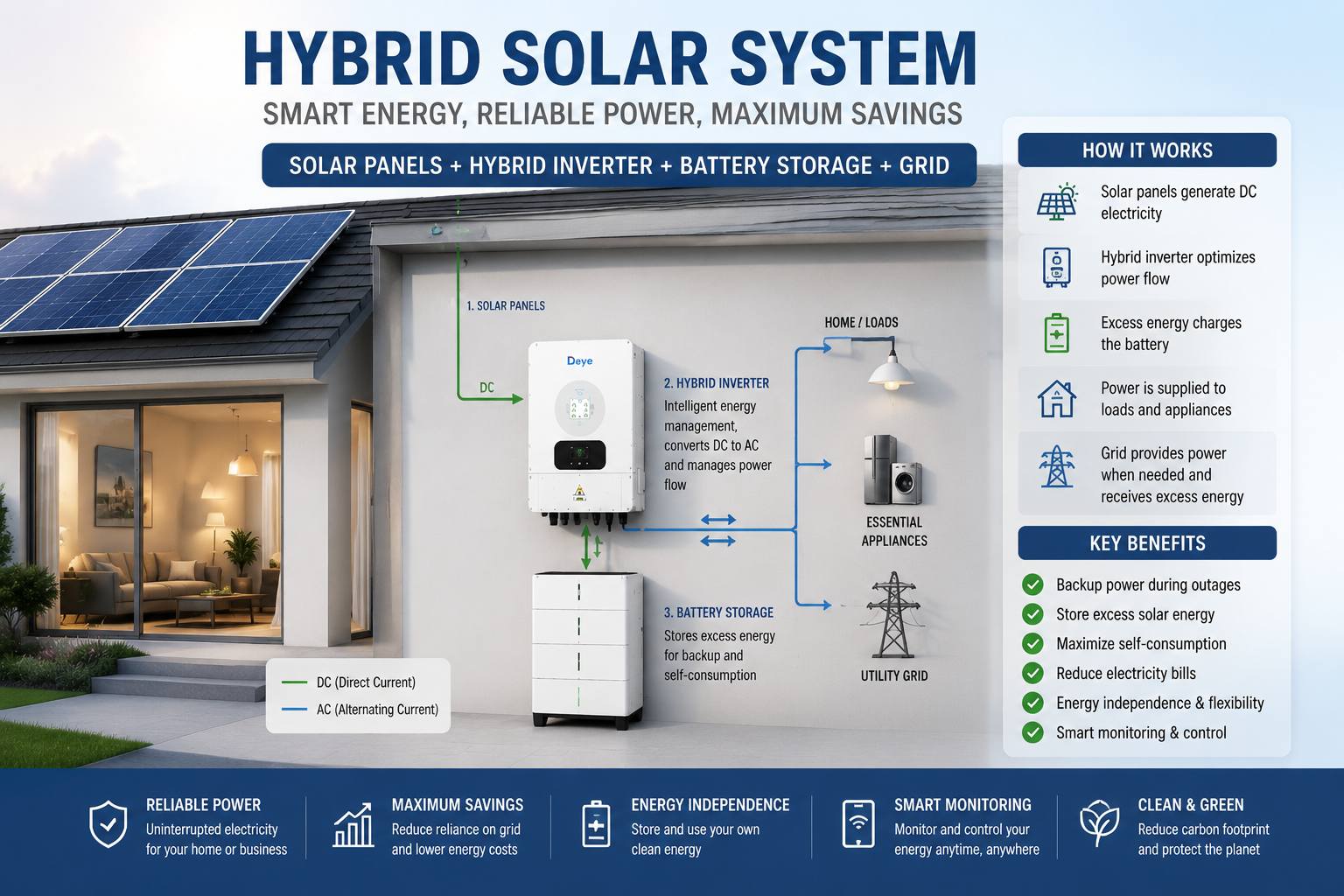
A hybrid solar system combines solar power, battery storage, and grid connection.
It provides greater flexibility because users can:
Hybrid systems typically use a hybrid solar inverter that manages energy flow between solar panels, batteries, loads, and the grid.
Advantages of Hybrid Solar Systems
Energy Storage Capability
A solar battery allows users to store unused solar energy for later use.This improves solar self-consumption and reduces dependence on grid electricity.
Backup Power Function
During grid interruptions, hybrid systems can provide backup electricity for selected loads.
Flexible Energy Management
Smart hybrid systems can optimize:
On Grid vs Off Grid vs Hybrid Solar System Comparison
| Feature | On-Grid Solar | Off-Grid Solar | Hybrid Solar |
| Grid connection | Yes | No | Yes |
| Battery required | Optional | Yes | Usually yes |
| Energy independence | Low | High | Medium to high |
| Backup power | Limited | Yes | Yes |
| Installation complexity | Low | High | Medium |
| Best for | Grid connected buildings | Remote locations | Homes, businesses, industries |
Choosing the Right Solar System for Different Applications
Residential Solar Applications
For homes, the best choice depends on energy goals.
On-grid residential solar
Suitable for:
Hybrid residential solar
Suitable for:
Hybrid systems combined with Deye, Growatt, GoodWe, or Solis hybrid inverter solutions are commonly considered for residential energy storage applications.
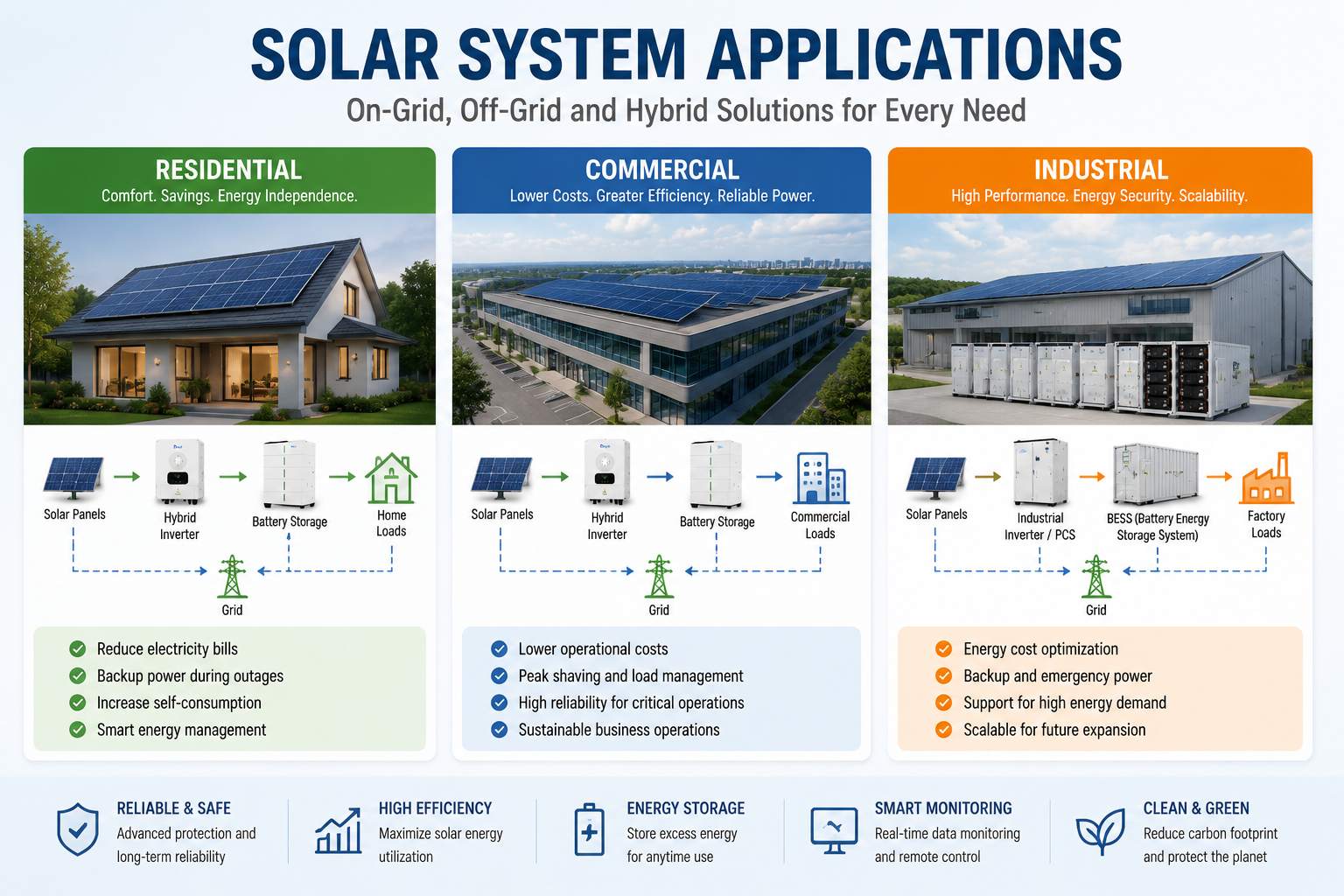
Commercial Solar Applications
Businesses often require reliable electricity and cost control.
Commercial solar systems can help:
Hybrid systems with solar batteries are becoming increasingly attractive for:
Industrial Solar Applications
Industrial projects usually have higher energy requirements.
Factories and large facilities may use:
A combination of solar generation and battery storage can help companies manage:
The Role of Solar Inverters in Different Solar Systems
The solar inverter is a key component in every photovoltaic system.
Different systems require different inverter technologies.
| System Type | Recommended Inverter Type |
| On-grid solar | Grid-tied inverter |
| Off-grid solar | Off-grid inverter |
| Hybrid solar | Hybrid inverter |
A high-quality inverter improves system efficiency, safety, and energy management.
Popular inverter options in international markets include:
The final selection should depend on project requirements, compatibility, certification requirements, and technical support availability.
Solar Battery and Energy Storage System Integration
Energy storage is becoming increasingly important as renewable energy adoption grows.
A solar battery storage system allows users to:
For larger projects, a BESS (Battery Energy Storage System) can support:
Energy storage systems are especially valuable in markets where electricity prices, grid stability, and renewable energy targets are important considerations.
How to Select the Best Solar Solution Partner
When selecting a solar supplier, customers should evaluate:
A reliable supplier should provide:
Important services include:
For Europe and Middle East projects, suppliers should understand:
FAQs About On-Grid, Off-Grid and Hybrid Solar Systems
1. What is the difference between on-grid and off-grid solar systems?
An on-grid solar system connects to the electricity grid, while an off-grid solar system operates independently using battery storage.
2. Is a hybrid solar system better than an on-grid system?
A hybrid solar system provides more flexibility because it includes battery storage and backup capability, but it usually requires a higher investment.
3. Do hybrid solar systems need batteries?
Most hybrid solar systems are designed to work with batteries, although some hybrid inverters can operate without storage.
4. Which solar system is best for factories?
Industrial facilities often benefit from hybrid solar systems combined with industrial energy storage systems or BESS solutions.
5. Can an off-grid solar system power a house?
Yes. A properly designed off-grid system can supply electricity for homes, but battery capacity must match energy demand.
6. What type of inverter is used in hybrid solar systems?
Hybrid solar systems use hybrid inverters that manage solar generation, battery storage, loads, and grid connection.
7. Are solar batteries necessary for solar systems?
Solar batteries are not required for traditional on-grid systems but are important for backup power and energy independence.
8. Which solar system is best for Europe and Middle East markets?
The best solution depends on location, grid conditions, energy demand, and project goals. Hybrid systems are increasingly popular where energy flexibility and backup power are priorities.
Conclusion: Choosing the Right Solar System Solution
On-grid, off-grid, and hybrid solar systems each serve different energy needs.
For residential, commercial, and industrial projects, selecting the right combination of solar inverter, solar battery, ESS, and BESS technology is essential for building an efficient and reliable renewable energy solution.

Address : Room 908-909, Building 2, No. 469 Huatuo Lane, Shushan District, Hefei City, Anhui Province


Please read on, stay posted, subscribe, and we welcome you to tell us what you think.
Copyright 2026 @ Anhui Solarasia Energy Technology Co.,Ltd .All Rights Reserved. Sitemap | Blog | XML | Privacy Policy
 Network Supported