
How Many Solar Panels Do You Need for a 100kW Solar System?
A 100kW solar system is a popular choice for warehouses, factories, agricultural facilities, retail buildings, offices, and other commercial properties. But one of the first questions businesses and solar installers often ask is:
How many solar panels do you need for a 100kW solar system?
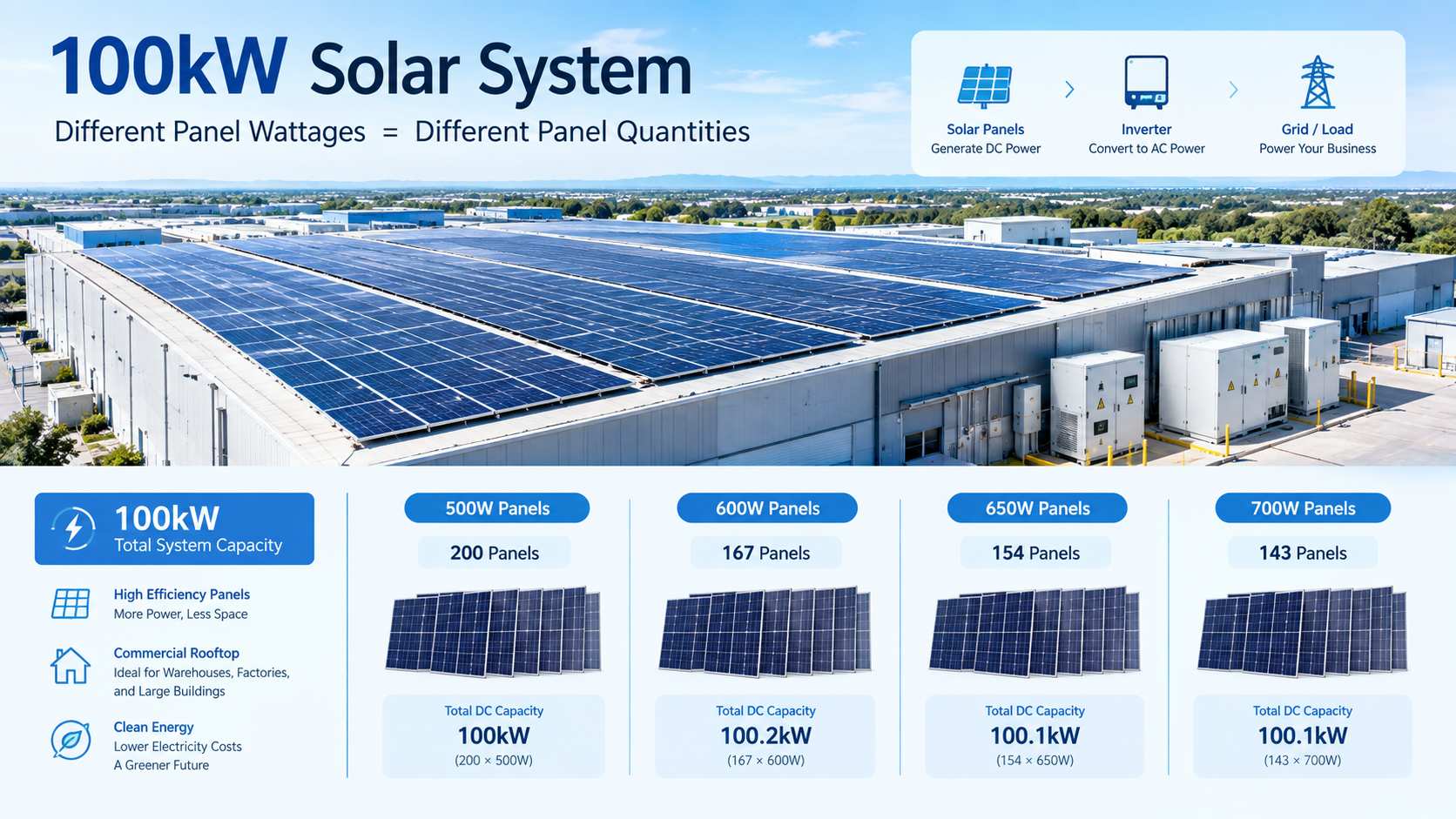
The answer depends primarily on the power rating of the solar panels.
For example, a 100kW system using 500W panels would require approximately 200 panels, while the same system using 700W panels would require only about 143 panels.
However, panel wattage is not the only factor that matters. Module efficiency, physical dimensions, available roof space, inverter configuration, electrical design, and the actual DC capacity of the system can all influence the final design.
In this guide, SolarAsia Power explains how to calculate the number of panels required for a 100kW PV system and what businesses should consider when selecting solar modules.
A 100kW solar system generally refers to a photovoltaic system with approximately 100 kilowatts of installed DC solar capacity.
The system converts sunlight into electricity through solar panels and then uses solar inverters to convert the DC electricity into AC electricity for the building or grid.
A typical commercial PV system may include:
The actual configuration depends on the project location, electricity consumption, available roof area, utility requirements, and system objectives.
The basic calculation is simple:
Because:
100kW = 100,000 watts
you can divide 100,000W by the power rating of one solar panel.
For example, if you choose a 600W module:
100,000W ÷ 600W = 166.67
Since you cannot install a fraction of a panel, you would need approximately:
167 × 600W solar panels
This would give a total DC capacity of:
167 × 600W = 100.2kW
Therefore, the exact number of modules does not always result in exactly 100.00kW. A practical system may be slightly above or below the nominal target depending on the selected module wattage and system design.
The number of panels depends on the wattage of the selected module.
Here is a simple comparison:
| Solar Panel Power | Approximate Number of Panels | Total DC Capacity |
|---|---|---|
| 400W | 250 | 100.0kW |
| 450W | 223 | 100.35kW |
| 500W | 200 | 100.0kW |
| 550W | 182 | 100.1kW |
| 580W | 173 | 100.34kW |
| 600W | 167 | 100.2kW |
| 650W | 154 | 100.1kW |
| 670W | 150 | 100.5kW |
| 700W | 143 | 100.1kW |
These figures are useful for preliminary planning.
The final number of modules may be different because professional system design also needs to consider string configuration, inverter input limits, MPPT voltage ranges, available roof space, electrical requirements, and module dimensions.
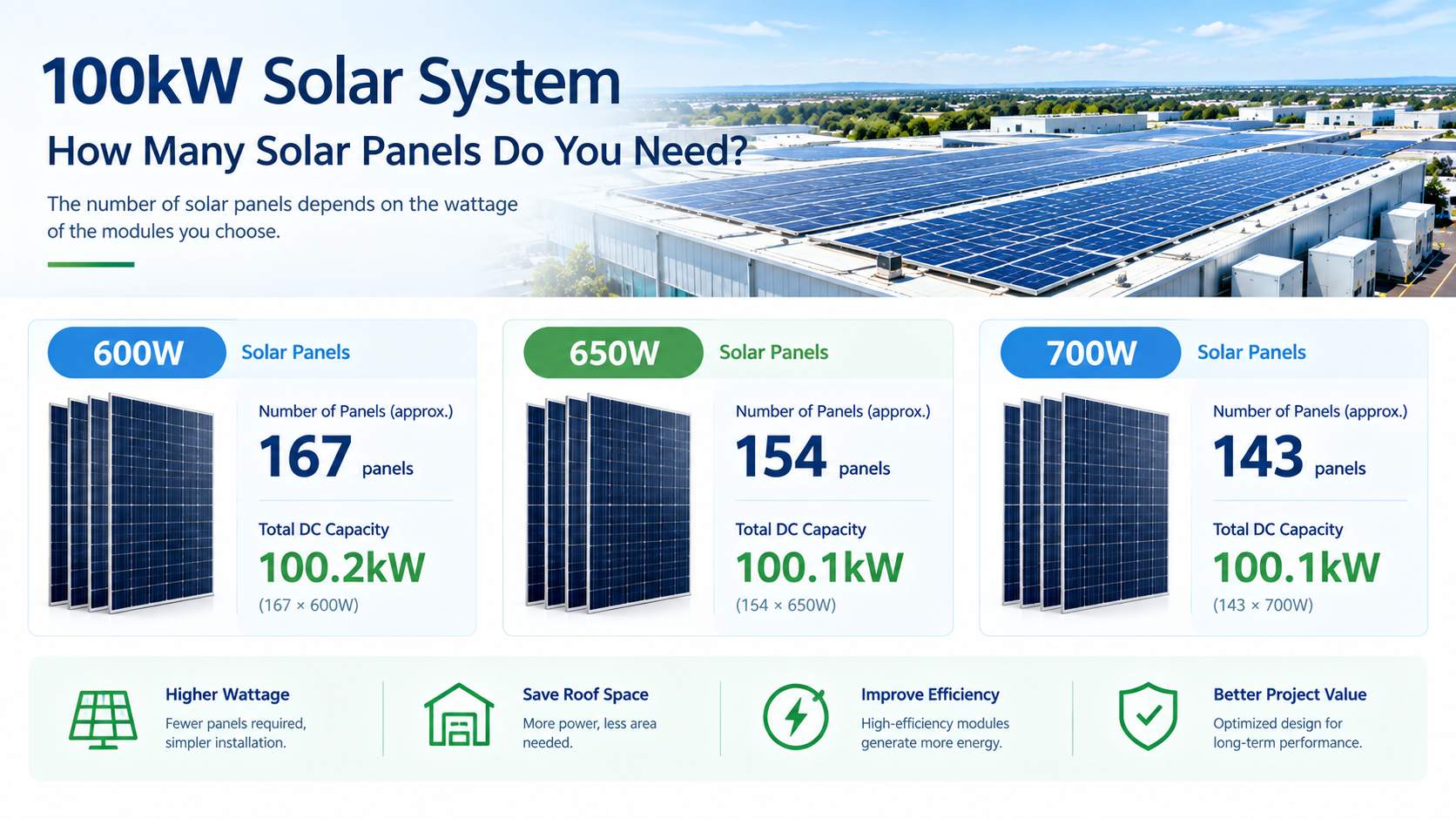
High power solar modules have become increasingly popular for commercial and utility-scale PV projects.
Let's compare three common module power ratings.
A 100kW system would require approximately:
167 × 600W panels
Advantages can include:
However, more modules are required compared with higher-power panels.
Using 650W modules:
100,000W ÷ 650W ≈ 154 panels
Therefore, approximately 154 × 650W solar panels can provide around 100kW of installed DC capacity.
This can reduce the number of modules and mounting points compared with a 600W configuration.
Using 700W modules:
100,000W ÷ 700W ≈ 143 panels
This means a 100kW system can use approximately 143 × 700W solar panels.
Compared with 600W panels, this reduces the number of modules by approximately 24 panels.
That can potentially simplify:
However, 700W modules can have larger physical dimensions and higher weight, so roof structure and installation conditions must be evaluated.
Not necessarily.
A higher-wattage panel can reduce the number of modules required, but the best solar panel depends on the complete project.
Important factors include:
Efficiency determines how effectively a panel converts available sunlight into electricity.
Higher-efficiency modules can be especially valuable when roof space is limited.
A 700W module may produce more power, but it can also have a larger footprint than a lower-wattage module.
For some rooftops, module dimensions can be just as important as module wattage.
The roof structure must be capable of supporting the selected modules and mounting system.
Solar modules lose some power as operating temperature increases. A better temperature coefficient can help maintain performance in hot conditions.
Businesses should evaluate both product warranty and long-term power performance.
For commercial projects, module availability, shipping dimensions, delivery time, and supply continuity can have a major impact on project schedules.
The number of panels is only one part of the equation.
You also need to determine whether the building has enough usable roof space.
The required area depends on:
For example, a 100kW system using 700W panels requires approximately 143 modules, while a system using 500W panels requires approximately 200 modules.
Although the higher-power system uses fewer panels, the physical dimensions of each module may be larger.
Therefore, the correct question is not simply:
“How many solar panels can fit on the roof?”
It should be:
“How much usable roof area is available, and which module configuration can provide the required capacity within that space?”
Module power and module efficiency are related but are not exactly the same thing.
Two panels can have similar power ratings but different physical dimensions and efficiency levels.
For commercial rooftops, high-efficiency solar panels can offer an important advantage because they can generate more electricity from a limited area.
For example, a warehouse may have a large roof, but part of the roof may be unavailable because of HVAC units, ventilation equipment, skylights, or safety access requirements.
In this situation, higher-efficiency modules may allow the project developer to achieve the desired system capacity without using as much usable roof area.
A 100kW system should not automatically be selected simply because the building has enough space.
Electricity consumption should be considered first.
For example, suppose a commercial building consumes:
150,000 kWh per year.
If a properly designed 100kW PV system can produce approximately 140,000 kWh annually at that location, the system could potentially offset a significant portion of the building's electricity consumption.
However, actual solar production depends on:
Therefore, businesses should use location-specific solar production estimates when deciding whether 100kW is the right system size.
Solar panels cannot be selected independently from the inverter.
The inverter has specific electrical limits, including:
For example, even if 143 × 700W panels theoretically provide approximately 100kW, the panels must still be configured into strings that fall within the inverter's voltage and current limits.
This is why commercial PV system design requires more than simply dividing 100,000W by the module wattage.
Solar panels are usually connected in series to create strings.
When panels are connected in series:
Voltage increases while current remains approximately the same.
The string configuration must remain within the inverter's allowable operating voltage and maximum input voltage.
For example, a system designer may determine the appropriate number of modules per string based on:
The number of panels in each string therefore needs to be calculated carefully.
Not necessarily.
In real commercial PV projects, the total DC capacity of the solar modules may be slightly higher than the inverter's AC output capacity.
For example:
120kW DC solar panels + 100kW AC inverter
creates a DC/AC ratio of:
1.2
This type of configuration can be used to improve inverter utilization during periods when the solar array is not operating at its maximum rated output.
However, oversizing the PV array too much can lead to greater clipping.
The appropriate DC/AC ratio depends on:
Therefore, the final design should be determined by a qualified system designer.
Yes.
A 100kW PV system can be combined with battery energy storage to create a solar-plus-storage solution.
A battery can help businesses:
For example, a factory may generate excess solar energy during midday but have significant electricity demand later in the afternoon or evening.
A battery energy storage system can store some of the excess solar energy and discharge it when needed.
However, battery capacity should be calculated separately from PV capacity.
The solar system is usually described in kW, while battery energy capacity is commonly expressed in kWh.
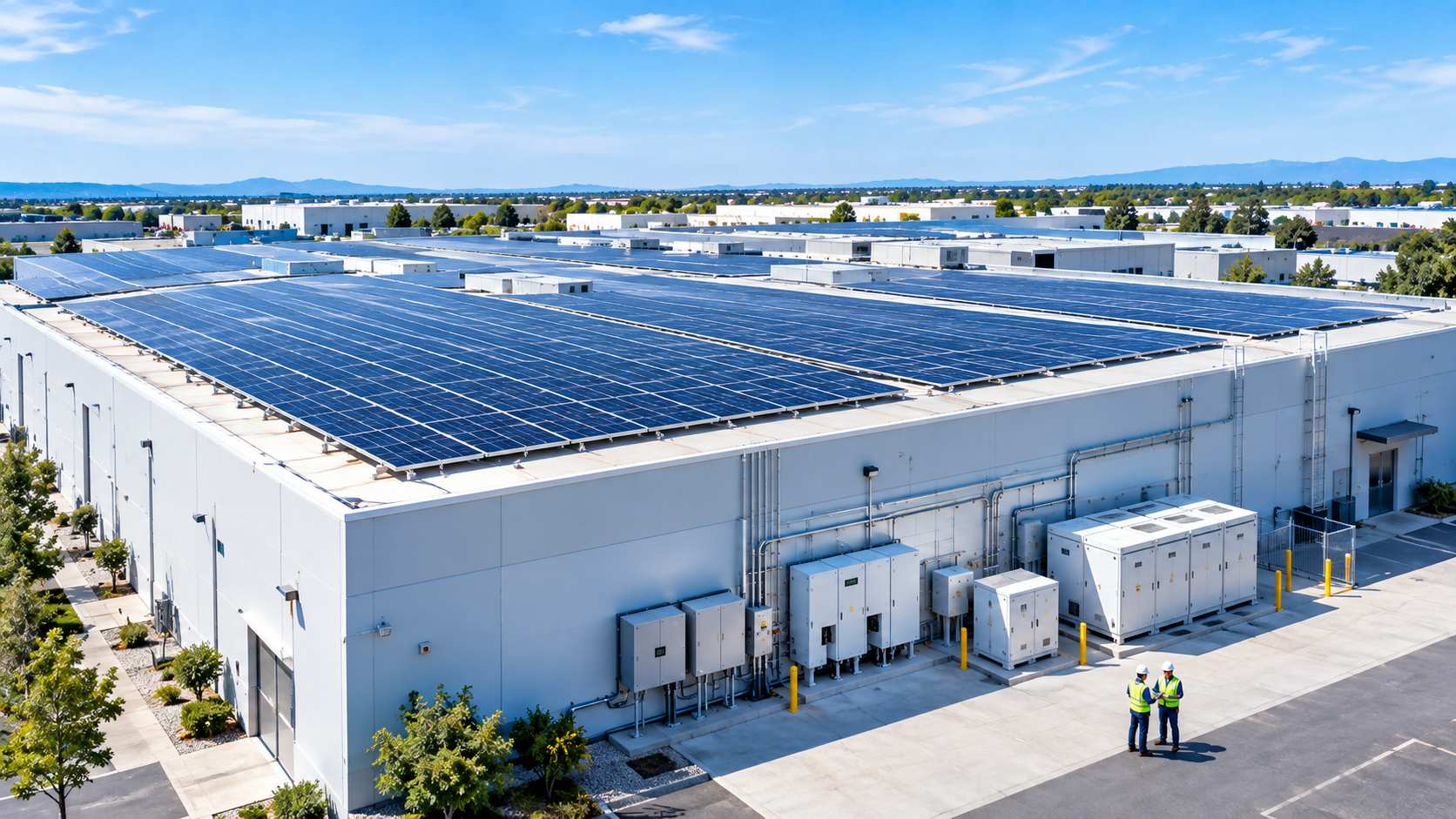
Let's consider a simplified commercial project.
A warehouse has:
The business is considering a 100kW PV system.
If the project uses 650W solar modules:
100,000W ÷ 650W ≈ 154 panels
The system could therefore use approximately:
Total DC capacity:
154 × 650W = 100.1kW
The next step would be to determine:
If the business also wants battery storage, the battery power and energy capacity should then be calculated according to the building's load profile.
A 700W panel is not automatically better than a 600W panel.
Module efficiency, dimensions, weight, warranty and degradation should also be considered.
A system may have enough theoretical capacity but still not fit efficiently on the available roof.
Roof layout should account for:
The module's voltage and current must be compatible with the selected inverter.
String design is especially important for commercial systems.
For a commercial project, equipment price is only one part of the total project cost.
A better evaluation should include:
A 100kW PV system may be appropriate for many commercial properties, but it is not the ideal size for every business.
A proper system design should consider:
How much electricity does the business use annually and monthly?
How much electricity is consumed during daylight hours?
How much space is actually available for solar panels?
How much solar energy is available at the project location?
Does the local utility impose export or interconnection limitations?
Will the business add production equipment, EV chargers, HVAC systems, or other electrical loads?
Does the business need energy storage for demand management, energy shifting, or backup power?
These factors should be evaluated together before deciding on the final system capacity.
Anhui Solarasia Energy Technology Co., Ltd., operating under the SolarAsia Power brand, provides solar energy products and solutions for international customers.
Our product portfolio includes:
For EPC contractors, distributors, wholesalers, installers, and commercial project developers, choosing compatible solar modules and inverters is an important part of system design.
SolarAsia Power can support international customers with solar panels, inverters, batteries, and customized energy solutions according to project requirements.
Whether you are planning a 100kW solar system for a warehouse, factory, agricultural facility, office, or retail building, selecting the right module wattage and system configuration can help optimize available space and overall project performance.
So, how many solar panels do you need for a 100kW solar system?
The answer depends primarily on the wattage of the selected solar modules.
For example:
The calculation is straightforward, but the final PV system design is more complex.
A professional commercial solar project should also consider module efficiency, roof space, string configuration, inverter capacity, DC/AC ratio, electrical infrastructure, local solar conditions, utility requirements, and optional battery storage.
For businesses planning a commercial solar system, the goal should not simply be to install the fewest possible panels. Instead, the objective should be to find the right balance between power output, efficiency, available space, equipment cost, installation requirements, and long-term energy production.
With the right combination of solar panels, inverters, and energy storage, a well-designed commercial PV system can provide a scalable solution for businesses looking to reduce grid electricity consumption and improve energy management.
Anhui Solarasia Energy Technology Co., Ltd. (SolarAsia Power) supplies solar panels, solar inverters, batteries, and energy storage solutions for international solar projects.


Address : Room 908-909, Building 2, No. 469 Huatuo Lane, Shushan District, Hefei City, Anhui Province


Please read on, stay posted, subscribe, and we welcome you to tell us what you think.
Copyright 2026 @ Anhui Solarasia Energy Technology Co.,Ltd .All Rights Reserved. Sitemap | Blog | XML | Privacy Policy
 Network Supported