
What Size Battery Energy Storage System Does Your Business Need?
Learn how to size a battery energy storage system for your business. Understand BESS power, energy capacity, load profile, peak shaving, solar integration, backup duration and battery sizing.
For businesses considering battery energy storage, one of the first questions is often:
How large should the battery energy storage system be?
The answer is not simply based on the size of the solar system or the building's total electricity consumption.
A commercial or industrial Battery Energy Storage System (BESS) must be sized according to how the business intends to use the battery.
For example, a business may want BESS to:
These applications can require very different battery configurations.
A 500 kWh battery may be suitable for one business but insufficient—or unnecessarily large—for another.
To determine the appropriate BESS size, businesses need to consider both power capacity and energy capacity, together with the site's load profile, solar generation, operating strategy and local electricity tariff.
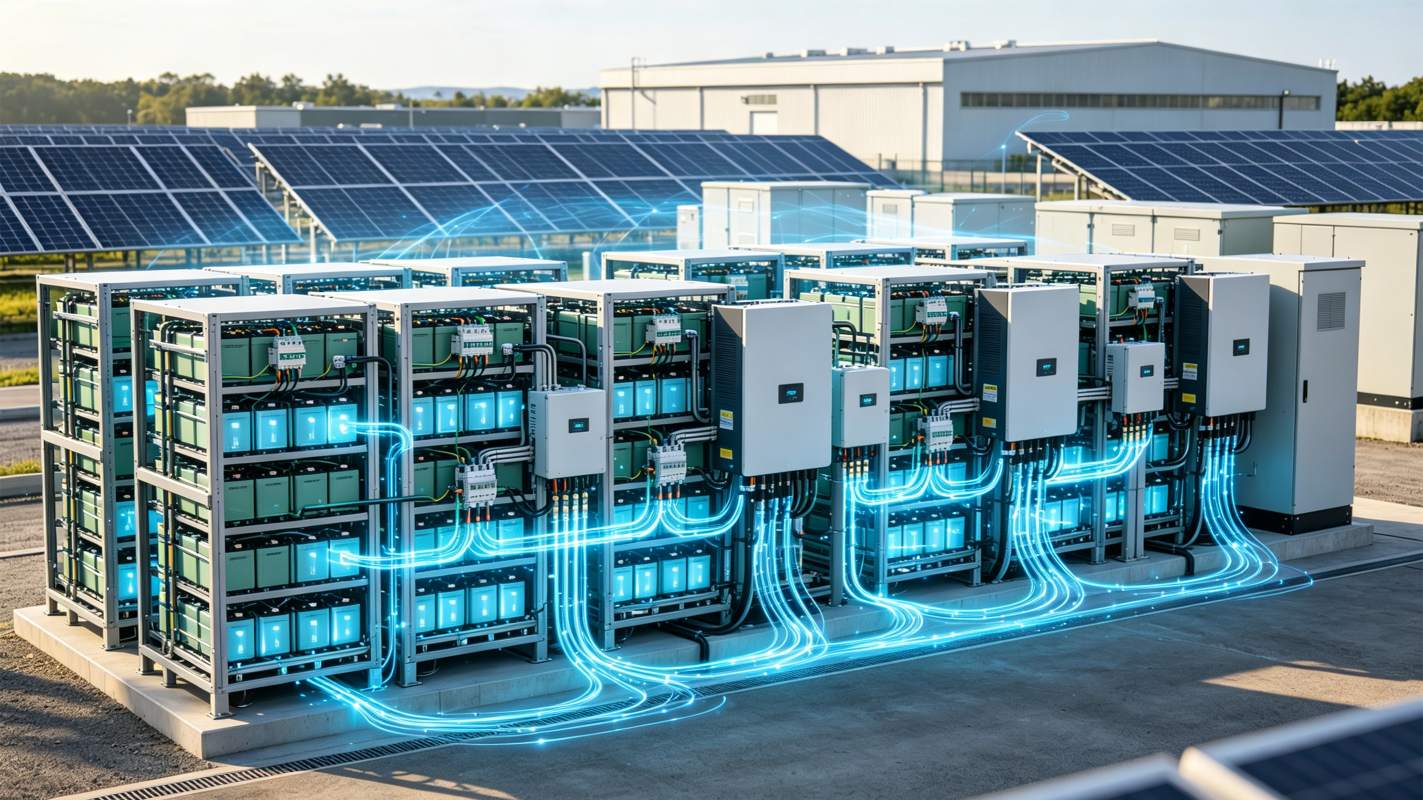
One of the most common mistakes when discussing battery storage is treating battery size as a single number.
A BESS has at least two important capacity specifications:
Power is normally measured in:
It describes how quickly the battery can charge or discharge electricity.
Energy is normally measured in:
It describes how much energy the battery can store.
For example:
means approximately:
At a simplified level, 1 MWh of usable energy could provide 500 kW for approximately two hours.
This relationship can be expressed as:
Battery Duration = Energy Capacity ÷ Power Capacity
So:
1,000 kWh ÷ 500 kW = 2 hours
However, actual operating duration depends on factors such as usable state-of-charge range, efficiency, temperature, battery degradation and system operating limits.
Before choosing a battery, understand how your business consumes electricity.
The most useful information is not just your monthly electricity bill.
You should ideally have interval electricity data showing how your load changes throughout the day.
For example:
| Time | Business Load |
|---|---|
| 00:00–06:00 | 250 kW |
| 06:00–09:00 | 400 kW |
| 09:00–12:00 | 650 kW |
| 12:00–15:00 | 800 kW |
| 15:00–18:00 | 700 kW |
| 18:00–22:00 | 450 kW |
| 22:00–00:00 | 300 kW |
This tells you much more than simply knowing that the facility uses, for example, 5,000 kWh per day.
Why?
Because BESS power requirements are closely related to the magnitude and duration of the loads you want the battery to address.
The correct battery size depends heavily on the application.
This should be the first major design question:
What problem is the battery supposed to solve?
Different objectives lead to different sizing strategies.
If the main objective is reducing peak demand, the battery may need substantial power capacity but relatively short discharge duration.
If the goal is storing daytime solar energy and using it later, energy capacity becomes particularly important.
If the battery must support critical loads during grid outages, both power and energy capacity must be calculated based on the critical loads and required backup duration.
If electricity prices vary during the day, the BESS can potentially charge during lower-cost periods and discharge during higher-cost periods, subject to local tariffs, regulations and system economics.
A battery can store excess PV generation and discharge when solar production falls while the business continues to consume electricity.
These applications can also be combined.
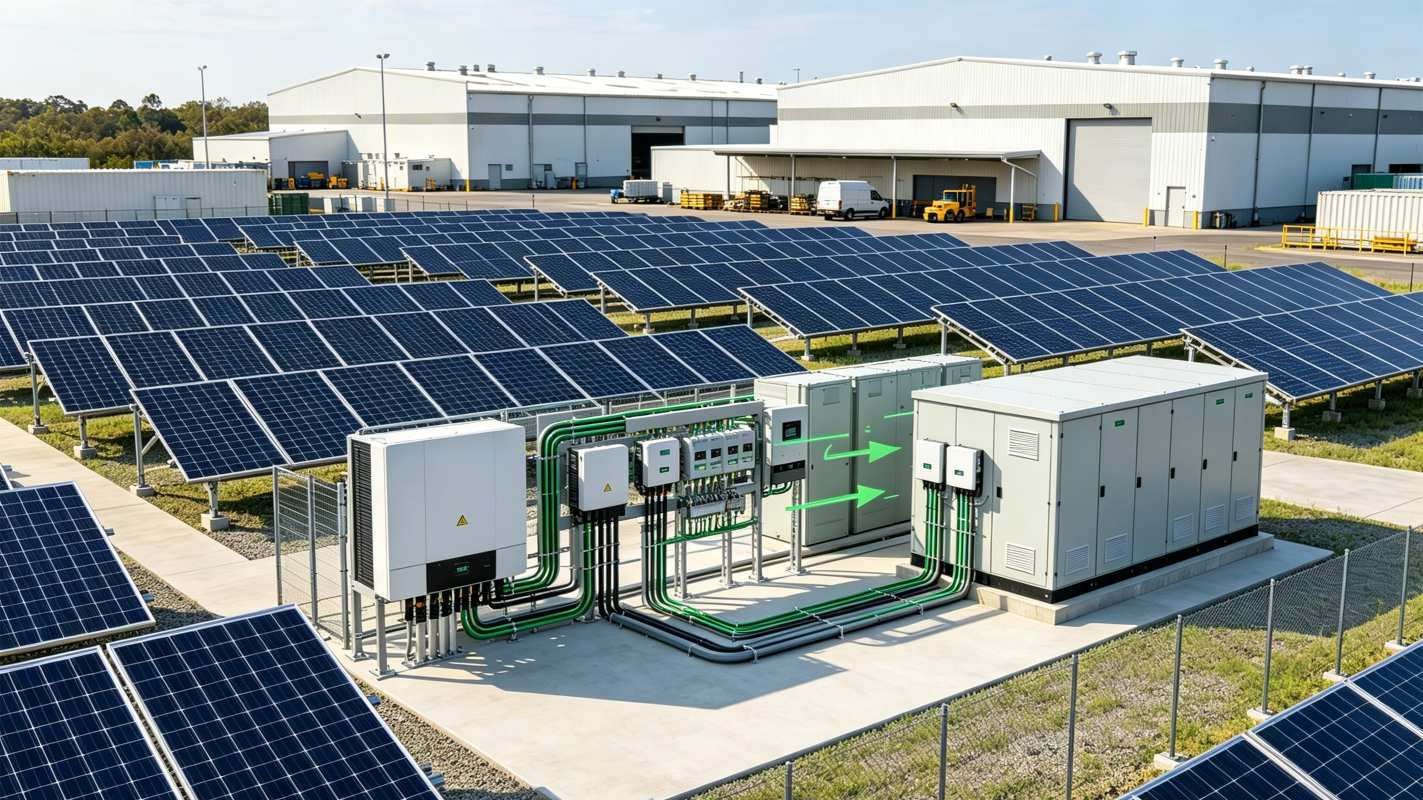
Peak shaving is one of the most common commercial BESS applications.
Suppose a facility has:
The theoretical power reduction is:
1,000 kW − 700 kW = 300 kW
The theoretical energy requirement is:
300 kW × 2 hours = 600 kWh
So the preliminary requirement might be approximately:
300 kW / 600 kWh
But this is not necessarily the final BESS specification.
The actual system may need additional capacity because of:
Therefore, the final design should be based on the actual operating model rather than the simple theoretical calculation alone.
Solar + BESS is another major commercial application.
Imagine a factory has:
During the middle of the day, solar generation exceeds the facility's immediate consumption.
Instead of exporting all excess solar electricity, the system can potentially charge the battery.
Later, when solar production decreases, the battery can discharge.
A simplified energy flow could look like:
Solar PV → Business Load
and when solar generation exceeds demand:
Solar PV → BESS
Later:
BESS → Business Load
This can increase the amount of solar energy used on-site, depending on the site's operating conditions and applicable grid rules.
A common misconception is:
“If I have a 1 MW solar system, I need a 1 MWh battery.”
Not necessarily.
The appropriate BESS size depends on:
For example, two facilities can both have:
1 MW PV
but have very different load profiles.
Most electricity is consumed during the daytime.There may be relatively little excess solar energy to store.
Electricity demand is lower during the day but remains high into the evening.A larger battery may provide more opportunities for solar energy shifting.
Therefore:
Same PV capacity ≠ Same BESS requirement
This distinction is critical when sizing BESS.
Consider two systems:
500 kW / 500 kWh
500 kW / 2 MWh
Both can potentially discharge at 500 kW.
But their approximate theoretical durations are:
This means businesses should ask two separate questions:
How much power do I need?Measured in kW or MW.
How long do I need that power?
Measured in hours.
Together, these determine the required energy capacity.
Backup sizing is different from peak shaving.
You first need to identify the critical loads that must remain operational during a grid outage.
For example:
| Critical Load | Power |
|---|---|
| Emergency lighting | 20 kW |
| IT equipment | 30 kW |
| Cooling system | 100 kW |
| Production equipment | 200 kW |
| Security systems | 10 kW |
| Total | 360 kW |
If the business requires four hours of backup:
360 kW × 4 hours = 1,440 kWh
A preliminary calculation therefore gives:
360 kW / 1.44 MWh
The final BESS would need to account for usable energy, system efficiency, operating reserve and battery aging.
One way to reduce BESS requirements is to distinguish between:
Critical loads
and
Non-critical loads
For example, during a grid outage, a factory may prioritize:
while temporarily disconnecting:
This approach can significantly change the required battery power and energy capacity.
Therefore, a good BESS design should consider load prioritization and energy management, not just total facility capacity.
Battery specifications may distinguish between nominal capacity and usable capacity.
For example, suppose a battery system has:
1,000 kWh nominal capacity
but the system is designed around an 90% usable energy window.
The usable energy would be approximately:
1,000 kWh × 90% = 900 kWh
Other system losses may further reduce the energy available to the load.
This is why businesses should look at usable energy capacity under the intended operating conditions, rather than comparing nominal MWh figures alone.
Battery capacity changes over time.
A BESS sizing study should therefore consider the expected operating life and degradation characteristics of the selected battery system.
For example, if a project requires a certain amount of usable energy throughout its operating life, the initial system may need to provide sufficient capacity to account for expected degradation.
The exact approach depends on:
For this reason, battery sizing should be evaluated using the manufacturer's technical documentation and warranty conditions.
Modern commercial BESS projects commonly use lithium-ion battery technologies, with LFP (lithium iron phosphate) widely used for stationary energy storage.
However, battery chemistry is only one part of system selection.
Businesses should also evaluate:
The right battery should be evaluated as part of the complete BESS rather than solely by cell chemistry.
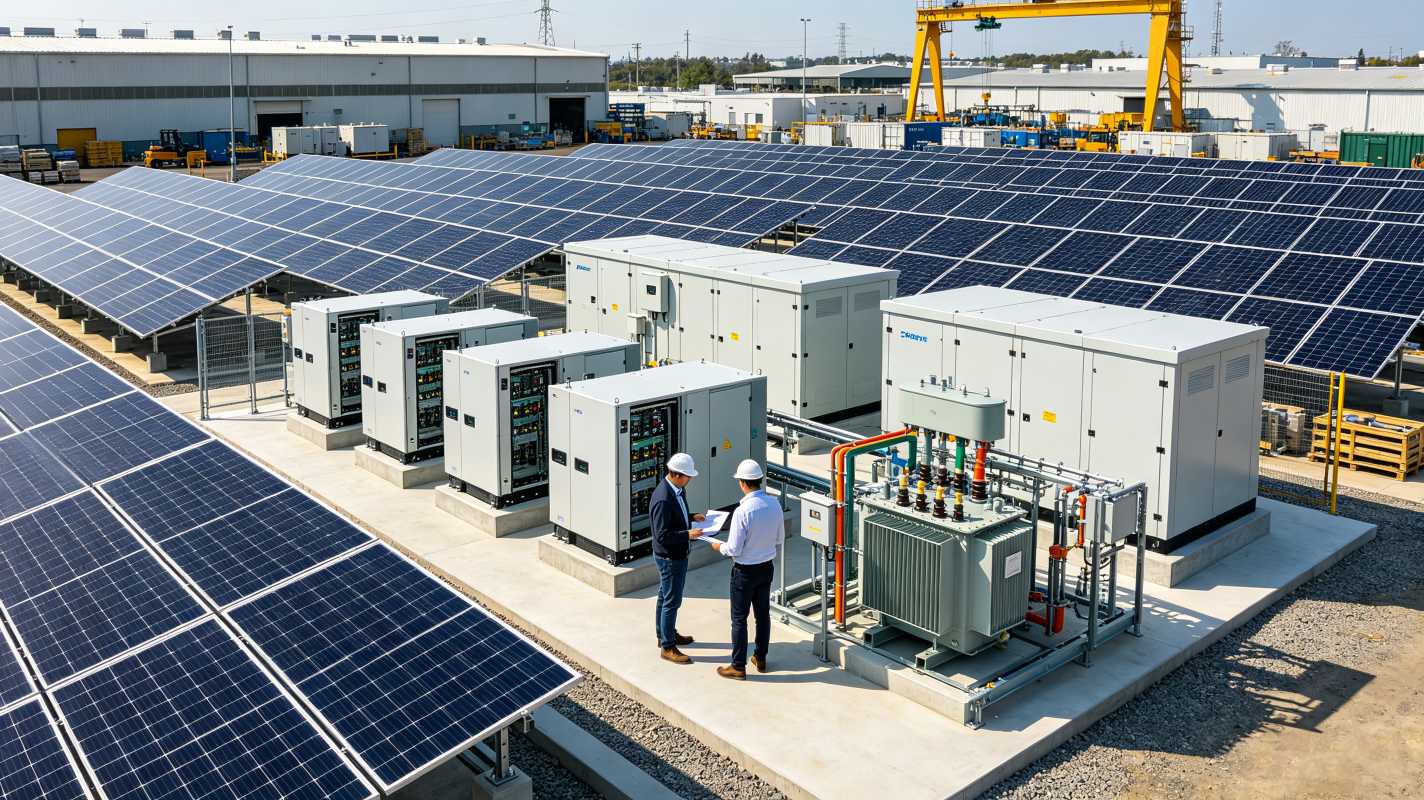
There is no universal BESS size for commercial buildings.
Commercial systems can range from relatively small installations to multi-megawatt, multi-megawatt-hour systems.
A preliminary sizing process can be:
Peak shaving?
Solar shifting?
Backup?
Arbitrage?
Or a combination?
Identify:
If PV is installed, determine:
Determine the maximum charge/discharge power required.
Estimate:
Required Energy = Required Power × Required Duration
Then adjust for efficiency, usable SOC range, reserve requirements and degradation.
For larger projects, hourly or sub-hourly modeling can compare different BESS configurations and operating strategies.
Consider a hypothetical manufacturing facility with:
The basic energy requirement would be:
300 kW × 3 hours = 900 kWh
This suggests a preliminary requirement around:
300 kW / 900 kWh
But the final system could require a larger nominal energy capacity after considering usable SOC, efficiency, reserve capacity and degradation.
If the business also wants several hours of backup power, the BESS may need to be significantly larger.
This example illustrates why:
BESS sizing should be based on the intended operating strategy, not simply the size of the solar installation.
The required discharge duration depends on the application.
A short-duration BESS may be designed around:
A longer-duration system may be designed for:
For example:
| Application | Main Sizing Consideration |
|---|---|
| Peak shaving | Power + peak duration |
| Solar shifting | Excess solar energy + discharge period |
| Backup | Critical load + backup duration |
| Arbitrage | Price periods + energy capacity |
| Microgrid | Load + generation + operating strategy |
The correct duration should therefore come from the business case.
Oversizing a battery is not automatically beneficial.
A larger battery can provide:
But it can also increase:
The goal should be to find the BESS configuration that meets the business's operational requirements and project economics.
A battery system is not just a collection of battery cells.
Commercial BESS typically includes components such as:
The PCS power rating determines how quickly energy can generally move between the battery and the AC system.
For example:
1 MW / 2 MWh BESS
has a nominal two-hour energy-to-power relationship.
But if the project requires 2 MW of discharge power for short periods, a 1 MW PCS would not meet that requirement even though the battery may contain 2 MWh of stored energy.
This is why BESS sizing must consider both battery energy capacity and power conversion capacity.
For businesses installing both solar and storage, it is better to evaluate the system as an integrated energy solution.
A typical architecture may look like:
Solar Panels → Solar Inverter → AC Bus → Business Loads
with:
Battery ↔ PCS ↔ AC Bus
An alternative architecture may use DC coupling depending on the equipment and project design.
The appropriate architecture depends on:
For commercial projects, integrating solar panels, inverters and BESS during the design stage can help create a more coordinated energy management strategy.
If you are requesting a BESS proposal from an EPC, integrator or supplier, prepare as much of the following information as possible:
With this information, a BESS provider can develop a much more meaningful technical proposal.
Before selecting a battery energy storage system, ask:
A basic calculation is:
Energy Capacity = Required Power × Required Discharge Duration
However, the final BESS size should also account for usable SOC range, system efficiency, reserve capacity, battery degradation and operating conditions.
A 1 MW solar system does not automatically require a 1 MWh BESS. The appropriate battery size depends on excess solar generation, load profile, desired discharge duration, power requirements and the project's operating strategy.
MW describes power—the rate at which electricity can be delivered or absorbed.MWh describes energy—the amount of electricity that can be stored.
For example, a 1 MW / 2 MWh system has a nominal two-hour energy-to-power relationship.
Start by determining how much grid demand you want to reduce and how long the reduction must be maintained.
A simplified calculation is:
BESS Power = Peak Demand − Target Demand
BESS Energy = BESS Power × Required Duration
The final design must then account for system losses, usable energy and operating reserves.
Yes, BESS can potentially be integrated with an existing PV installation. The appropriate architecture depends on the existing solar inverter, grid connection, battery system, PCS and desired operating strategy.
There is no universal requirement. Peak-shaving applications may prioritize power over long duration, while solar shifting and backup applications may require greater energy capacity.
No. A larger BESS provides more energy capacity but also increases capital cost, space requirements and system complexity. The appropriate size should be determined by the business's load profile, energy objectives and project economics.
Yes. Solar PV, inverters and BESS can be integrated into a coordinated energy system. The architecture can be AC-coupled, DC-coupled or another configuration depending on the equipment and project requirements.
So, what size battery energy storage system does your business need?
The answer starts with two numbers:
Hot tags : commercial battery energy storage system commercial BESS industrial battery storage battery energy storage system solar battery storage for business 1 MWh BESS

Address : Room 908-909, Building 2, No. 469 Huatuo Lane, Shushan District, Hefei City, Anhui Province


Please read on, stay posted, subscribe, and we welcome you to tell us what you think.
Copyright 2026 @ Anhui Solarasia Energy Technology Co.,Ltd .All Rights Reserved. Sitemap | Blog | XML | Privacy Policy
 Network Supported