
6kW vs 10kW Solar Inverter: Which One Should You Choose?
Compare 6kW and 10kW solar inverters based on PV capacity, electricity consumption, roof space, DC/AC ratio, MPPT, battery storage and future expansion.
Choosing the right inverter is one of the most important decisions when designing a solar power system.
For residential properties and small commercial projects, 6kW solar inverter and 10kW solar inverter options are both widely considered. But which one is better?
The answer depends on the size of your solar panel array, household or building electricity consumption, available roof space, local grid requirements, battery storage plans, and future electricity demand.
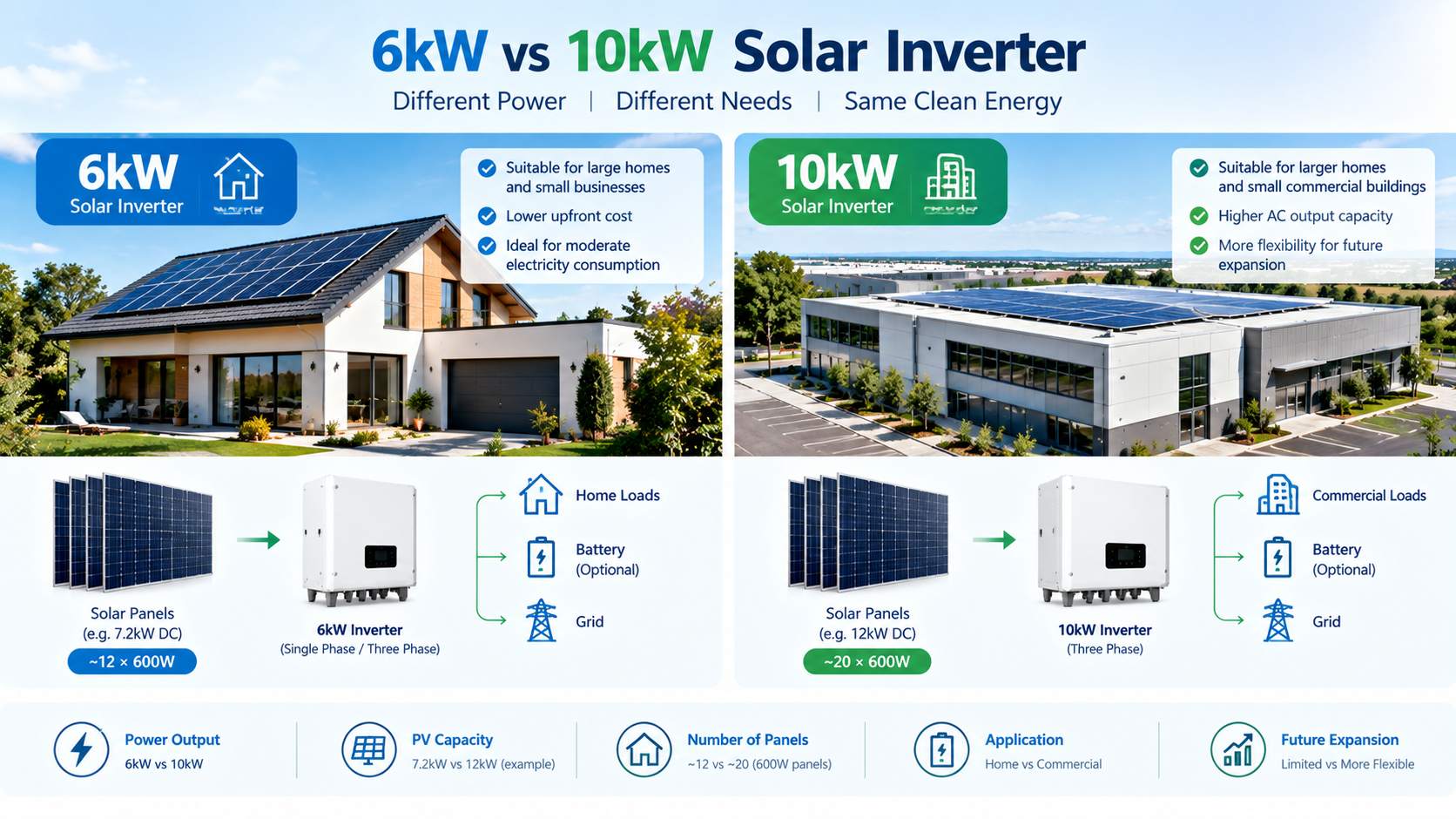
A 10kW inverter is not automatically better simply because it has a higher power rating. If the solar system and electrical loads are relatively small, a 6kW inverter may be more practical and economical.
On the other hand, if a property has higher electricity consumption, more solar panels, or plans to expand the PV system in the future, a 10kW inverter may provide greater flexibility.
In this guide, Solarasia Power compares 6kW and 10kW solar inverters and explains how to choose the right option for your solar project.
The power rating of an inverter refers to its maximum rated AC output power under specified operating conditions.
For example:
The inverter receives DC electricity from solar panels and converts it into AC electricity that can be used by electrical loads or supplied to the grid.
A typical grid-connected solar system includes:
Solar Panels → DC Protection → Solar Inverter → AC Distribution → Loads / Grid
If battery storage is included, the system may also contain a battery energy storage system and battery management equipment.
The inverter therefore plays a central role in determining how much AC power the solar system can deliver.
Before looking at the technical details, the basic differences can be summarized as follows:
| Feature | 6kW Inverter | 10kW Inverter |
| Rated AC Output | Approx. 6kW | Approx. 10kW |
| Typical Application | Residential / Small Projects | Large Residential / Small Commercial |
| Suitable PV Capacity | Depends on inverter specification | Depends on inverter specification |
| Space for Future Expansion | More limited | Generally greater |
| Potential Load Capacity | Lower | Higher |
| Typical Installation Cost | Lower | Higher |
| Best For | Moderate electricity demand | Higher electricity demand |
These are general comparisons only. Actual specifications vary between inverter models and manufacturers.
One of the most important factors when selecting an inverter is the size of the solar PV array.
For example, a property may install:
The inverter should be selected according to the complete electrical design rather than simply matching the panel capacity exactly.
For example, a system could potentially use:
7.2kW DC solar panels + 6kW AC inverter
This creates a DC/AC ratio of:
7.2 ÷ 6 = 1.2
Similarly:
12kW DC solar panels + 10kW AC inverter
also creates a:
1.2 DC/AC ratio
Whether this configuration is appropriate depends on the inverter's permitted PV input capacity and the project design.
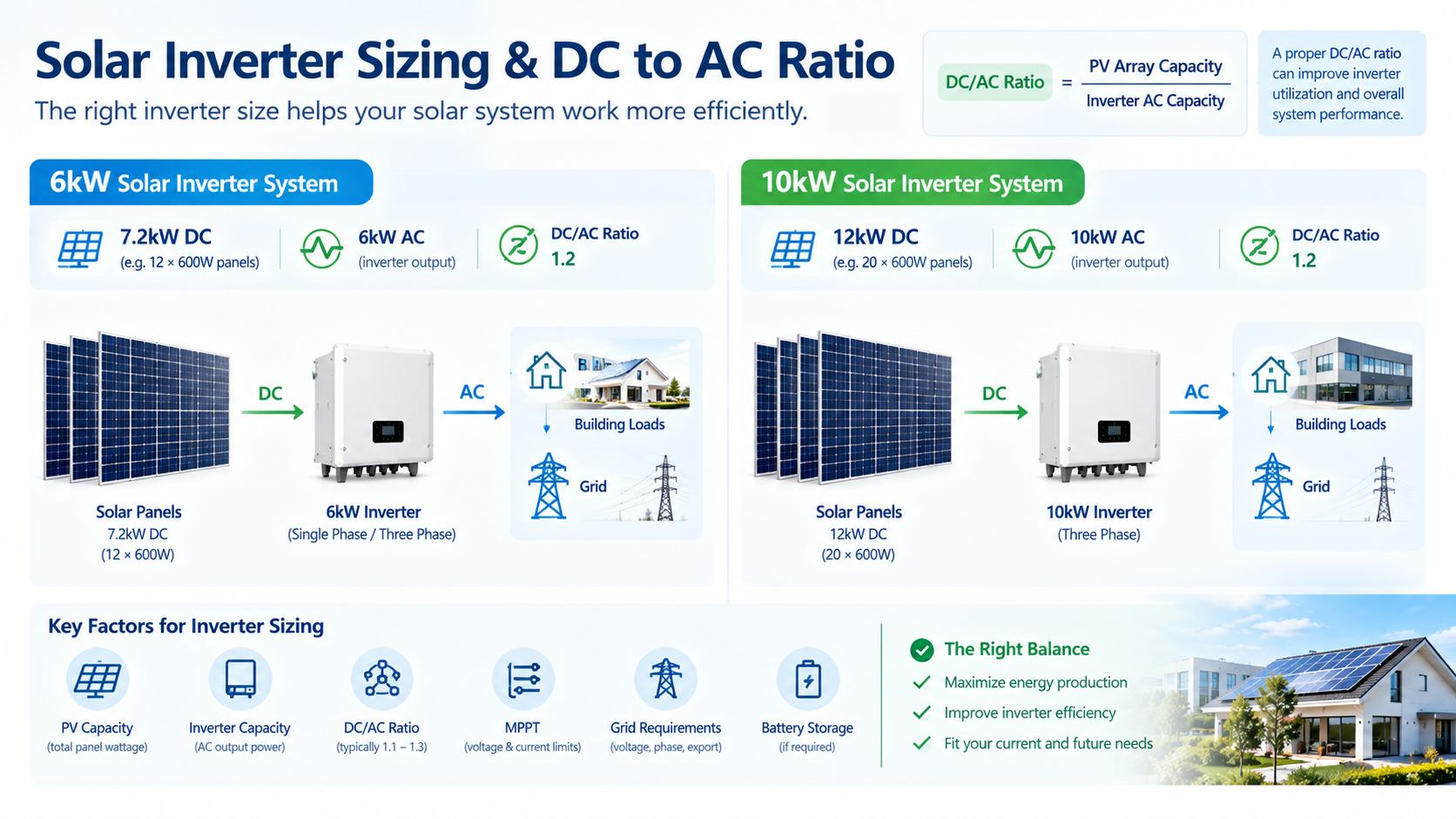
The DC/AC ratio compares the total rated capacity of the solar panels with the AC output capacity of the inverter.
DC/AC Ratio = PV Array Capacity ÷ Inverter AC Capacity
For example:
7.2kW PV ÷ 6kW inverter = 1.2
A higher DC capacity than inverter AC capacity can be intentional in a properly designed system.
Solar panels rarely operate at their nameplate maximum power continuously because actual output changes with:
A suitable DC/AC ratio can help the inverter operate efficiently over a broader portion of the day.
However, excessive oversizing can result in clipping, so the permitted PV input range and inverter specifications must always be checked.
A 6kW inverter can be a good choice for properties with moderate electricity consumption and a relatively compact solar array.
Typical applications may include:
For example, if a home has a PV array of around 7kW and the inverter supports the required DC input capacity, a 6kW inverter could be considered.
A 6kW inverter may also be attractive when:
The exact configuration should always be checked against the inverter manufacturer's electrical specifications.
A 10kW inverter may be more suitable for properties with higher electricity consumption or larger PV arrays.
Potential applications include:
A 10kW inverter can provide greater AC output capability than a 6kW model.
This can be useful when the property has higher simultaneous loads such as:
If several high power loads operate at the same time, the additional inverter capacity may provide more flexibility.
This depends on the specific inverter.
You cannot determine the maximum number of solar panels simply from the inverter's AC rating.
For example, a particular 6kW inverter may support a PV input above 6kW, while another model may have different specifications.
Important parameters include:
Therefore, when comparing a 6kW and 10kW inverter, always check the maximum recommended PV capacity rather than looking only at the AC output rating.
Suppose a solar project uses 600W panels.
If the project installs:
12 × 600W panels = 7.2kW DC
A compatible 6kW inverter may be able to handle this configuration if its technical specifications allow approximately 7.2kW or more of PV input.
The exact number of modules per string must then be determined according to:
A larger system could use:
20 × 600W panels = 12kW DC
A compatible 10kW inverter may support this configuration if the inverter's maximum PV input power and electrical parameters allow it.
Again, the panels should be arranged into suitable strings according to the inverter's MPPT and voltage requirements.
This demonstrates an important principle:
Inverter sizing is not simply about matching the total wattage of the panels.
The complete DC electrical design must be checked.
Not necessarily.
A 10kW inverter does not automatically cause the solar panels to generate more energy.
Solar energy production primarily depends on:
The primary advantage of a larger inverter is its ability to handle a greater AC output and potentially support a larger PV system.
For example, if the solar array can only produce 5kW under current conditions, installing a 10kW inverter instead of a 6kW inverter will not make the panels suddenly produce 10kW.
The inverter must be appropriately matched to the actual PV system and load requirements.
Another important consideration is whether the project requires a single-phase or three-phase inverter.
Many residential systems use single-phase electrical connections, while larger residential and commercial properties may use three-phase power.
However, this varies by country and utility connection.
Before selecting an inverter, check:
A 10kW inverter may be available in different electrical configurations, and the correct model must match the property's electrical system.
This is particularly important for international solar projects because grid standards vary between markets.
Both 6kW and 10kW inverters can potentially be used in solar-plus-storage systems, depending on the inverter type.
For hybrid systems, the inverter may connect:
Solar Panels + Grid + Battery + Loads
A hybrid inverter can coordinate solar generation, battery charging, battery discharging, and grid power depending on its design.
For example, a household may use solar energy during the day, charge the battery with excess PV generation, and then use stored energy in the evening.
A larger 10kW inverter may be more suitable when the property has:
However, the battery's power rating and energy capacity must also be considered separately.
Future expansion is often overlooked when purchasing a solar inverter.
Imagine a home currently has:
6kW of PV
but plans to add:
A 10kW inverter may offer more flexibility if the initial system design supports future expansion.
However, simply installing an oversized inverter does not guarantee that additional PV modules can be added later.
The inverter's:
must all be considered.
Future expansion should therefore be planned from the beginning.
A 6kW inverter will generally have a lower equipment cost than a comparable 10kW inverter.
However, the cheapest inverter is not necessarily the most cost-effective choice.
The better question is:
Which inverter provides the right capacity for the entire solar system at an appropriate total project cost?
Choosing a 6kW inverter for a system that actually needs 10kW of AC output may limit the system's performance.
Conversely, choosing a 10kW inverter for a small PV system with low electricity consumption may result in unnecessary upfront investment.
The ideal solution balances:
There is no universal answer.
A 6kW solar inverter may be a better choice when:
A 10kW solar inverter may be more appropriate when:
The final decision should be based on the actual project rather than inverter capacity alone.
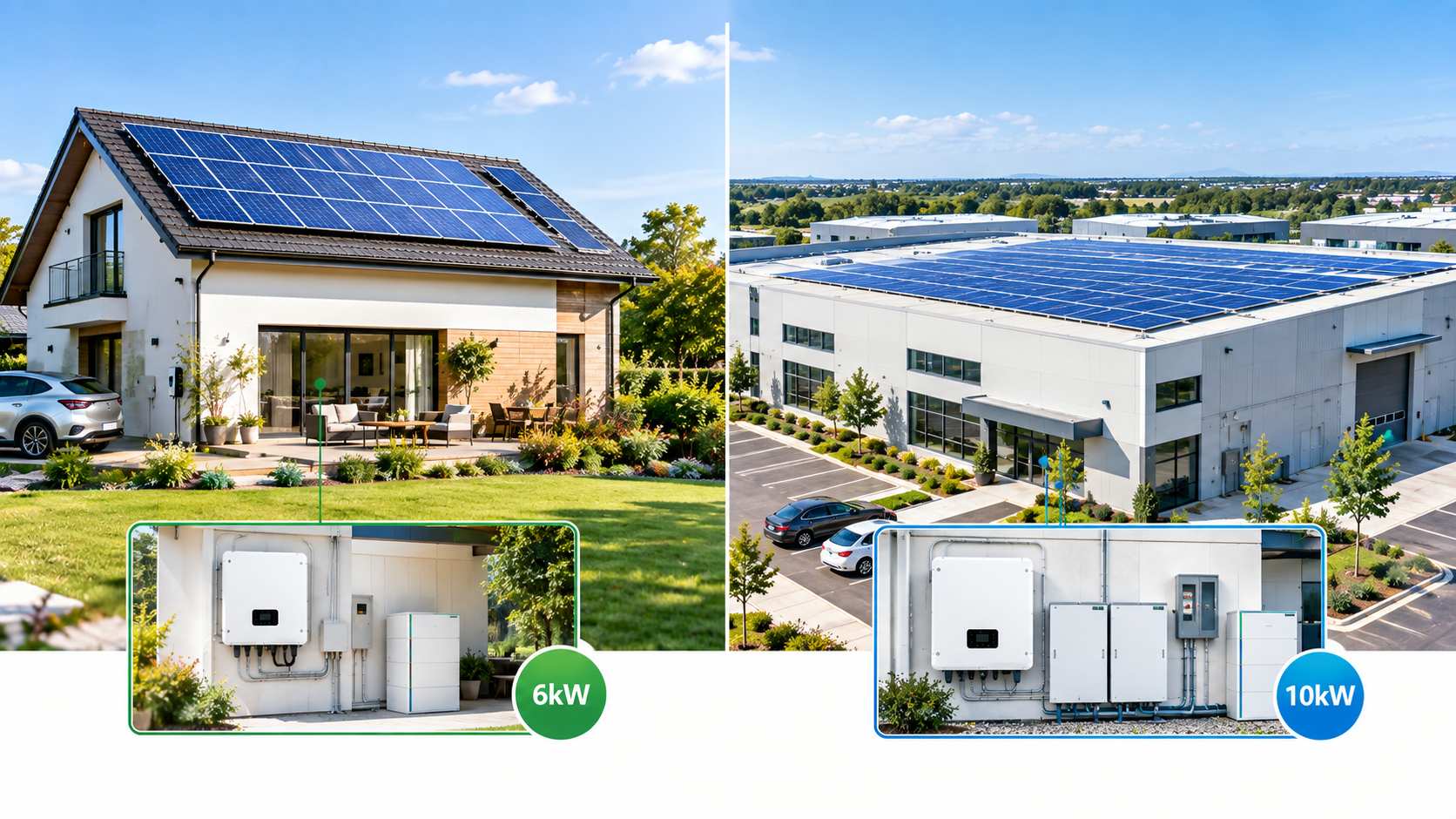
Consider two properties.
A large home uses approximately 700–900 kWh of electricity per month.
It has suitable roof space for approximately 7kW of solar panels and moderate daytime electricity consumption.
A compatible 6kW inverter could be a reasonable option if the inverter supports the required PV input.
A small commercial building consumes approximately 1,500–2,000 kWh of electricity per month.
It has sufficient roof space for approximately 12kW of PV panels and several high-power daytime loads.
A compatible 10kW inverter may be more suitable because it provides greater AC output capacity.
These examples are simplified. Actual system sizing should be based on detailed load data, solar resource analysis, equipment specifications, and local grid requirements.
The solar panel capacity is important, but it is not the only factor.
The inverter's voltage, current, MPPT range, and maximum PV input must also be checked.
A system should be designed around the building's actual load profile.
A property with high simultaneous electricity demand may require a larger inverter even if the annual energy consumption appears moderate.
Different countries and utilities have different requirements for:
Always verify local requirements before purchasing.
If additional solar panels, batteries, EV chargers, or electrical loads may be added later, this should be considered during the initial design.
Reliability, efficiency, warranty, monitoring functions, compatibility, technical support, and after-sales service can all affect the long-term value of an inverter.
Before purchasing a 6kW or 10kW inverter, prepare the following information:
Having this information makes it much easier to select an appropriately sized inverter.
Anhui Solarasia Energy Technology Co., Ltd., operating under the Solarasia Power brand, supplies solar inverters and related renewable energy equipment for international customers.
Our product portfolio covers solutions for:
In addition to solar inverters, SolarAsia Power supplies:
For distributors, wholesalers, EPC contractors, installers, and project developers, inverter selection should be based on the complete system design rather than simply choosing the highest-rated model.
Whether you need a 6kW inverter for a residential application or a 10kW inverter for a larger home or small commercial project, the right configuration can help improve system compatibility, energy utilization, and long-term project performance.
So, 6kW vs 10kW solar inverter: which one should you choose?
A 6kW inverter can be suitable for moderate residential loads and smaller PV systems, while a 10kW inverter may be a better fit for larger residential properties, small commercial buildings, and systems with higher electricity demand.
However, inverter capacity should never be selected in isolation.
The final decision should consider:
PV capacity + electricity consumption + DC/AC ratio + MPPT configuration + grid requirements + battery storage + future expansion.
If your solar array and electricity demand are relatively modest, a 6kW inverter may provide a cost-effective solution.
If your property has higher loads, a larger PV array, battery storage, or future expansion plans, a 10kW inverter may provide greater flexibility.
The most important goal is not choosing the largest inverter, but choosing an inverter that is properly matched to the complete solar energy system.


Address : Room 908-909, Building 2, No. 469 Huatuo Lane, Shushan District, Hefei City, Anhui Province


Please read on, stay posted, subscribe, and we welcome you to tell us what you think.
Copyright 2026 @ Anhui Solarasia Energy Technology Co.,Ltd .All Rights Reserved. Sitemap | Blog | XML | Privacy Policy
 Network Supported