
Finding the Best Tilt and Azimuth Angle for Your Solar Panels
When installing a solar energy system, panel position is very important. It matters just as much as the number of panels. Setting the correct tilt and azimuth angles helps panels receive more sunlight. This directly improves electricity production.
This applies to many situations. You may be installing panels on a home rooftop. You may be working on a commercial building. You may also be building an off-grid solar project. Understanding these angles helps you maximize system efficiency.
In this guide, we explain solar tilt and azimuth angles. We also show how to find the best angles for your location.
What Are Solar Tilt and Azimuth Angles?
Before optimizing your installation, you need to understand two key angles. These angles determine solar panel orientation.
Solar Panel Tilt Angle
The tilt angle is also called the elevation angle. It refers to the vertical angle of the panel relative to the ground. Simply put, it describes how steeply the panel is tilted toward the sky. A proper tilt angle helps panels capture maximum sunlight all year.
Solar Panel Azimuth Angle
The azimuth angle is the horizontal direction the panels face. It is measured in degrees relative to true north. This angle decides whether panels face south, east, west, or north. It affects how much sunlight they receive during the day.
The sun moves across the sky daily. It also changes position throughout the year. Choosing the right tilt and azimuth angles ensures consistent power generation.
Finding the Optimal Azimuth Angle
The ideal azimuth angle depends mainly on your location.
Here is the general rule:
Facing panels toward the equator helps capture the most sunlight daily.
However, you must understand the difference between true direction and magnetic direction. A standard compass points to magnetic north. This is slightly different from true north. The difference is called magnetic declination.
What Is Magnetic Declination?
Magnetic declination is the angle difference between magnetic north and true north. If true north lies east of magnetic north, the declination is positive. If it lies west, the declination is negative.
You can use tools to find accurate direction. For example, try the NOAA Magnetic Declination Calculator.
Example Adjustments
Here are some examples.
In San Diego, California, magnetic declination is about 11° east. To face true south, rotate panels 11° east of magnetic south.
In Cochran, Chile, the declination is the same. Panels should rotate 11° west of magnetic north. This aligns them with true north.
Correcting for magnetic declination ensures panels face the best direction for energy production.
Finding the Optimal Tilt Angle
The azimuth angle sets the direction. The tilt angle determines how effectively panels capture sunlight. This changes as the sun moves across the sky. Luckily, there are simple guidelines for choosing the right tilt.
Set It and Forget It: Use Your Latitude
The easiest method is to set the tilt angle equal to your latitude. This provides balanced performance all year.
For example, San Diego is at about 33° latitude. A 33° tilt works well for a fixed installation. This approach is ideal for most homes and businesses. It requires no seasonal adjustments.
Seasonal Tilt Adjustments
If you want to maximize production, you can adjust the tilt seasonally.
Here are general recommendations:
Spring and Fall: Tilt angle = Latitude
Summer: Tilt angle = Latitude − 10° to 15°(A flatter angle captures stronger overhead sunlight.)
Winter: Tilt angle = Latitude + 10° to 15°(A steeper angle helps capture lower winter sunlight.)
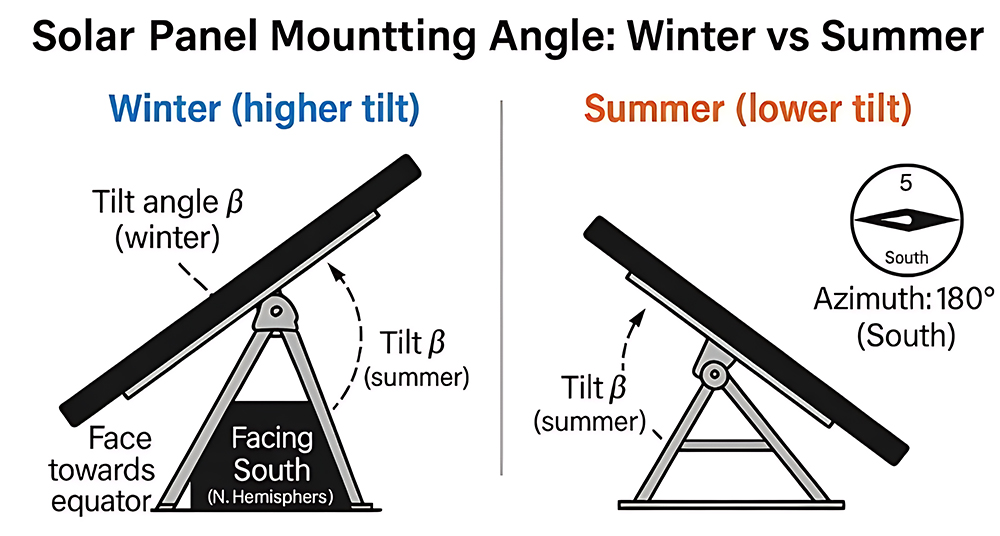
Seasonal adjustments can improve performance slightly. However, many owners prefer a fixed tilt for convenience.
Snow Conditions and Steeper Tilt Angles
In snowy regions, a steeper winter tilt helps snow slide off panels. This prevents snow from blocking sunlight. The system can then continue producing electricity.
Adjustable pole-mounted systems are very useful in heavy snow areas. They allow users to change the tilt angle throughout the year.
Should You Use a Solar Tracker?
Solar trackers move panels automatically. They follow the sun's path during the day. This can increase energy production. However, trackers are often not cost-effective for small installations.
A solar tracker costs about $600 to $1000 per panel. It may only increase output by 60 to 90 watts on a 300-watt panel.
In comparison, adding an extra panel costs around $160. It provides significantly more power for a lower investment.
Solar trackers are more suitable for large commercial or utility projects. In these cases, maximizing production is critical.
For most residential systems, it is more practical to install a slightly larger array. This is better than investing in tracking equipment.
Final Thoughts
Solar panels are forgiving regarding tilt and azimuth angles. Even if your installation is not perfectly optimized, it will still generate plenty of electricity.
For a simple and reliable setup, set the tilt angle equal to your latitude. Face panels toward true south (Northern Hemisphere) or true north (Southern Hemisphere).
If you want to maximize efficiency, make seasonal tilt adjustments. You can also consider advanced solutions like solar trackers.
However, the easiest and most cost effective solution is often to install one or two extra panels. This ensures stable energy production all year.
Want to Maximize Your Solar Performance?
Selecting the right panels, inverter, and system design is just as important as setting the correct angles.
We provide high quality solar panels and commercial inverters. We offer complete solar solutions for residential, commercial, and industrial projects worldwide.Contact us today for a professional solar solution. We will provide a competitive quotation for your project.


Address : Room 908-909, Building 2, No. 469 Huatuo Lane, Shushan District, Hefei City, Anhui Province


Please read on, stay posted, subscribe, and we welcome you to tell us what you think.
Copyright 2026 @ Anhui Solarasia Energy Technology Co.,Ltd .All Rights Reserved. Sitemap | Blog | XML | Privacy Policy
 Network Supported