
Why Is 2026 the Year Your Business Can’t Afford to Skip Solar + Storage? (ROI Analysis Inside)
In an era defined by volatile energy markets and tightening corporate sustainability mandates, the conversation around Commercial & Industrial (C&I) power has fundamentally shifted. If 2024 was about feasibility and 2025 was about pilot projects, 2026 is the definitive year of financial reckoning. The question facing CFOs and Facility Managers is no longer "Should we go green?" but rather,"How much revenue are we losing by waiting?"
This deep dive explores the technological leaps, policy deadlines, and pure economic calculus that make Solar + Storage the most compelling infrastructure investment for businesses in 2026.
What makes the 2026 C&I solar proposition radically different from just two years ago?
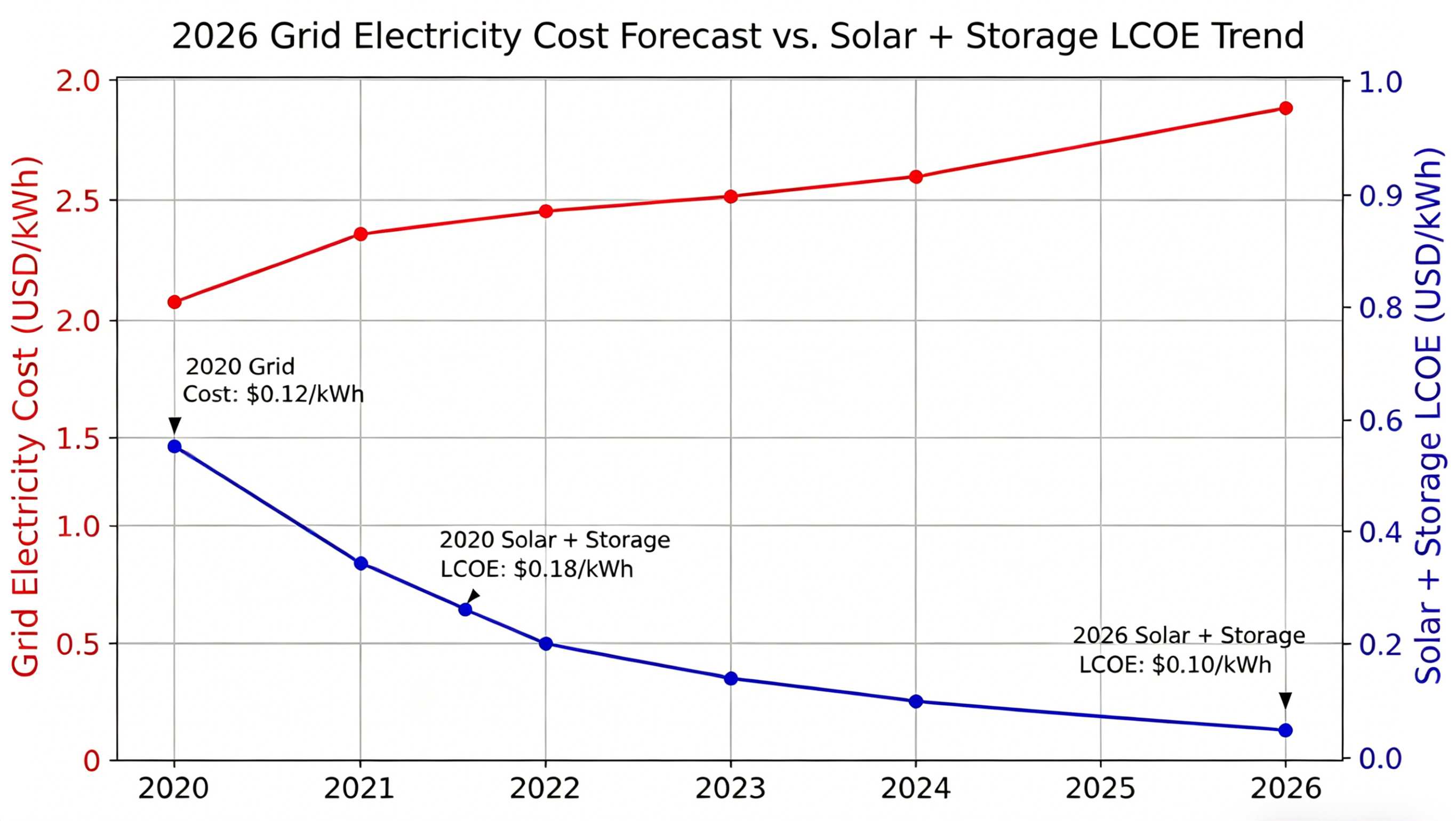
The answer lies in the death of flat-rate electricity and the birth of sophisticated energy arbitrage. In 2026, we are witnessing a global decoupling of generation cost and retail price. While Levelized Cost of Energy (LCOE)(Click here to learn LCOE) for utility scale solar has plummeted to between $0.03 and $0.06 per kWh in sun-rich regions, peak commercial grid tariffs in markets like California, Germany, and Australia routinely exceed $0.35 to $0.50 per kWh.
This gap represents a delta of nearly 10x. However, without storage, this delta is wasted. The 2026 roadmap emphasizes Grid Sovereignty through Load Shifting. By pairing high efficiency PV with intelligent battery storage, a business can store mid-day solar surplus (when grid export prices are near zero) and discharge it precisely during the evening peak tariff window. This turns a simple rooftop array into a dynamic financial hedge against time of use (TOU) rate hikes.
How can choosing the wrong solar panel erode your 2026 returns?
While many procurement teams still focus solely on upfront cost per watt, the real metric for 2026 is Energy Yield per Square Meter and Degradation Rate. This is where the technology chasm between older PERC cells and next-generation N-Type Modules becomes a balance sheet issue.
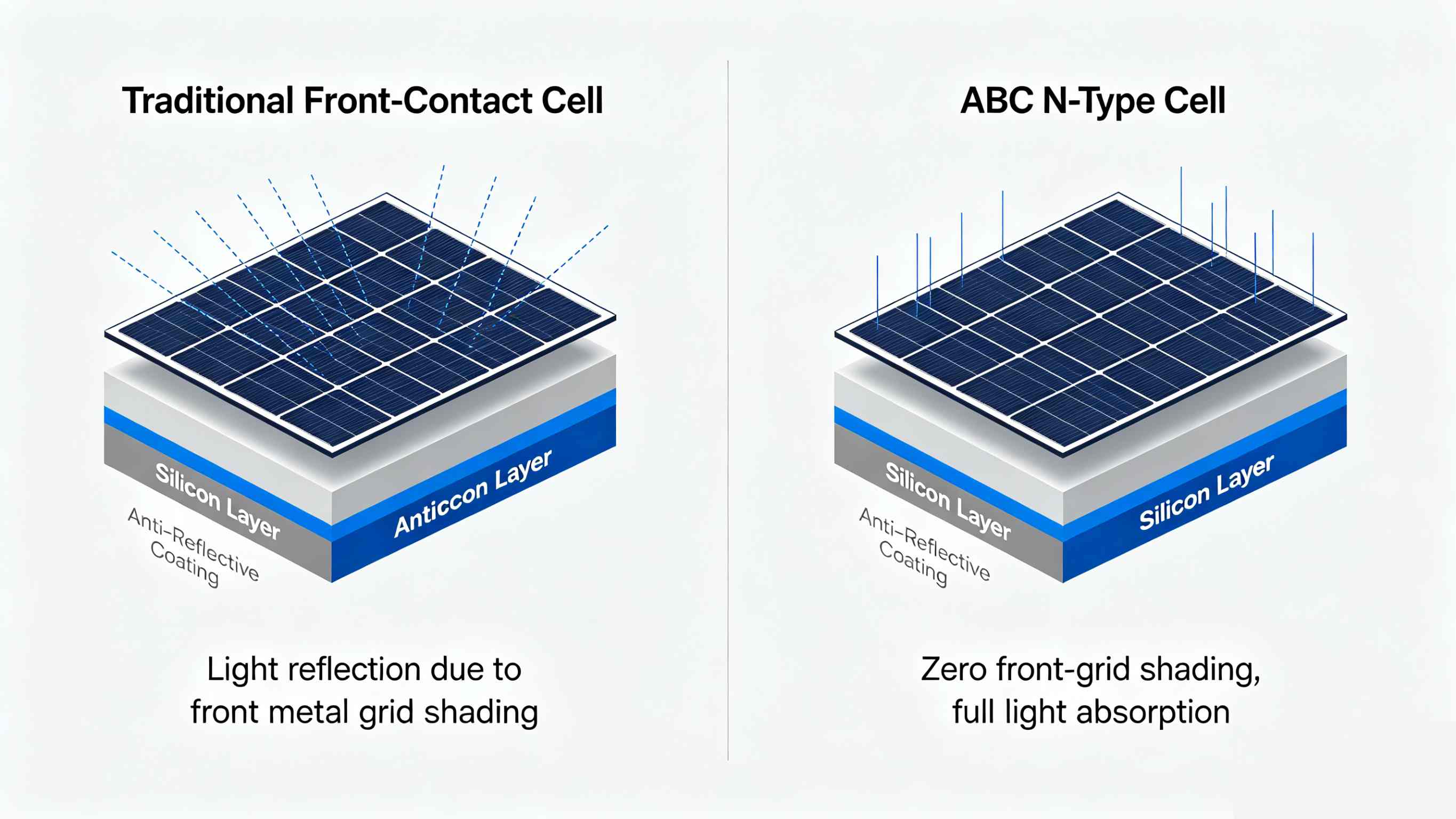
In 2026, Tier 1 manufacturers have almost entirely sunset PERC production. The new standard bearers are TOPCon and Heterojunction (HJT) technologies. For example, panels leveraging ABC (All Back Contact) architecture are now hitting commercial delivery efficiencies of 24.8% with power outputs in the 640W-670W range. Why does this matter for your farm or factory?
Space Optimization: A 670W N-Type panel generates significantly more power from the exact same roof footprint as a 550W legacy panel. This reduces Balance of System (BOS) costs—fewer rails, less cabling, and lower labor costs per watt installed.
Better Low-Light & Temperature Coefficients: In 2026, with hotter summers becoming the norm, ABC modules maintain higher performance during peak heat hours compared to standard cells, which suffer from thermal throttling.
Why is a "dumb" battery a liability in 2026's energy market?
Adding a containerized BESS is essential, but the magic lies in the software stack. In 2026, we are seeing the widespread adoption of negative pricing events and real-time wholesale market exposure for commercial entities. A standard battery set to a simple timer will charge when the sun is shining. A smart storage system integrated with AI-driven Energy Management Systems (EMS) will charge when the grid price is negative (literally getting paid to charge) and discharge when grid congestion fees spike.
Furthermore, the hardware integrity of the cells is paramount. As outlined in our previous deep dive on Identify Grade B Cells in Large Scale Containerized BESS, the difference between a 10-year asset and a 7-year fire risk often comes down to cell grading and thermal management. In 2026, Liquid Cooling systems have become non-negotiable for C&I projects seeking bankability. They ensure Round-Trip Efficiency (RTE) stays above 92%, squeezing every last kilowatt-hour of profit from the system.
When does the window of maximum financial incentive close?
Across the US and parts of Europe, the current incentive landscape is as good as it will ever be. Whether it's the Investment Tax Credit (ITC) in the US or various feed-in premium adjustments in Europe, the legislative calendar points to a gradual step-down beginning in late 2026.
For US businesses, the Inflation Reduction Act (IRA) provisions offer a 30% base tax credit, with potential adders of up to 40% or more for using domestic content or siting in energy communities. However, to lock in the "safe harbor" for the full 30% rate, projects must demonstrate commencement of construction before the anticipated adjustment date in July 2026. Waiting until 2027 could mean leaving 10-20% of your capital stack on the table—a direct hit to your project's Internal Rate of Return (IRR).
Why is 2026 the year to scrutinize how your battery gets to site?
As explored in "Beyond the Box: How Solarasia Guarantees Lithium Battery Safety in Global Transit," the logistics of moving large-scale energy storage are more complex than ever. In 2026, new UN38.3 and ADR regulations are tightening the noose on poorly packaged or untested battery shipments.
For a farm owner looking at the post-harvest electricity bill or a factory manager worried about production downtime, the Residential and Commercial Energy Independence movement rests on reliability. A system that suffers from Grade B Cell failure or transit damage before it's even commissioned is a stranded asset. Due diligence in supply chain verification is the unsung hero of a successful 2026 energy project.
In 2026, Grid Sovereignty is not a futuristic buzzword; it is the ability to keep the lights on and the production line moving when the grid fails, while simultaneously hedging against inflationary energy costs.
The data is irrefutable: Projects utilizing high efficiency AIKO ABC 640W-670W Solar Panels paired with liquid-cooled smart storage are delivering IRRs well above 12% in many markets, with payback periods shrinking below four years.
Don't let the 2026 deadline for peak incentives pass you by. Secure your energy independence today.


Address : Room 908-909, Building 2, No. 469 Huatuo Lane, Shushan District, Hefei City, Anhui Province


Please read on, stay posted, subscribe, and we welcome you to tell us what you think.
Copyright 2026 @ Anhui Solarasia Energy Technology Co.,Ltd .All Rights Reserved. Sitemap | Blog | XML | Privacy Policy
 Network Supported