
Grid Tied VS Hybrid VS Off Grid Solar: What’s the REAL Difference for Your ROI in 2026?
The solar industry has a messaging problem. Walk into any trade show or scroll through a distributor’s website in 2026, and you will be bombarded with three distinct categories—Grid-Tied, Hybrid, and Off-Grid—each presented as if it were the “correct” answer to a universal problem. The truth is far more nuanced. These are not lifestyle choices; they are financial and engineering decisions with vastly different implications for energy independence, system Levelized Cost of Energy (LCOE), and long term operational security.
At Solarasia Power, we have deployed all three configurations across more than 100 countries, from grid-tied commercial rooftops in stable European markets to fully autonomous off-grid systems in remote mining operations. What we have learned is this: choosing the wrong architecture in 2026 does not just cost you a few percentage points of efficiency—it can fundamentally undermine your entire investment thesis.
This article goes beyond the surface-level feature list. We will dissect the three architectures through the lens of 2026’s specific technological and regulatory realities: the emergence of Virtual Power Plant (VPP) economics, the impact of Time-of-Use (TOU) rate arbitrage on battery ROI, and the silent role that N-type TOPCon module selection plays in shrinking or inflating your LCOE.
How They Work
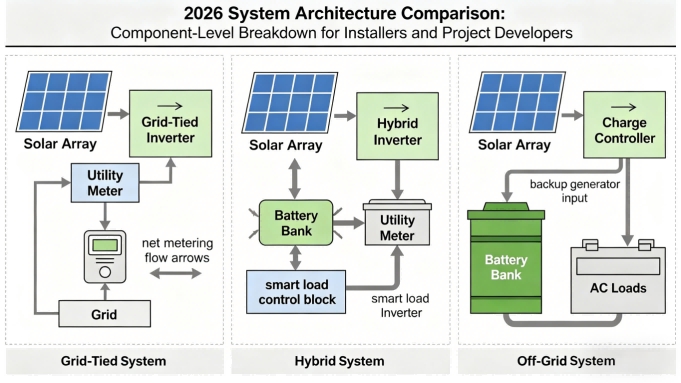
A grid-tied system is the most direct implementation of photovoltaic generation. Solar panels feed DC power to a grid tied inverter, which converts it to AC and synchronizes with the utility waveform. When generation exceeds consumption, surplus flows to the grid; when consumption exceeds generation, the grid fills the gap. There is no battery. The grid acts as an infinite, zero-maintenance buffer.
The 2026 Financial Equation
On paper, grid tied remains the lowest capital cost option. A residential on-grid system typically costs 40–60% less than an equivalent off grid system, owing to the absence of batteries, charge controllers, and backup switchgear.For Commercial & Industrial (C&I) applications in markets with favorable net metering policies, payback periods of 4–7 years are still achievable.
However,2026 has fundamentally rewritten the grid-tied value proposition. The defining dynamic is the widening chasm between generation LCOE and retail electricity prices. While utility-scale solar LCOE has plummeted to between $0.03 and $0.06 per kWh in sun-rich regions, peak commercial grid tariffs in markets like California, Germany, and Australia routinely exceed $0.35 to $0.50 per kWh.This delta—nearly a 10x spread—represents a massive arbitrage opportunity.
The Policy Landmine
The catch is that pure grid-tied systems cannot capture this delta. They produce when the sun shines, regardless of when power is most valuable. Under California’s Net Billing Tariff (NEM 3.0), export credits have been slashed by up to 75% compared to legacy net metering, with compensation now based on avoided energy costs at specific times of day rather than simple retail-rate netting.Meanwhile, European markets are moving even more aggressively: the Netherlands has approved the phase-out of net metering (salderingsregeling) by January 1, 2027, and energy suppliers are already imposing solar grid penalties during periods of negative electricity prices.
2026 Verdict
Grid-tied systems excel where the grid is stable, net metering remains favorable (increasingly rare), and daytime consumption closely matches solar generation. For C&I facilities with high base loads during operating hours—manufacturing plants, data centers, cold storage—grid-tied remains a compelling baseline. But for any project where TOU rate differentials exceed 3x or where grid reliability is questionable, a grid-tied-only approach in 2026 is increasingly a value-destructive decision.
How They Work
A hybrid system adds a bidirectional inverter and battery storage to the grid-tied architecture. During the day, solar generation first serves the building’s loads. Any surplus charges the battery; only after the battery reaches its target state of charge does excess export to the grid. During evening peak pricing windows, the inverter can discharge stored energy to offset expensive grid imports—or, in markets with VPP programs, dispatch it to the grid for direct compensation.
The Battery Intelligence Layer
In 2026, the critical differentiator in hybrid systems is no longer battery chemistry (LFP has largely won that battle at the residential and light C&I scale). It is the Smart Energy Management System (EMS) that orchestrates the entire operation. Advanced hybrid inverters now integrate AI algorithms that analyze real-time weather forecasts and local grid pricing. If the system predicts a storm or a localized grid failure, it automatically prioritizes a “Battery First” mode. If it detects a price surge from the utility provider, it shifts the entire house to the storage reserve.
This is the crucial nuance that many procurement teams miss: a hybrid inverter without smart load management is just a grid-tied inverter with an expensive battery attached. Modern 25 kW hybrid inverters, for instance, are designed to handle heavy industrial loads without triggering expensive “peak demand” penalties from the utility. Through automated load shedding, if a facility’s demand exceeds the inverter limit, the system enters “Hybrid Mode” and seamlessly draws only the excess difference from the grid—precisely shaving the most expensive kilowatts off the utility bill.
The 2026 ROI Math
The numbers make the case decisively. Under NEM 3.0 in California, a solar-only system sees its payback period stretch to 12–15 years. Adding a battery, however, cuts that payback to 7–9 years by enabling peak-shaving during the expensive 4–9 PM window.
A 10 kW solar + 13.5 kWh battery system costs approximately $32,550 after incentives, breaking even in Year 8 for a typical $400/month household—delivering over $77,000 in 20-year savings.
For C&I applications, the numbers are even more compelling. Top-performing projects have delivered payback in as little as 1.3 years, with lifetime savings exceeding $15 million and internal rates of return above 60%.The key driver is peak demand charge avoidance, which in commercial rate structures can represent 30–50% of the total electricity bill.
The VPP Wildcard: Turning Your Battery into a Revenue Stream
Perhaps the most consequential development for hybrid system economics in 2026 is the operationalization of Virtual Power Plants (VPPs) . Across the United States, battery-based aggregation is rapidly scaling—ratepayers who own or lease batteries can now join a VPP in more than half of all states and earn direct compensation for their grid service.In Arizona, VPP programs offer incentives up to $110/kW per year for battery dispatch during peak hours.In Northern California, Ava Community Energy’s SmartHome Battery program provides both installation rebates of up to $500/kWh for income-qualified customers and ongoing participation payments of $3 per kWh per month based on the portion of battery capacity shared with the VPP.
This fundamentally changes the hybrid system ROI model. A battery is no longer merely a cost center that enables self-consumption—it is a grid asset that can generate recurring revenue. In 2026, the question is shifting from “Can this work?” to “How do we scale?”
2026 Verdict
Hybrid systems are the default choice for any project in a market with TOU rate structures, NEM 3.0-style net billing, or active VPP programs. The 30–50% premium over grid-tied systems is more than offset by the combination of self-consumption optimization, peak demand charge avoidance, and VPP participation revenue.For businesses, hybrid is no longer an “upgrade”—it is the baseline configuration for financial viability.
How They Work
Off-grid systems have no utility connection whatsoever. Solar panels charge a battery bank through a charge controller, and an off-grid inverter converts stored DC power to AC for the building’s loads. Because there is no grid to fall back on, the entire system must be sized to meet the worst-case scenario: the longest stretch of cloudy days coupled with the highest seasonal load. A backup generator (diesel or propane) is almost always included as a failsafe.
The Sizing Imperative: Depth of Discharge and Days of Autonomy
This is where off-grid diverges most sharply from grid-tied and hybrid—not just in cost, but in design philosophy. Off-grid sizing is an exercise in risk management. Two parameters govern the entire design: Depth of Discharge (DoD) and Days of Autonomy.
DoD determines how much stored energy you can actually use without damaging your batteries. Research on standalone PV/battery systems has identified 70% as the optimal DoD value for maximizing battery longevity while maintaining zero loss of load probability (LLP).This means a 10 kWh battery bank in an off-grid context is not 10 kWh of usable capacity—it is 7 kWh. Oversizing the battery bank to maintain a conservative average DoD is not optional; it is the difference between a system that lasts 15 years and one that fails in three.
Days of Autonomy is the number of consecutive days the battery bank can sustain the load without any solar input. In temperate climates with reliable sun,2–3 days may suffice. In monsoon regions or high-latitude installations,5–7 days is often required. Each additional day of autonomy adds approximately 20–30% to the battery capital cost—and this cost compounds because the solar array must also be oversized to recharge that larger bank within the available sun hours.
The Real-World Economics
A 3 kW off-grid system typically costs 2–3 times more than a comparable 3 kW on-grid system.But the cost premium is not just about the hardware—it is about the design rigor required. Improperly sized off-grid systems fail silently. They work beautifully in July, then collapse during a week of overcast weather in January. The cost of that failure, in a remote telecommunications site or an island resort, can dwarf the entire system’s capital expenditure.
2026 Verdict
Off-grid is not a “choice” in the conventional sense—it is a necessity dictated by geography. Where grid connection is physically impossible or prohibitively expensive (e.g., remote mining camps, island communities, agricultural monitoring stations), off-grid is the only viable solution. The 2026 optimization frontier for off-grid is not about reducing capital cost; it is about right-sizing DoD, autonomy days, and generator integration to minimize total lifecycle cost over a 20–25 year horizon. This requires sophisticated energy modeling—spreadsheet-level napkin math is a recipe for stranded assets.
Regardless of which architecture you choose, one factor silently compounds or erodes your returns: module technology selection. In 2026, the industry has decisively entered the N-type era. High-efficiency technologies such as N-type TOPCon, Back Contact (BC), and HJT are now mainstream, while traditional P-type PERC modules are rapidly being phased out.
The numbers are striking. TOPCon modules have demonstrated a consistent performance advantage over BC modules in real-world field testing. Over a four-month monitoring period from November 2025 to February 2026, TOPCon modules achieved an average cumulative power gain of 3.16% per watt compared to BC modules. Cumulative generation per watt reached 310.26 kWh/kW for the 650W TOPCon module versus 300.76 kWh/kW for the 650W BC module.
Why does this matter for your 2026 project? Three reasons:
First, temperature coefficient. TOPCon’s temperature coefficient is approximately -0.26%/°C, meaning it loses only about 0.26% of rated power output for every degree above standard test conditions. In hot climates—think Middle East, Latin America, sub-Saharan Africa—this advantage compounds across the entire system lifetime.
Second, low-light performance. During the field test period, Yantai experienced 43–47 days of irradiance below 400 W/m², accounting for 70–77% of the monitoring period. During these low-irradiance days, TOPCon modules recorded power gains of 5.39% and 4.30% over BC modules, respectively.This means more kilowatt-hours on cloudy days, in winter, and during early morning and late afternoon hours—precisely when grid electricity is often most expensive.
Third, bifacial gain. TOPCon’s high bifaciality enables effective capture of reflected and scattered light from the rear side of the module. In ground-mount installations with modules elevated just 1.5 meters above ground, this contributed significantly to cumulative power gains without increasing installed capacity.
The 2026 Takeaway
For grid-tied systems, TOPCon’s efficiency advantage directly reduces the number of modules required to hit a given power target—lowering Balance of System (BOS) costs for racking, cabling, and labor. For hybrid systems, the improved low-light performance extends the daily generation window, reducing reliance on the battery during shoulder hours. For off-grid systems, higher energy yield per square meter means a smaller array can meet the same load—or the same array can support more days of autonomy.
Choosing the right module technology in 2026 is not about chasing the highest nameplate efficiency; it is about understanding which technology delivers the most consistent, real-world energy yield for your specific climate and application.
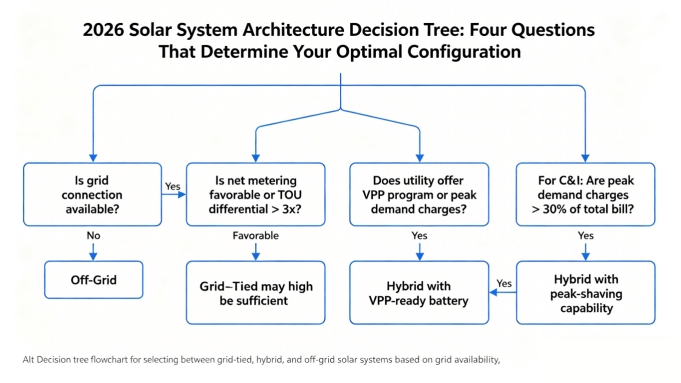
Given all of the above, the 2026 decision framework distills to four sequential questions:
1. Is grid connection physically available and economically feasible?
If the answer is no—you are in a remote location where extending utility infrastructure would cost more than the entire solar-plus-storage system—then off-grid is your only path. Accept the higher upfront capital cost as the price of operational autonomy, and focus your optimization efforts on DoD, autonomy days, and generator integration.
2. If grid-connected, what is your net metering or net billing policy?
In markets where net metering remains favorable (retail-rate credits for exports, no export penalties), a pure grid-tied system may still deliver the fastest payback. However, these markets are shrinking rapidly. If you are in California (NEM 3.0), much of Europe (post-net-metering phase-out), or any market with TOU differentials exceeding 3x between peak and off-peak, a hybrid system is almost certainly the correct financial decision.
3. Does your utility offer a Virtual Power Plant (VPP) program, or are you subject to peak demand charges?
If yes to either, hybrid becomes not just financially advantageous but strategically essential. A VPP program turns your battery into a recurring revenue stream; peak demand charge avoidance can reduce a C&I electricity bill by 30–50%. In these scenarios, the 30–50% premium for hybrid over grid-tied should be reframed as an investment with a sub-5-year payback—not an incremental cost.
4. What is your load profile relative to solar generation?
If your facility operates primarily during daylight hours (e.g., manufacturing, retail, education), your self-consumption will naturally be high, reducing the value of battery storage. If your load peaks in the evening or overnight (e.g., residential, hospitality, data centers), battery storage is essential to capture daytime solar generation for later use. This single factor can make the difference between a hybrid system that pays for itself in 5 years and one that takes 12.
The solar industry spent its first two decades selling a simple proposition: put panels on your roof, watch your meter spin backwards, and enjoy the savings. That era is over. In 2026, the financial performance of a solar installation is determined less by the quality of the sunlight on your site and more by the sophistication of your system architecture.
Grid-tied remains the LCOE champion where policies support it—but those markets are shrinking. Hybrid has emerged as the default configuration for any project where TOU rates, peak demand charges, or VPP participation shape the economics. Off-grid remains the only viable option where the grid does not exist, demanding a level of engineering rigor that far exceeds the other two categories.
At Anhui Solarasia, we do not believe in pushing a single “best” system. We believe in equipping our global partners with the right combination of N-type TOPCon modules, intelligent hybrid inverters, and LFP battery storage to optimize for your specific conditions—not a generic playbook.
The 2026 question is not “Which system is cheaper?” It is “Which system will still be performing profitably in 2036?” If you are ready to answer that question with data rather than assumptions, we are ready to help you engineer the solution.


Address : Room 908-909, Building 2, No. 469 Huatuo Lane, Shushan District, Hefei City, Anhui Province


Please read on, stay posted, subscribe, and we welcome you to tell us what you think.
Copyright 2026 @ Anhui Solarasia Energy Technology Co.,Ltd .All Rights Reserved. Sitemap | Blog | XML | Privacy Policy
 Network Supported