
How to Choose a Commercial Lithium Battery: A Complete Buyer’s Guide for 2026
As more businesses invest in solar power and energy storage, choosing the right commercial lithium battery has become an important part of project planning. Factories, warehouses, commercial buildings, solar installers, and energy storage system integrators all need reliable battery solutions that match their power requirements, operating conditions, and long-term financial goals.
However, not every lithium battery is suitable for every commercial application. A battery designed for a small residential solar system may not meet the power, capacity, scalability, or integration requirements of a large commercial or industrial project.
So, how do you choose the right commercial lithium battery for your business?
The answer depends on several factors, including battery capacity, power output, chemistry, cycle life, safety features, inverter compatibility, operating environment, and total cost of ownership. Understanding these factors before purchasing can help you compare suppliers, avoid unsuitable configurations, and select a battery solution that meets your project's actual needs.
In this guide, we explain how to evaluate commercial lithium batteries for solar energy storage, industrial facilities, and commercial battery energy storage systems.
Before comparing battery products or requesting quotations, identify what you want the battery to accomplish. The intended application determines the battery capacity, power rating, control strategy, and system configuration.
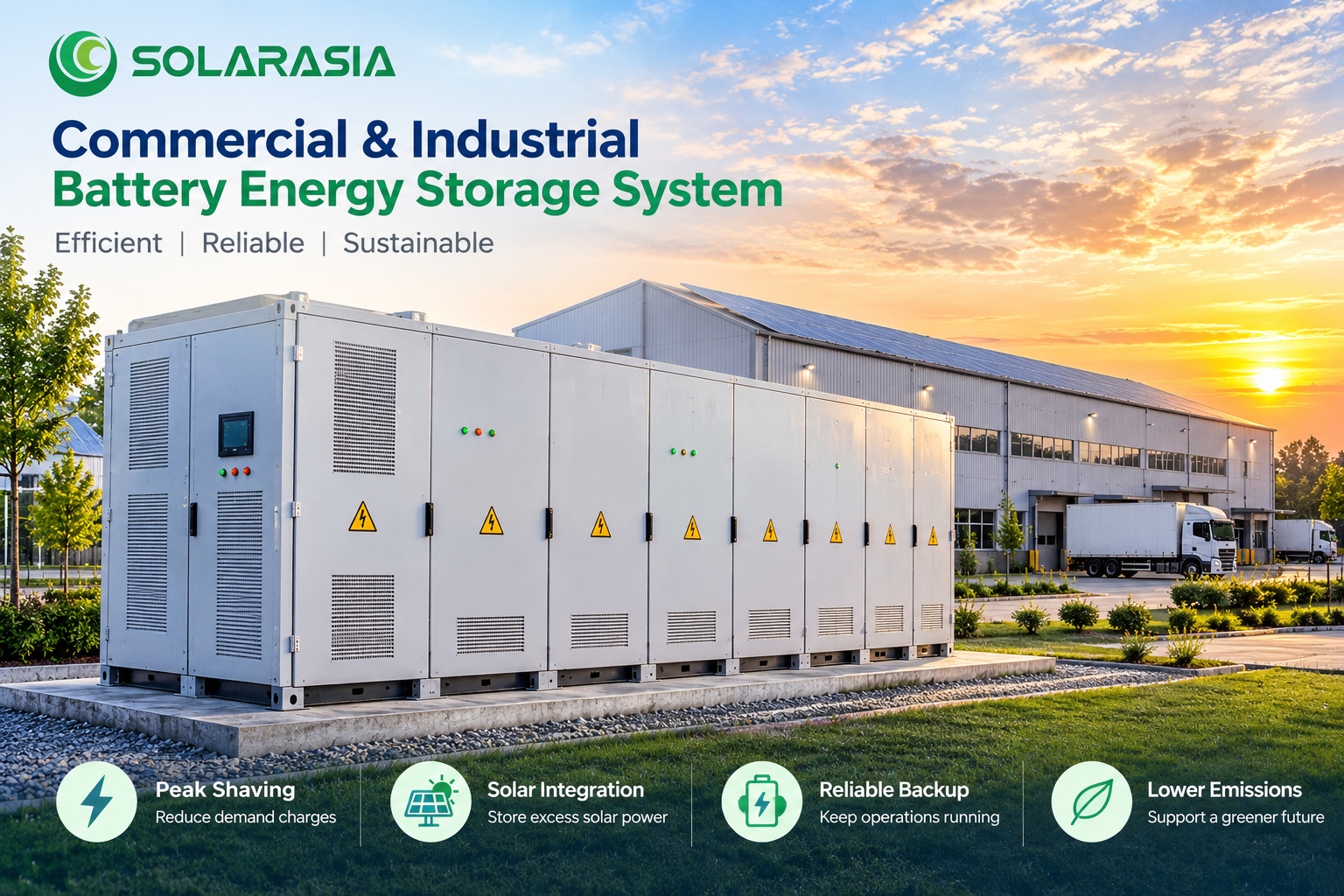
Businesses with high electricity demand may use battery storage to reduce peak power consumption. The battery charges when appropriate and discharges during selected high-demand periods.
For this application, consider the facility's demand profile, peak duration, required discharge power, and electricity tariff structure. A battery with sufficient energy capacity but inadequate power output may not reduce the targeted peak effectively.
Commercial buildings with rooftop solar panels may use batteries to store excess daytime solar generation for later consumption.
The required capacity depends on solar production, the site's load profile, the amount of surplus electricity, and when the business needs to use stored energy.
For a solar-plus-storage project, check whether the battery can work with the existing inverter or whether additional power conversion equipment is required.
Some businesses need batteries to supply critical loads during a grid outage. These applications require more than simply selecting a battery with a large capacity.
You should identify which loads must remain operational, how long they need power, and whether the system supports the necessary backup and islanding functions.
Not every grid-connected battery system automatically provides backup power. The inverter, transfer equipment, controls, and electrical design must support the intended operating mode.
Factories and other energy-intensive facilities may use battery storage for peak shaving, renewable energy integration, time-of-use energy management, or a combination of these applications.
For these projects, a commercial battery energy storage system should be evaluated as an integrated solution rather than as a standalone battery. Battery modules, the power conversion system, the energy management system, protection equipment, and site electrical infrastructure all influence system performance.
Battery capacity and power output are two of the most important specifications to understand when choosing a commercial lithium battery.
Battery capacity, measured in kilowatt-hours (kWh) or megawatt-hours (MWh), indicates how much energy the battery can store.
Power output, measured in kilowatts (kW) or megawatts (MW), indicates how quickly the battery can deliver energy.
These specifications serve different purposes. A battery may have a large energy capacity but insufficient power to support a particular load. Alternatively, it may provide high power for a short period but lack enough stored energy for longer discharge requirements.
A simplified preliminary calculation is:
Required nominal battery capacity = Required delivered energy ÷ (Usable depth of discharge × Discharge efficiency)
For example, suppose a commercial facility needs to receive 200 kWh of energy from its battery during a discharge period. If the design assumes a usable depth of discharge of 90% and a discharge efficiency of 95%, the preliminary nominal capacity estimate is:
200 kWh ÷ (0.90 × 0.95) ≈ 234 kWh
This is only a starting point. The final design should also account for reserve capacity, battery degradation, temperature, power limits, operating conditions, and manufacturer specifications.
The required power rating must be calculated separately based on the load and the intended discharge duration.
Some businesses expect their energy consumption or solar capacity to increase over time. If future expansion is likely, check whether the battery system supports additional modules or cabinets.
Modular commercial lithium battery storage solutions can offer flexibility, but expansion is not always as simple as adding more batteries. The inverter or PCS rating, communication architecture, battery compatibility, installation space, and system controls may impose limits.
Discuss future capacity requirements with the supplier before finalizing the configuration.
Different lithium battery chemistries have different performance characteristics. The appropriate choice depends on the application's energy requirements, operating conditions, safety considerations, and financial objectives.
Lithium iron phosphate batteries are widely used in stationary energy storage applications, including residential solar storage and commercial and industrial energy storage systems.
Common reasons for considering LFP include its thermal stability characteristics, cycle-life potential, and suitability for repeated charging and discharging.
However, actual performance depends on cell design, battery management, operating temperature, charging and discharging conditions, system integration, and the manufacturer's specifications.
Other lithium-ion chemistries may be used in different battery applications depending on their energy density, power characteristics, and design requirements.
For stationary commercial storage, compare complete system performance rather than choosing a chemistry based on one specification alone. Safety design, usable capacity, cycle-life conditions, warranty coverage, and lifecycle cost are all important.
When evaluating commercial lithium battery chemistry, review:
Energy density and the available installation space
Expected cycle life under the intended operating conditions
Usable capacity and permitted depth of discharge
Charging and discharging limits
Thermal management requirements
Safety features and applicable certifications
Warranty terms and expected maintenance needs
For many stationary solar and energy storage applications, LiFePO4 is a strong option to evaluate, but the final selection should be based on project-specific requirements.
Battery lifespan affects the long-term value of a commercial energy storage investment. A lower purchase price may not be the most economical choice if the battery degrades quickly or requires earlier replacement.
Cycle life is often expressed as the number of charge and discharge cycles a battery can complete before reaching a specified end-of-life capacity threshold under defined test conditions.
However, cycle-life figures cannot be compared accurately without understanding the conditions behind them.
When comparing products, ask:
At what depth of discharge was the cycle life tested?
What temperature and charge or discharge rates were used?
What remaining capacity defines the end of the cycle-life test?
Does the warranty specify energy throughput or operating restrictions?
How do operating conditions affect the expected service life?
A battery's actual lifespan also depends on calendar aging, operating temperature, charging practices, and system design.
For a commercial lithium battery storage system, review both the expected service life and the warranty conditions. A long advertised cycle life should not replace a careful assessment of the manufacturer's test data and warranty documentation.
Safety is a critical consideration when choosing a lithium battery for commercial or industrial applications.
A battery installation may contain many cells or modules operating together. The design should therefore include suitable monitoring, electrical protection, thermal management, and installation procedures.
The battery management system monitors battery operating conditions and helps protect the battery within its specified limits.
Depending on the design, BMS functions may include:
Cell or module voltage monitoring
Current and temperature monitoring
Overvoltage and undervoltage protection
Overcurrent and temperature protection
Cell balancing
Fault detection and communication
The exact functions vary by product. Buyers should confirm the available protection features in the product documentation rather than assume that every battery has the same capabilities.
Battery performance and safety can be affected by ambient temperature and operating conditions. Depending on the design and installation environment, the system may use air cooling, liquid cooling, or other thermal management methods.
Check the permitted operating temperature range, heat dissipation requirements, ventilation needs, and environmental protection rating.
Outdoor systems may also need appropriate protection against rain, dust, humidity, corrosion, and local weather conditions.
Ask for documentation relevant to the exact battery model and system configuration. Requirements may vary according to the application, installation location, and transportation method.
For US projects, confirm applicable electrical codes, fire safety requirements, product certifications, and local permitting requirements with qualified professionals and the relevant authorities.
Do not assume that a certificate for one component automatically demonstrates compliance of the complete installed energy storage system.
A commercial lithium battery must be compatible with the power conversion equipment and control system used in the installation.
This is especially important when adding storage to an existing solar system or combining equipment from different manufacturers.
Confirm that the battery's voltage range, maximum charging current, maximum discharge current, and power limits are compatible with the selected inverter or PCS.
A mismatch can limit system performance or prevent the equipment from operating as intended.
Many battery and inverter combinations communicate through supported protocols, allowing the equipment to exchange information about battery status, charging limits, alarms, and operating conditions.
Before purchasing, confirm the supported communication interface, protocol, firmware requirements, and compatibility list.
Physical connections alone do not guarantee communication compatibility.
In an AC-coupled system, battery storage is connected on the AC side through suitable power conversion equipment. In a DC-coupled design, the battery and solar array may share DC-side equipment, depending on the architecture.
The appropriate approach depends on the existing installation, equipment selection, energy flows, and project objectives.
For a new commercial solar-plus-storage installation, evaluate the entire system design. For a retrofit project, pay particular attention to compatibility with the existing solar inverter, electrical infrastructure, and monitoring platform.
The installation environment can affect battery performance, maintenance requirements, and equipment selection.
Before selecting a commercial lithium battery, assess the following factors.
| Factor | What to Evaluate |
| Ambient temperature | Expected seasonal temperatures and battery operating limits |
| Installation location | Indoor or outdoor installation, available space, and access |
| Environmental protection | Dust, humidity, rain, corrosion, and enclosure requirements |
| Ventilation and cooling | Heat dissipation and the required thermal management approach |
| Electrical infrastructure | Voltage, current, switchgear, protection, and grid connection |
| Maintenance access | Inspection space, service access, and equipment replacement |
| Future expansion | Space and electrical capacity for potential system upgrades |
Some commercial projects use rack-mounted battery modules, while others require integrated cabinets or larger containerized systems. The correct format depends on capacity, installation space, project scale, environmental conditions, and maintenance requirements.
For larger industrial installations, the design may also need to account for site access, equipment lifting, foundations, and coordination with the electrical contractor.
The initial equipment price is only one component of a commercial battery investment.
A more complete comparison considers the total cost of ownership over the intended project period.
Relevant cost categories may include:
Battery modules and racks
Power conversion equipment
Energy management and monitoring
Thermal management and safety equipment
Engineering, installation, and commissioning
Maintenance and service
Charging and discharging losses
Battery augmentation or replacement, if required
End-of-life handling and recycling
The financial benefits also depend on the intended application.
For example, a business may evaluate savings from peak shaving, increased solar self-consumption, or time-of-use energy management. The potential return depends on the site's electricity tariff, operating profile, battery efficiency, degradation, and dispatch strategy.
Backup power may provide operational value that is not fully reflected in direct electricity-bill savings.
Before investing, use actual electricity bills and load data to estimate potential benefits. Compare proposals using consistent assumptions and avoid relying on generic payback estimates that may not match your facility.
The supplier can influence product selection, system integration, technical support, and long-term project management.
For distributors, EPC contractors, installers, and system integrators, it is important to assess not only the product but also the supplier's ability to support the intended application.
Ask about the supplier's manufacturing capabilities, quality-control procedures, product testing, and traceability practices.
Request relevant technical documents and quality records for the proposed product. If a project requires factory audits or specific quality standards, clarify those requirements before placing an order.
Commercial projects may require different capacities, installation formats, communication protocols, or system configurations.
Confirm whether the supplier can support the required customization and provide technical documentation, integration information, and troubleshooting assistance.
Review the warranty period, exclusions, performance conditions, service process, and responsibility for replacement parts or labor.
For international projects, also consider shipping arrangements, technical communication, spare parts availability, and the process for handling product issues.
Before selecting a supplier, request clear answers to the following questions:
What are the nominal and usable battery capacities?
What are the continuous charging and discharging power limits?
What cycle-life data and warranty conditions apply?
Which inverters, PCS units, and communication protocols are supported?
What safety features and product certifications are documented?
What installation, maintenance, and technical documents are provided?
Can the system be customized or expanded if project requirements change?
What are the lead time, shipping terms, and after-sales support arrangements?
Comparing suppliers against the same checklist can help procurement teams identify differences in technical capability, service, and overall value.
There is no single battery configuration that is best for every commercial application. The right solution depends on the site's energy requirements and the purpose of the investment.
A warehouse with rooftop solar may prioritize solar self-consumption. A factory with high demand charges may focus on peak shaving. A business requiring continuity during outages may prioritize backup capability for critical loads.
For distributors and system integrators, flexibility, compatibility, documentation, and supplier support may be particularly important.
Before making a decision, define the application, calculate the required energy capacity and power rating, check the operating environment, verify system compatibility, and compare total cost of ownership.
The most suitable commercial lithium battery is the one that meets the project's technical requirements while providing a practical balance of safety, performance, cost, and long-term support.
At Solarasia Power, we provide lithium battery products and energy storage solutions for residential and commercial applications. We work with customers to understand their project requirements and discuss suitable configurations based on the intended use.
If you are planning a commercial solar-plus-storage project, evaluating industrial battery storage, or sourcing lithium batteries for a distribution or integration business, defining your capacity, power, operating conditions, and compatibility requirements is the first step toward selecting a suitable solution.
Explore our Commercial and Industrial Battery Energy Storage Solutions to learn more about our BESS offerings.
When contacting our team, you can share:
Required battery capacity in kWh or MWh
Required power output in kW or MW
Intended application, such as peak shaving or solar self-consumption
Project location and installation environment
Existing solar inverter or PCS information, if applicable
Expected project timeline and customization requirements
With these details, our team can better understand your project and help you discuss an appropriate battery storage configuration.
The best option depends on the project's capacity, power, operating conditions, safety requirements, and financial goals. LiFePO4 batteries are widely used in stationary storage, but the final selection should be based on product specifications and system requirements.
Estimate the energy that must be delivered during the discharge period, then account for usable depth of discharge and efficiency. Final sizing should also consider reserve capacity, degradation, temperature, power limits, and operating conditions.
Service life depends on battery chemistry, operating temperature, charging and discharging patterns, depth of discharge, and product design. Compare cycle-life test conditions, warranty terms, and expected operating requirements.
No. Battery voltage, current limits, communication protocols, firmware, and inverter support must be compatible. Confirm compatibility with the battery and inverter manufacturers before purchasing.
Capacity indicates how much energy a battery can store, usually measured in kWh or MWh. Power indicates how quickly it can deliver energy, measured in kW or MW. Both specifications are necessary for appropriate system sizing.
The price depends on capacity, power rating, chemistry, system integration, safety equipment, installation, and project location. Request an itemized quotation that clearly distinguishes battery equipment costs from the total installed project cost.
Evaluate manufacturing and quality-control practices, technical documentation, product compatibility, customization options, warranty conditions, lead times, and after-sales support. Compare suppliers using the same technical and commercial requirements.


Address : Room 908-909, Building 2, No. 469 Huatuo Lane, Shushan District, Hefei City, Anhui Province


Please read on, stay posted, subscribe, and we welcome you to tell us what you think.
Copyright 2026 @ Anhui Solarasia Energy Technology Co.,Ltd .All Rights Reserved. Sitemap | Blog | XML | Privacy Policy
 Network Supported